
Small World Play Ideas for Toddlers: 6 Magical Worlds to Build in One Tray
A small world is the most magical sentence you can set up on your kitchen table: one tray, one theme, and a whole tiny universe your toddler gets to run. When my daughter was little, our small worlds were the play setups she returned to again and again — not because they were elaborate, but because they were hers to direct. These 6 small world play ideas for toddlers each fit in a single tray, use materials you probably already own, and turn an ordinary afternoon into a farm, a dinosaur dig, an arctic expedition, and more.
What makes small world play so powerful for toddlers
Small world play is simply this: you build a miniature scene — a farm, an ocean, a construction site — and your child plays inside it with small figures. That's it. But for a toddler's brain, a small world is a whole storytelling engine. She decides the cow is hungry. She decides the volcano is about to erupt. She moves the pieces, narrates the action, and works through every scenario her imagination hands her — all from a tray she can see all at once.
What I loved most about our small world era was how much talking happened. When my daughter was around three, she played mostly in narration: "The mama dinosaur is coming, stomp stomp stomp, the baby is hiding behind the tree!" She wasn't performing for anyone; the small world just gave her a stage and she filled it with words. That's the quiet gift of this kind of play — a child deep in a small world is practicing storytelling, sequencing, and vocabulary without a single worksheet in sight.
And the practical side is just as good: one tray means the play has edges. Everything stays in the tray (mostly), cleanup takes minutes, and when she was done, the tray slid into a corner until the next day. For busy weeks, small world play was my secret weapon — maximum imagination, minimum sprawl.
Set up any small world in one tray
All six ideas below follow the same simple formula, so once you've done it once, you can build any world in about ten minutes:
- The ground. A sensory filler that reads as the landscape: lentils for farm soil, blue water or blue fabric for the ocean, white rice or cotton for snow. The filler is what makes it feel like a place instead of a pile of toys.
- The residents. 3–8 small figures — toy animals, dinosaurs, vehicles, or people. Fewer than you think; a crowd of twenty figures overwhelms a toddler, while six or seven invite her to name and know each one.
- Two or three story props. A barn, a volcano, a shell, a truck. These are the landmarks of the world — the places the story happens. Our IKEA FLISAT table guide walks through our full tray-and-bin setup if you want the longer version of how we ran these.
- One tool. A scoop, tongs, or a small cup. The tool turns filler-messing into purposeful work — scooping "feed" for the animals, pouring "water" for the ocean — and it keeps little hands busy between story beats.

Keep the rest in a basket nearby rather than in the tray. Toddlers love "ordering" new pieces into the world ("now we need THREE more cows!"), and handing them over one at a time stretches the play beautifully.
6 small world play ideas for toddlers
1. The farm small world
The farm is the perfect first small world because your toddler already knows the script. Cows moo, pigs roll in mud, the farmer feeds everyone. Fill a tray with lentils and corn (our mix was lentils, corn kernels, pumpkin seeds, and a few pasta shells), add 5–6 farm animal figurines, and set a small dish as the "feed trough." We tucked a little bowl of pasta shells into ours as grain, and my daughter spent an entire afternoon solemnly serving dinner to every animal, one shell at a time.

What made our farm world special was pairing it with her farm animal sensory bin setup — same animals, same filler, but the small world version gave each animal a job and a story. If your little one is deep in a farm phase, a chicken lifecycle puzzle or a farm book propped beside the tray (we used a simple farm board book) turns the play into a whole themed morning.
Easy extension: let the farmer "harvest." Toss in a few orange pom-poms as pumpkins or carrots, hand her tongs, and suddenly it's harvest day — sorting, counting, and the most serious farm work a three-year-old has ever done.
2. The dinosaur dig small world
Dinosaurs are the heavyweight champions of toddler small worlds, and for good reason: they're big, they're dramatic, and they do things — they stomp, they roar, they hatch from eggs. Our dinosaur world started with a base of kinetic sand or regular play sand, a few plastic trees or sprigs of greenery from the yard, and her collection of dinosaur figurines. The centerpiece was a "volcano" — a small bowl or cup turned upside down and covered in brown playdough or crumpled paper — which she informed us erupted exactly three times per day.
The magic ingredient for this one is the dig element. Bury a few "fossils" (salt dough shapes, large pasta shells, or smooth stones) in the sand and hand her a paintbrush for excavation. Our full step-by-step for the salt dough fossils and the plaster volcano lives in our dinosaur dig paleontology sensory play post — the dig turned a twenty-minute dinosaur session into an hour-long expedition when we did it.
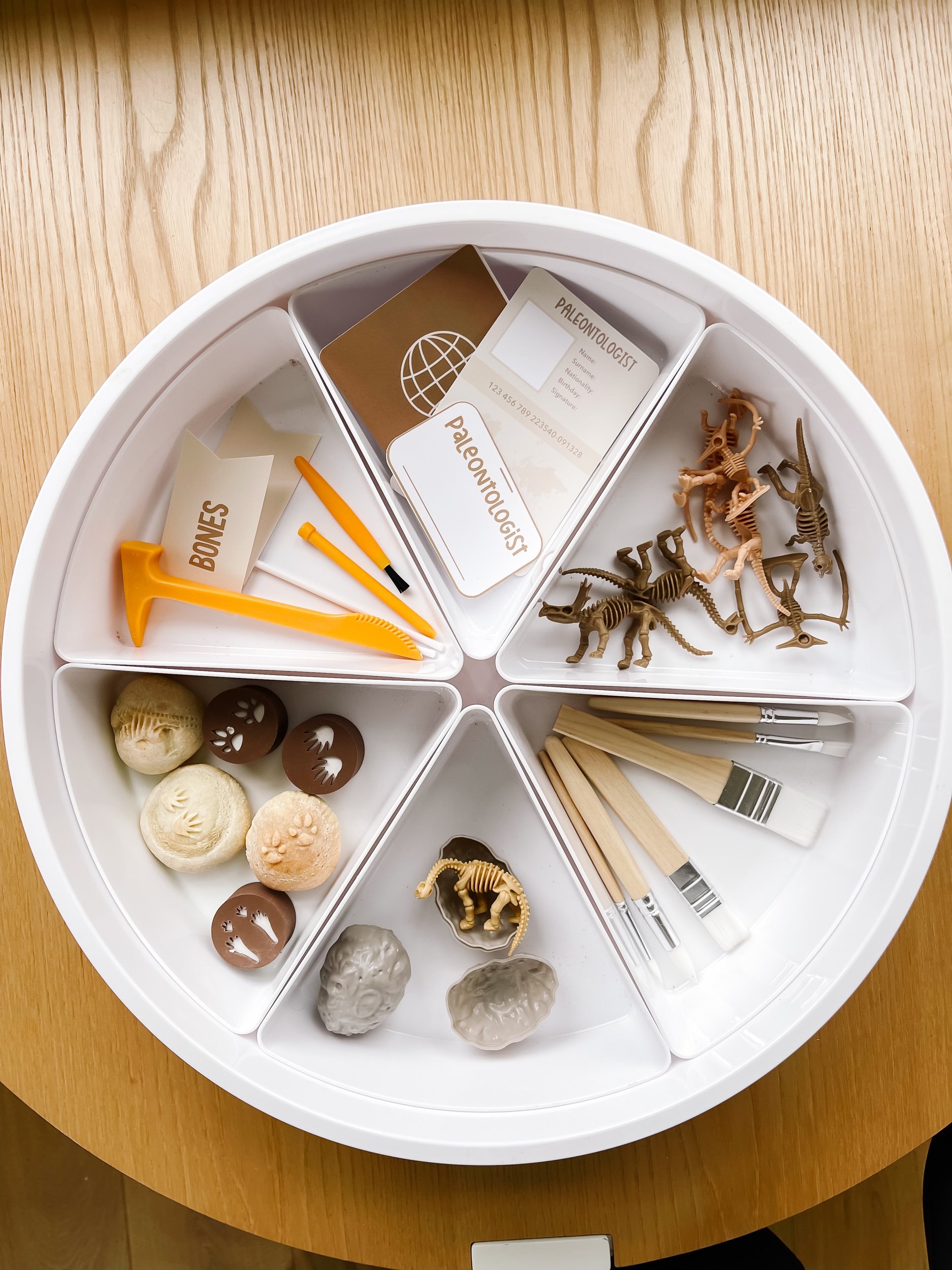
Extension that kept it going for weeks: a dinosaur egg hunt. Hide a few plastic eggs (or playdough eggs with a tiny dino inside) around the tray, and let her be the paleontologist. She narrated the whole thing — "I found a baby one! It's sleeping!" — which was the storytelling payoff I was hoping for.
Free: Dino Sensory Play
If dinosaurs are the whole world as far as your toddler is concerned, our free Dino sensory play lead magnet walks you through a done-for-you dinosaur sensory setup — the same dig-style play she loved, with a printable to go with it.
3. The arctic small world
There's something about a cold, sparkly world that toddlers find irresistible — maybe because it's so different from everything else in the playroom. Fill a tray with white rice, cotton balls, or faux snow; add ice cubes or clear blue gems as "icebergs"; and bring in the polar animals. White and blue fillers make every figure pop visually, which is part of why this world photographs beautifully and holds attention so well.
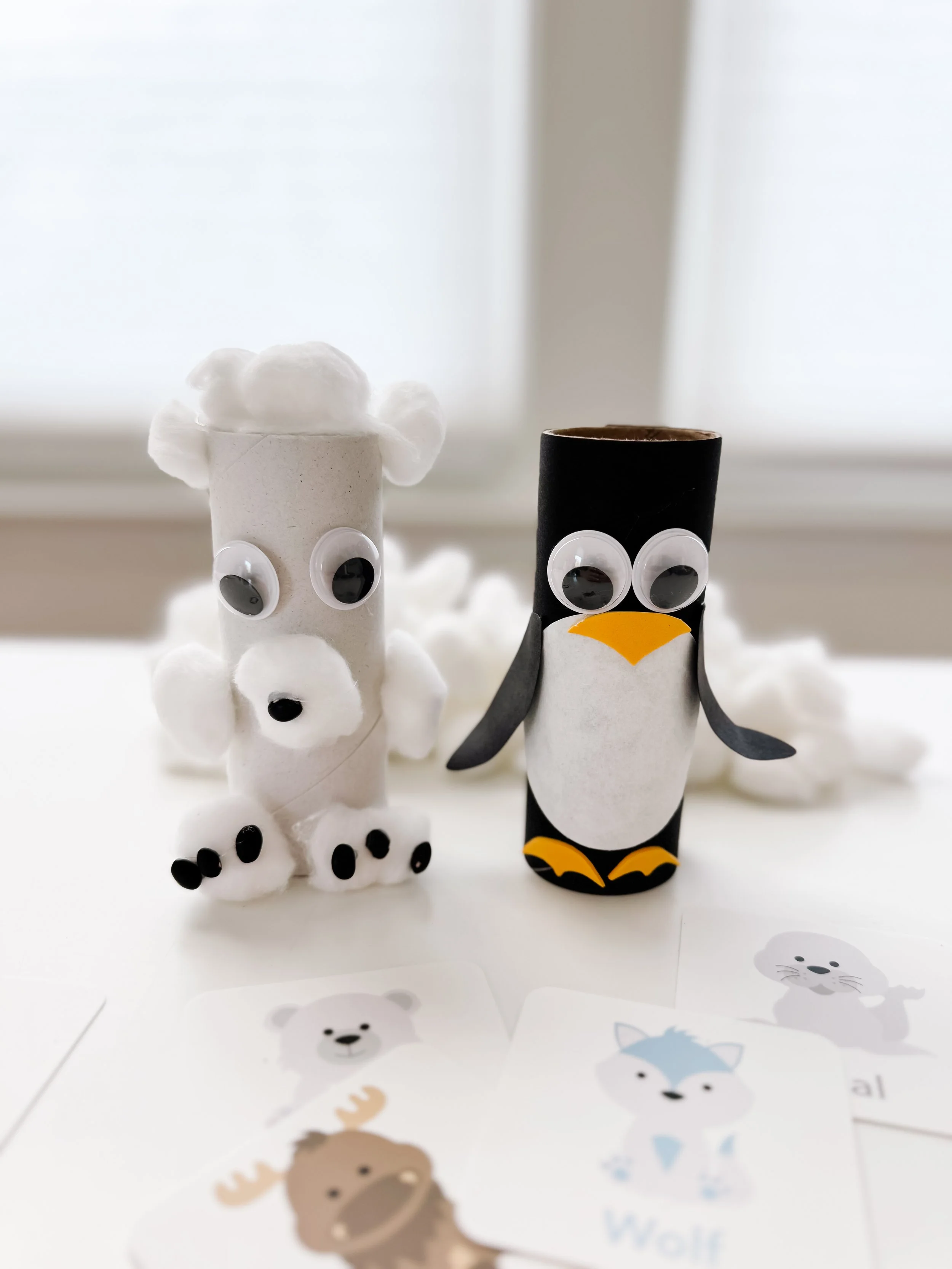
Our arctic world got a huge upgrade the year we made our toilet roll arctic animals — a polar bear and penguin she crafted herself became the stars of the scene, and because she'd made them, she played with them differently: more gently, more protectively, with whole storylines about keeping the penguin warm. If you want the full winter arc, our arctic ice sensory bin pairs ice-cube play with polar animals for the sensory side of the same theme.
Arctic Animal Snow Globe Printable — $5
Keep the arctic theme going after the tray is packed away: our printable snow globe kit turns 12 arctic animals — penguin, polar bear, arctic fox — into photo ornaments with "Let It Snow" collars. We paired these with our arctic snow globe ornament craft, and they stretched the polar-animals play for weeks.
4. The ocean small world
An ocean world is the easiest sensory small world on this list: water is the landscape, and water is also the toy. Fill a shallow tray with a few inches of water, add a drop or two of blue food coloring, and toss in shells, smooth stones, and any sea creature figurines you have. A strip of blue fabric or a blue towel under a dry version works too, if you'd rather keep water play outside or in the bathtub.
What made our ocean world sing was the treasure element: a few "sunken" items at the bottom (a plastic ring, a shiny coin, a small shell) turned the whole tray into a treasure dive. She'd send the dolphin down to fetch things, narrating the rescue mission in her best serious voice. Add a toy boat or a folded paper boat and you've got a surface story and an underwater story running at the same time.

Tip from our many, many water trays: put the tray on a towel, keep a second towel nearby, and let it be a little wet. Fighting the water ruins the play; containing it keeps everyone happy.
Our Sensory Jars: Dinosaur + Ocean — $15 each
For the days you want the small world without building it: our sensory jars are ready-made tiny worlds in a jar. The Dinosaur Sensory Jar ($15) packs a dino scene into a shake-and-watch jar, and the Ocean Sensory Jar ($15) does the same for the sea — both were made for exactly this kind of imaginative, on-the-go play.
5. The backyard bugs meadow small world
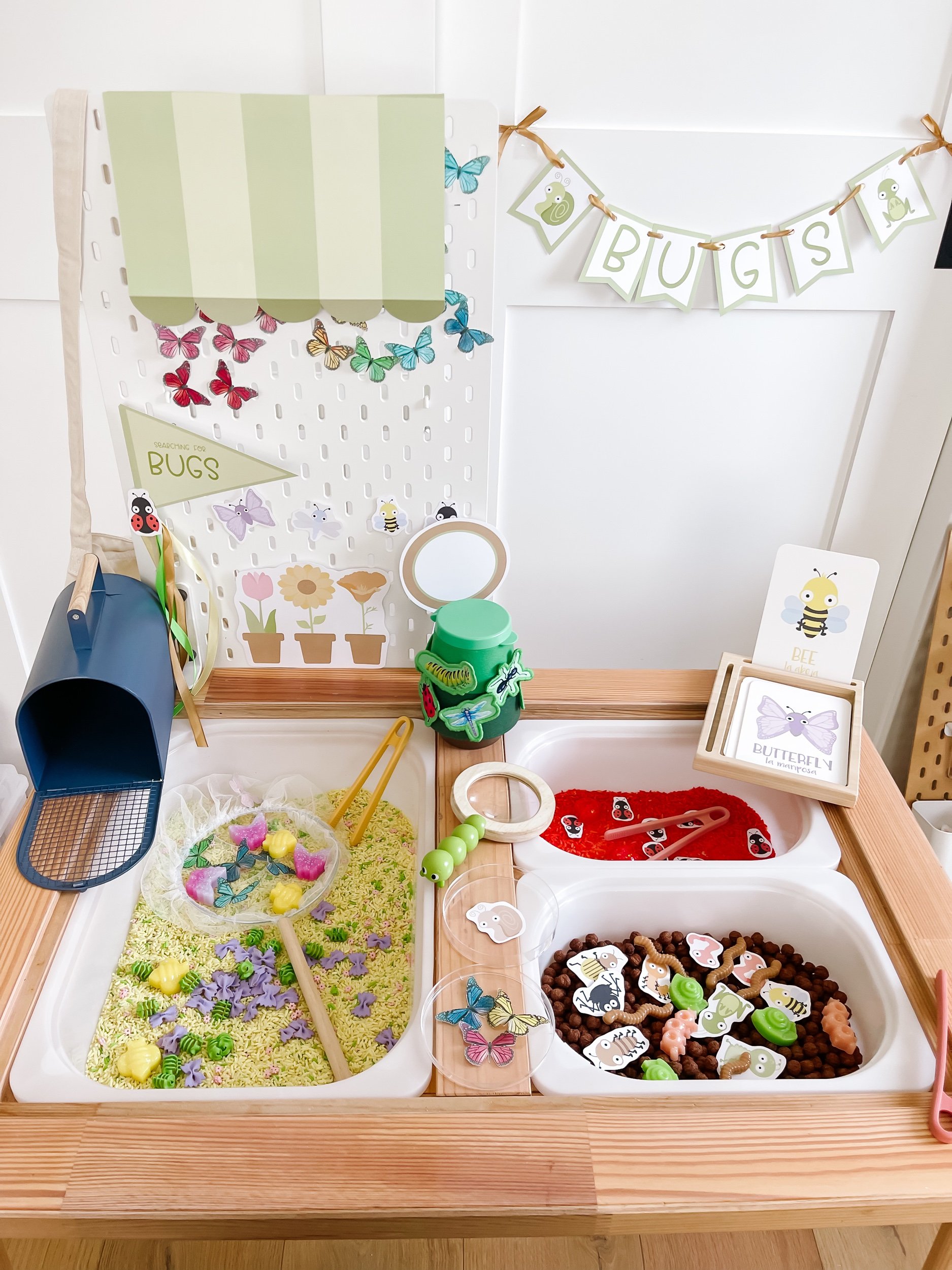
This is the small world for the toddler who stops to watch ants on the sidewalk — and honestly, that was my daughter for a solid year. Dye a batch of rice green (a zip bag, a squirt of green food coloring, and a shake is all it takes), spread it in a tray as the meadow, and add silk flowers or real dandelions, a few smooth stones, and toy insects. A small terracotta pot on its side becomes a "bug house," and a magnifying glass beside the tray invites the close-up inspection that bug-obsessed toddlers live for.
The storytelling in this world surprised me — hers was less about the bugs and more about the meadow as a neighborhood. The ladybug visited the bee. The butterfly was having a party and everyone was invited. If your little one loves this theme, our free Habitat Printable Play Mats give the meadow a printed backdrop: farm, ocean, and woodland scenes she can build her small world on top of.
Free: Habitat Printable Play Mats
Give any small world an instant landscape: our free printable habitat play mats include farm, ocean, and woodland backdrops sized for trays and table play. Print, laminate if you're feeling fancy, and let the world-building begin.
6. The construction site small world
Every toddler I know has a construction phase, and a small world is the perfect container for it. Fill a tray with black beans, oats, or kinetic sand as the "dirt"; add toy trucks, a few wooden blocks as building materials, and traffic cones (or paper cups flipped over). A strip of gray felt or construction paper becomes the road, and a little sign — "WORK ZONE," drawn by your toddler — makes it official.
The play pattern here is deeply satisfying for little ones: load, haul, dump, repeat — and then build something with the "materials" that just got delivered. My daughter's version always ended with a block tower that the bulldozer would then, very dramatically, need to clear away. The demolition was the best part; the rebuilding was the encore.

Extension for the truck-obsessed: add a "weigh station" (a kitchen scale) or a "gas station" (a small box with a straw as the pump). One new job for the trucks can buy you another week of play out of the same tray.
Ways to make each small world last longer
- Introduce one new resident at a time. A surprise guest — "look who just moved into the farm!" — can revive a tired world overnight. Keep a basket of extra figures nearby for exactly this.
- Add a problem to solve. The bridge is out. The baby dinosaur is lost. The ocean needs cleaning up. Toddlers adore a mission, and a tiny problem turns free play into a story with an arc.
- Change the weather. Blue fabric becomes rain over the farm; ice cubes melt into the arctic world; a flashlight becomes the sun setting over the meadow. Weather is a free special effect.
- Bring in a book. Read a themed picture book first, then build the world from the story. The book gives the play characters, a setting, and a plot — your toddler does the rest.
- Let the worlds collide. When a world is truly played out, let the dinosaur visit the farm. Crossovers are hilarious to toddlers and squeeze one more act out of two finished setups.
- Photograph the world before cleanup. "Let's take a picture of the farm so we remember it!" This honors the play, gives you a sweet keepsake, and — practically — makes your toddler much more willing to help clean up.
What you actually need (and what you don't)
You don't need a single purpose-bought toy to build a great small world. Our longest-running worlds used: a tray or shallow bin, one bag of filler from the pantry (lentils, rice, oats, beans), 5–6 small figures you already own, and two or three "landmarks" built from household things — an upside-down bowl as a volcano, a strip of fabric as a river, a small box as a barn. The filler is the only thing worth buying specifically, and even that can come from the kitchen.
If you want the world-building done for you — printed habitats to build on, a ready-made jar world for the diaper bag, or a free themed printable to pair with the play — the cards above have our small-world-ready picks. One download or one jar, and the tiny universe is open for business.
What is small world play?
Small world play is when a child plays with miniature figures and objects arranged as a tiny scene — a farm in a tray, dinosaurs in a sandbox, polar animals on cotton-ball snow. The child controls the whole world at once, moving the pieces and narrating the story. It's imaginative play with a built-in stage.
What age is small world play best for?
Ages 2 to 6 hit the sweet spot. Two-year-olds love the sensory side — moving figures through the filler, filling and dumping — while 3- to 6-year-olds dive into the storytelling, giving each figure a name, a job, and a very dramatic day. The same tray grows with your child; you just add more complex story prompts as they get older.
What do I put in a small world tray for a toddler?
Four things: a filler as the landscape (lentils, rice, water, cotton balls), 3–8 small figures (animals, dinosaurs, vehicles), two or three "landmark" props (a barn, a volcano, a shell), and one tool (a scoop, tongs, or a cup). That's the whole formula — everything else is optional garnish.
How is small world play different from a sensory bin?
They overlap a lot — most of our small worlds were sensory bins with a theme. The difference is the story: a sensory bin is about exploring the material (scooping, pouring, feeling), while a small world adds characters and a narrative. In practice, toddlers bounce between the two modes constantly, and that's exactly right.
How do I clean up small world play without a fight?
Three tricks that worked for us: photograph the world first so it feels "saved," make cleanup part of the story ("the farmer needs to put all the animals to bed"), and keep the filler in a lidded container so the whole world packs away in minutes. A tray with edges is half the battle — play that can't spill far is play that's easy to end.
However you build them — one tray, a FLISAT bin, or a corner of the sandbox — small worlds are some of the richest play you can offer a toddler for the least effort. Put out the ground, add the residents, and let your little one take it from there. And if you try one of these six, I'd love to hear which world your toddler moved into first.