
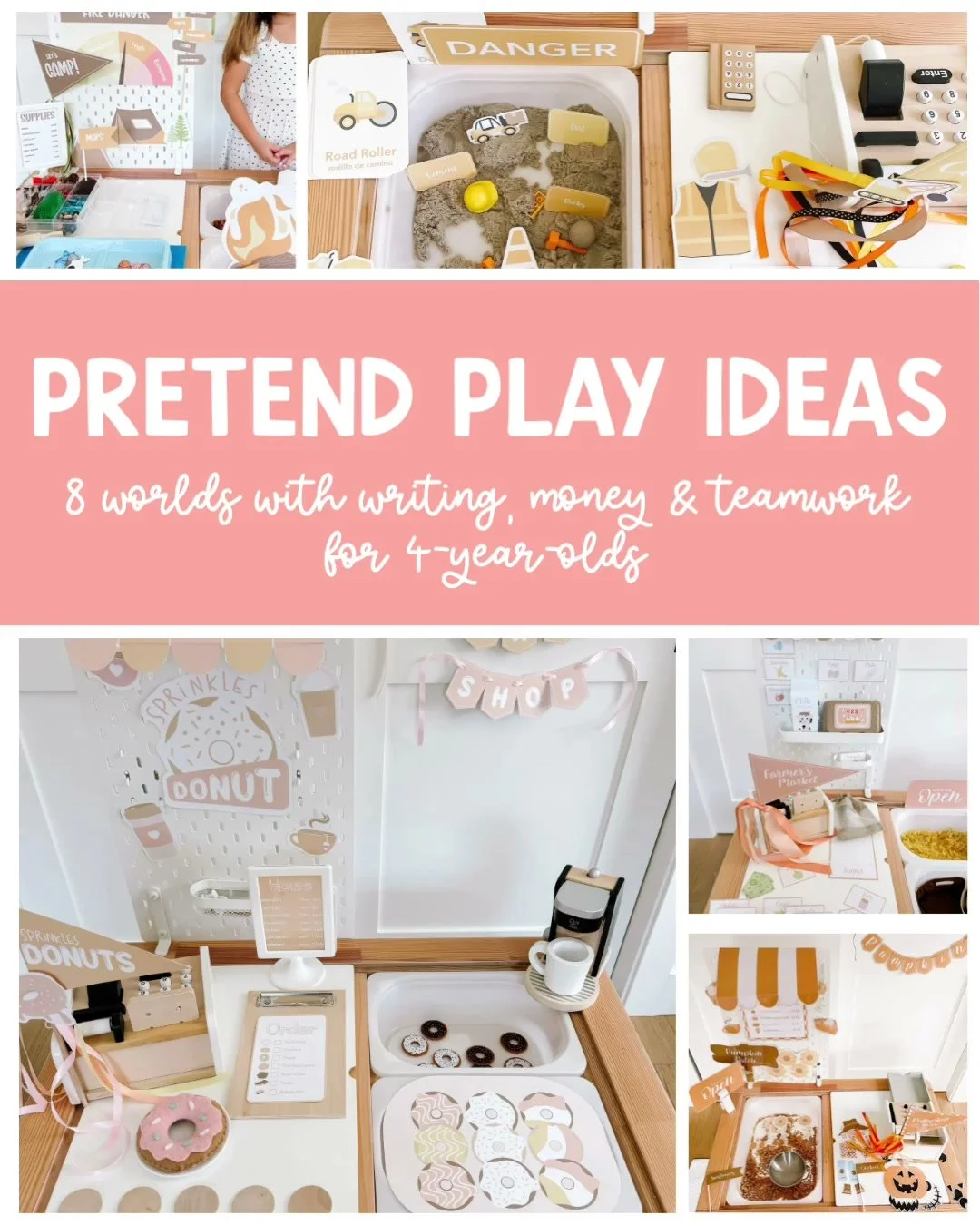
Pretend Play Ideas for 4-Year-Olds: 8 Worlds with Roles, Writing & Play Money
Something shifts around four. The shop still has a baker and a customer, but now the baker has a job card, the customer has a written order, and the cashier counts out the change — and woe betide anyone who tries to pay with the wrong coins. The games get longer, the roles get real, and for the first time the play genuinely needs a second person: a foreman and a builder, a florist and a delivery driver, a camper and a camp cook. These 8 pretend play ideas for 4-year-olds are built for that shift: assigned roles, writing inside the play, play money with real counting, and cooperative games that only work when everyone does their job. When my daughter was four, this was the year the play got a team.
How 4-year-old pretend play is different
At three, pretend play became a story: roles, a script, a sequence — take the order, make it, serve it, pay. At four, the story gets a crew. Your child is no longer playing every part herself. She wants a foreman and a builder, a florist and a delivery driver, a shopkeeper and a customer who has a very particular order and a wallet full of coins. The game only works if everyone does their job, and that — the depending on each other — is the whole point of four.
Five things change at four, and every game below is built around them. First, assigned roles: your child can hold a role and hand out the others. "You be the foreman, I am the builder, and Bear is the delivery driver" — and she will keep track of who is who for the whole game. Second, writing inside the play: at three, an order slip was a scribble. At four, it is a real piece of writing — a blueprint with a drawing of the building, an order form with the flower and the number of stems, a packing list with boxes to check off. Four-year-olds who would run from a worksheet will fill out forms all afternoon when a customer is waiting. Third, money and early math: counting out coins, making change, weighing pumpkins, counting stems — the transaction is no longer just the end of the game, it is a game of its own. Fourth, cooperation: four-year-olds start to play as a team instead of just taking turns. They negotiate ("You be the cook this time, I will be the ranger"), they plan together, and they solve the problem when the plan falls apart. And fifth, longer sequences that span days: a four-year-old's game can run for an hour, pause for dinner, and resume the next morning with the same job cards and the same unfinished orders. The sequence is the game now, and following it all the way through — with a partner — is the skill they are practicing.
The other difference is pride. A four-year-old does not just want to play shop. She wants to run the shop — to have a system, a job, and a customer who depends on her getting it right. That is why the games below are built as small businesses and small crews, not single actions. Give her a role, a form, and a coin purse, and she will run the whole operation.
Set up any 4-year-old pretend game in 5 minutes
Before you pick a game, gather the kit that works for all eight:
- A defined space. A low table, the FLISAT sensory table with one bin as the counter and one as the work area, a bookshelf as store shelving, or a blanket on the floor as the shop floor. Boundaries make the world feel real — and give the roles somewhere to live. If you are new to the FLISAT table, our FLISAT beginner guide walks through the setup that works for all of these games.
- Roles, assigned out loud — with job cards. At four, roles deserve a card: "Foreman," "Builder," "Cashier," "Florist," "Camp Cook." Write each role on a card or a sticky note and hand them out before the game starts. Four-year-olds take job cards seriously — and a card makes the role swap fair, because everyone can see whose turn it is to be the boss.
- Paperwork that does real work. This is the piece that changes everything at four: a blueprint, an order form, a packing list, a receipt book, a price list. One notepad and a pencil is enough. The paperwork is where the reading and writing hide — your child "reads" the order form and "writes" the delivery note, real practice disguised as the best job in the world.
- Money, prices, and a way to count. Play money, real coins in a jar, paper price tags with numbers on them, a kitchen scale for weighing pumpkins. The transaction is the heart of the game now — count the coins, make the change, weigh the order — and four-year-olds love the counting part best of all.
- A script starter — plus a problem to solve. Two or three lines, written on a card or just said out loud at the start: "Welcome to our flower shop! What kind of bouquet are you looking for today?" Then add a wrinkle: the customer wants a flower you are out of, the delivery is late, the blueprint is missing a wall. At four, solving the problem is the game, and a crew that fixes it together is practicing teamwork.
- A prop box to rotate. Keep one box of shop props — aprons, name tags, a bell, a notepad, play money, job cards, a few signs — and swap the theme inside it instead of rebuilding from scratch. The same box becomes a construction site on Monday, a flower shop on Wednesday, and a pumpkin patch on Friday.
8 pretend play ideas for 4-year-olds
1. The construction site: blueprints, job cards, and a crew
Set out: blocks or wooden bricks, toy trucks, a tray of kinetic sand or chickpeas as the "building site," a clipboard with a hand-drawn blueprint, job cards (Foreman, Builder, Delivery Driver), a tape measure, and a few cones or signs. One FLISAT bin can be the site and the other the supply yard.
How they play it: the foreman holds the blueprint and hands out the jobs; the builder follows the plan; the delivery driver brings the bricks in the truck. The sequence is the whole game: read the blueprint, gather the materials, build it, inspect it, sign off. When my daughter was four, the construction site was the game where she finally stopped playing every role herself — she handed me the foreman card, kept the builder card, and told the delivery driver (a stuffed bear in a truck) exactly where to park. She checked my work against the blueprint with total seriousness, and when the tower did not match the drawing, she made me rebuild it. Our construction play post shows the sensory tray setup this little crew grew out of, with the printable vehicle cards that became our job cards.
Stretch it: add a change order. Halfway through the build, the "client" (you, or a stuffed animal) asks for a window where the blueprint says wall. The foreman has to update the drawing, tell the builder, and re-inspect — and changing a plan mid-build is exactly the kind of flexible thinking four-year-olds are ready to practice.

2. The flower shop: bouquet order forms and a delivery route
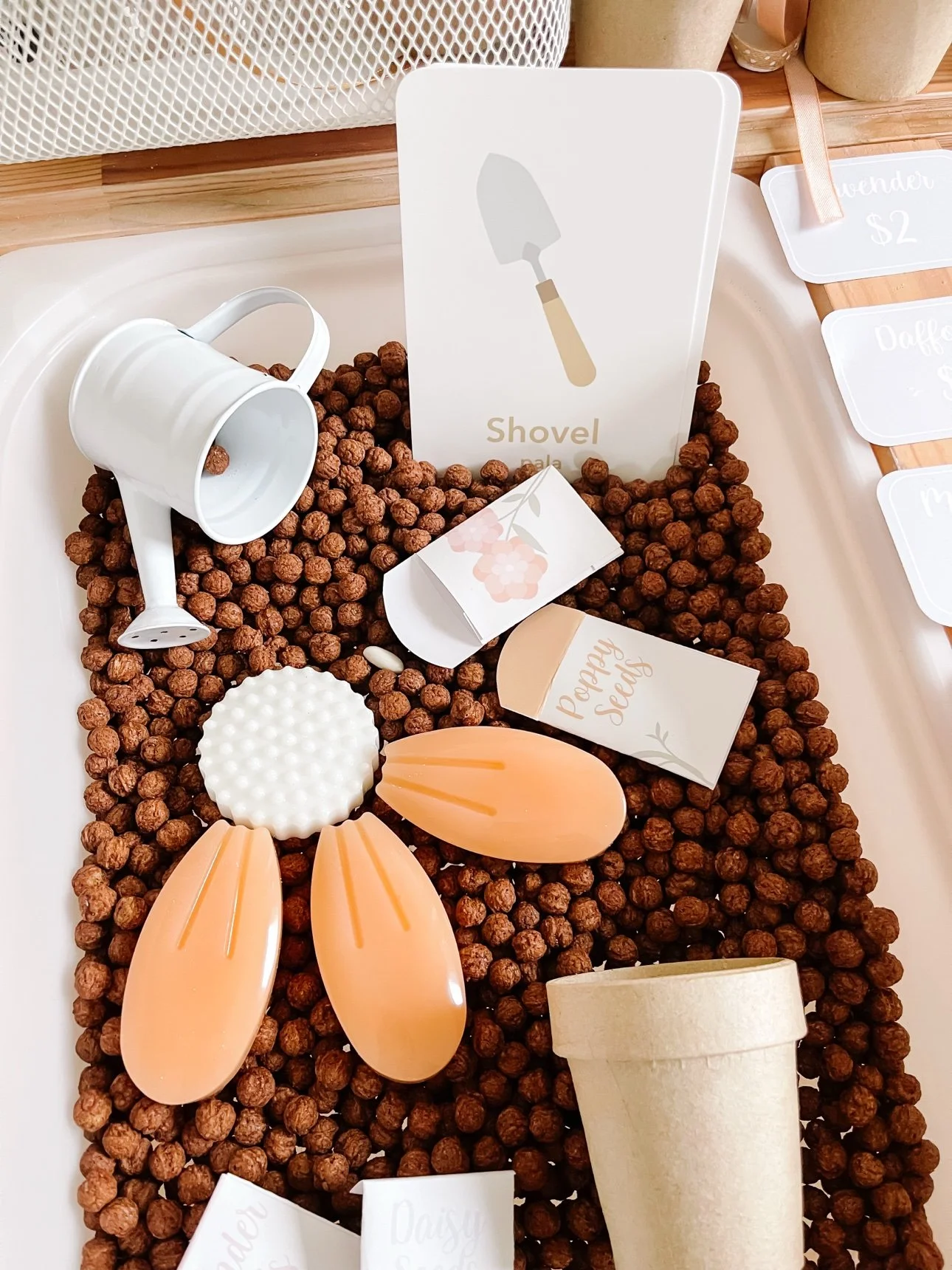
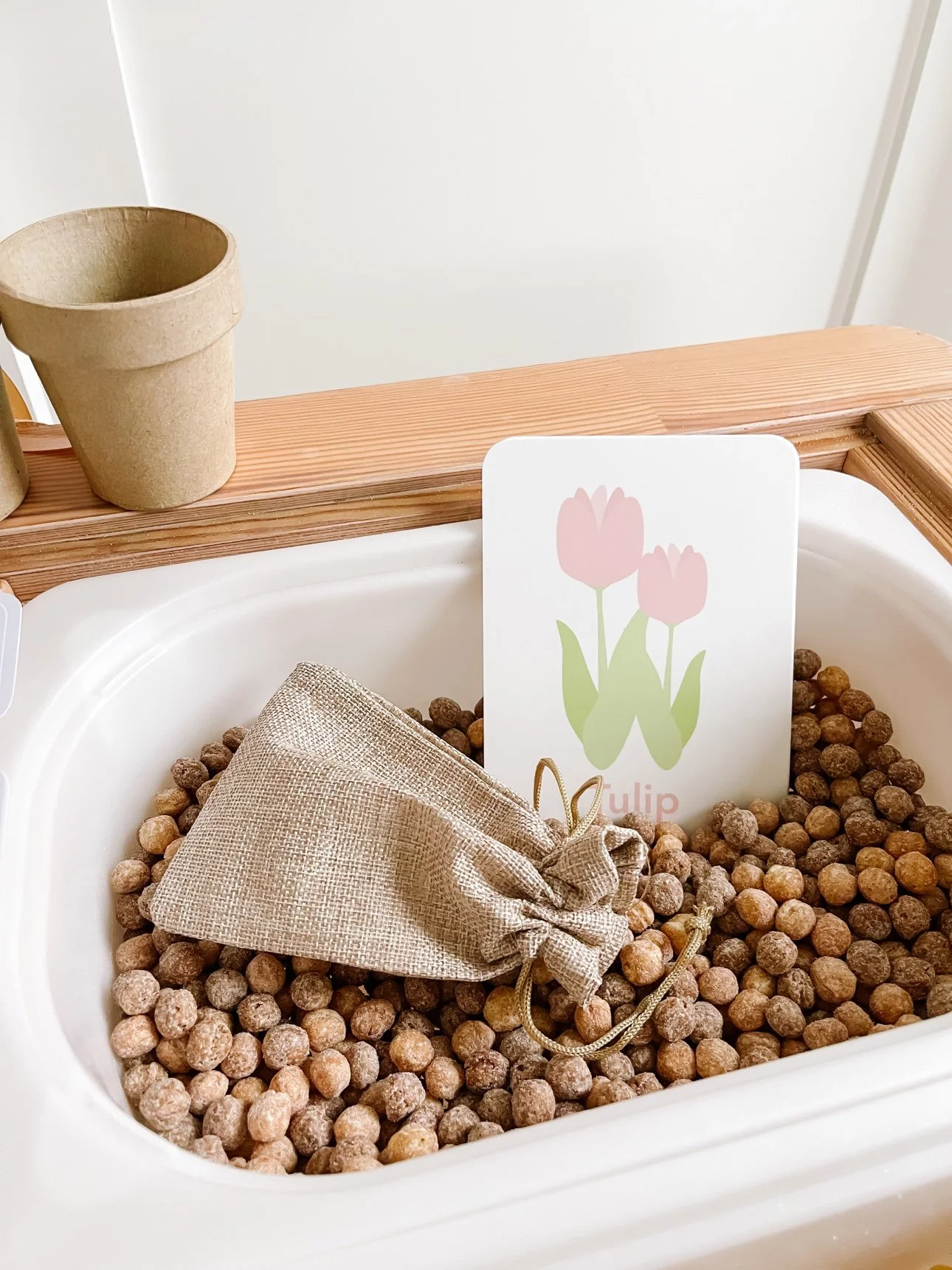
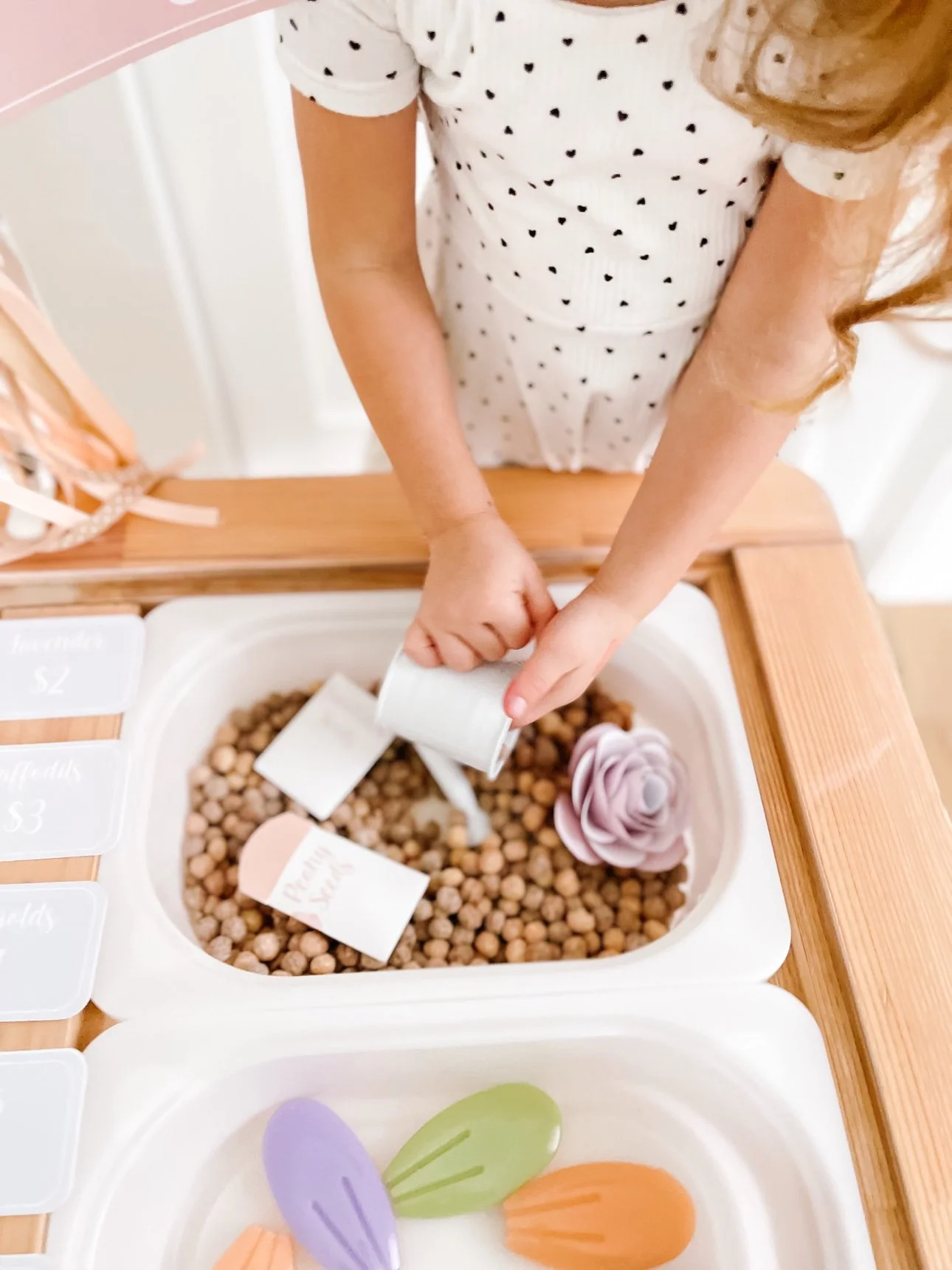
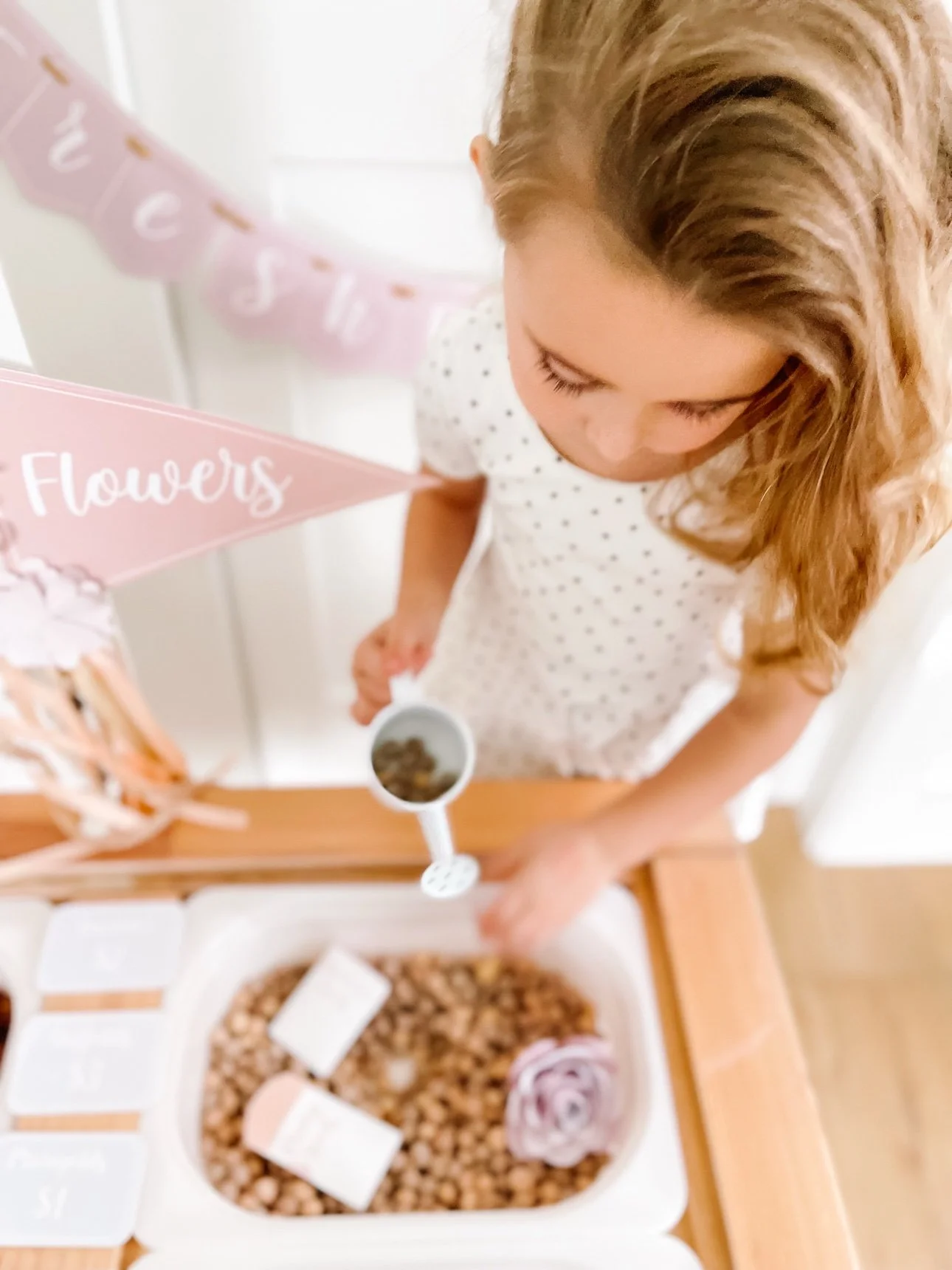
Set out: paper or silk flowers (or real ones past their prime), small vases or jars, wrapping paper and ribbon, a price list by flower, order forms with spaces for flower type, color, how many stems, and who the bouquet is for, and a basket for deliveries.
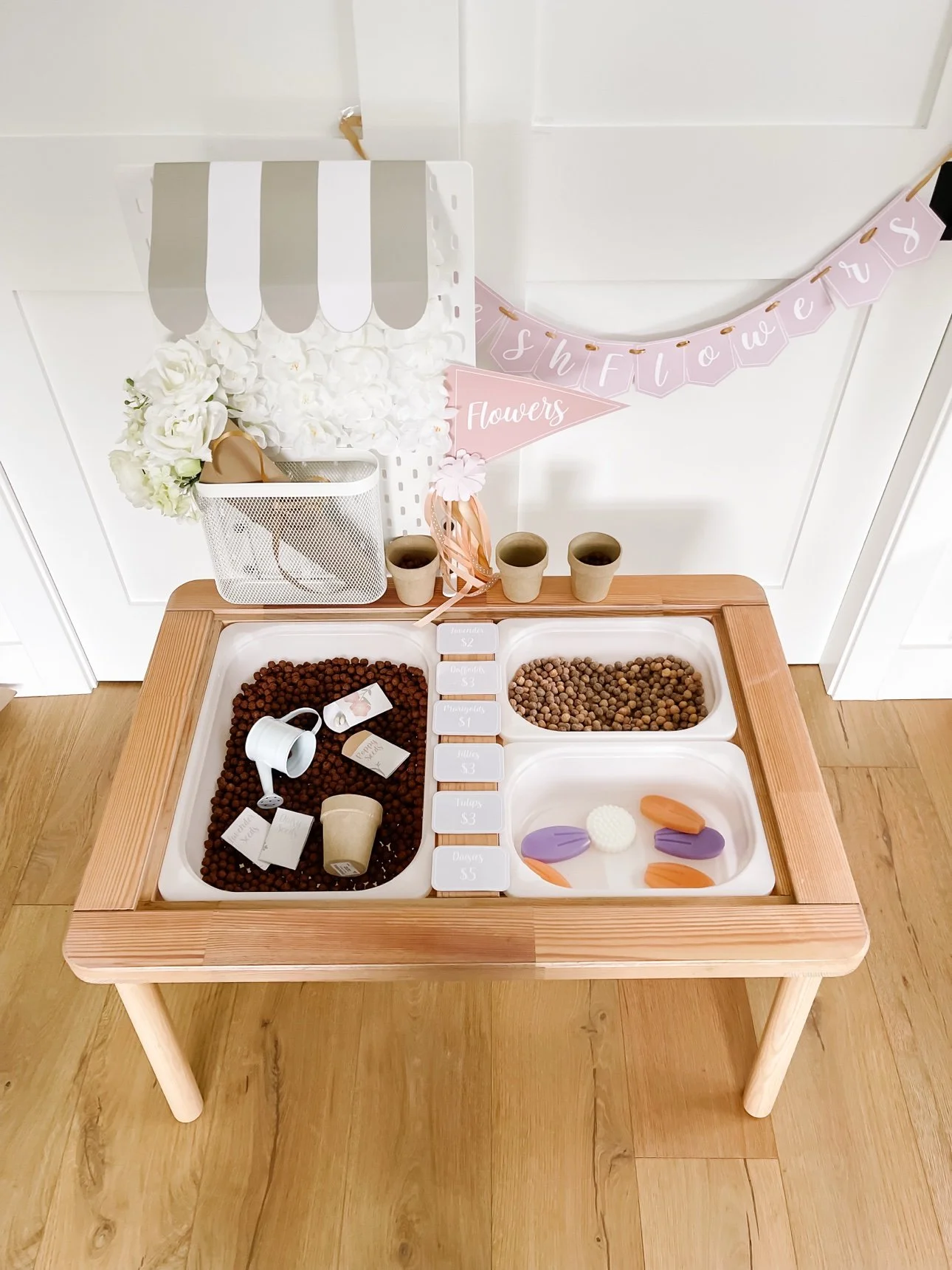
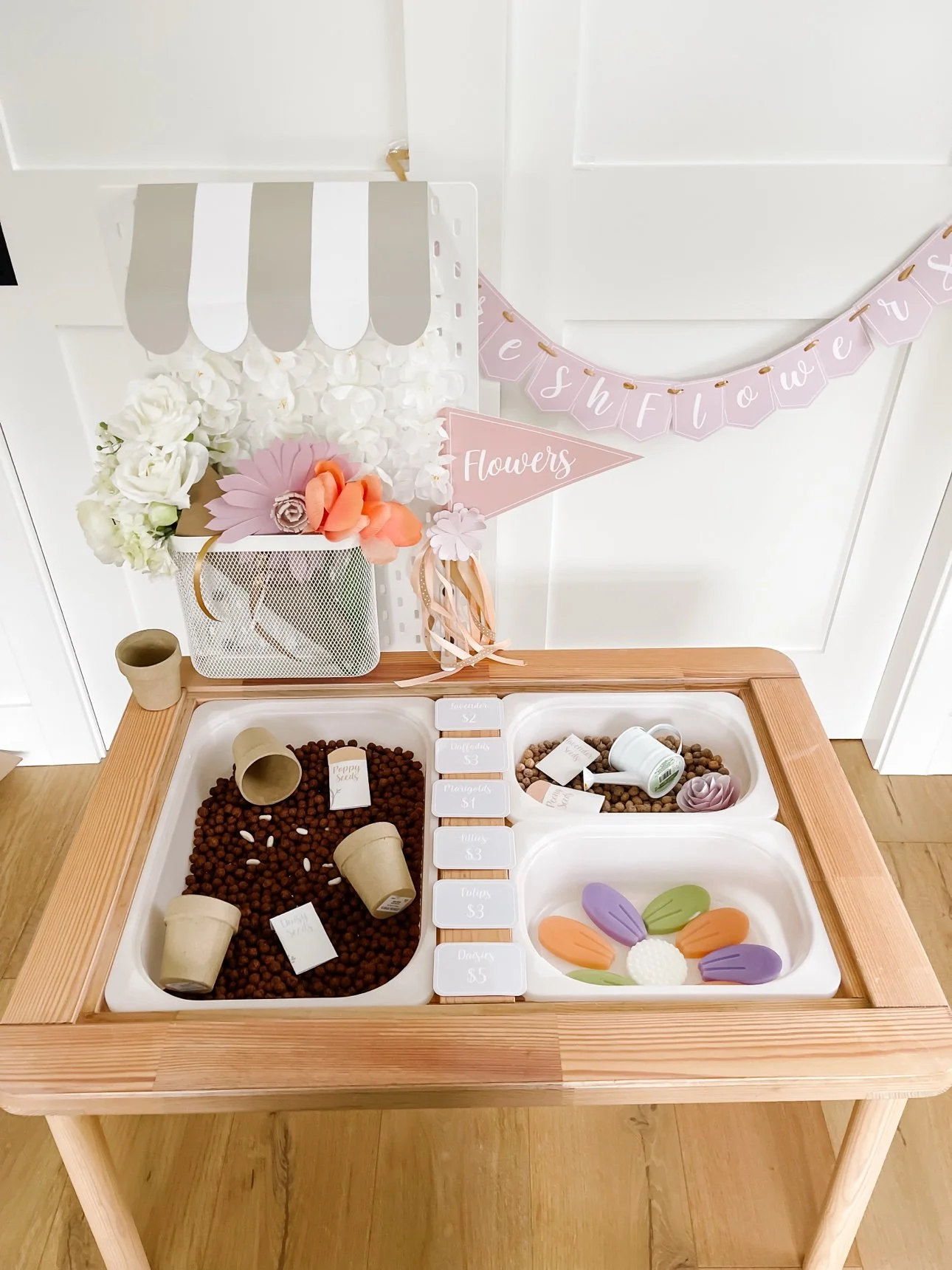
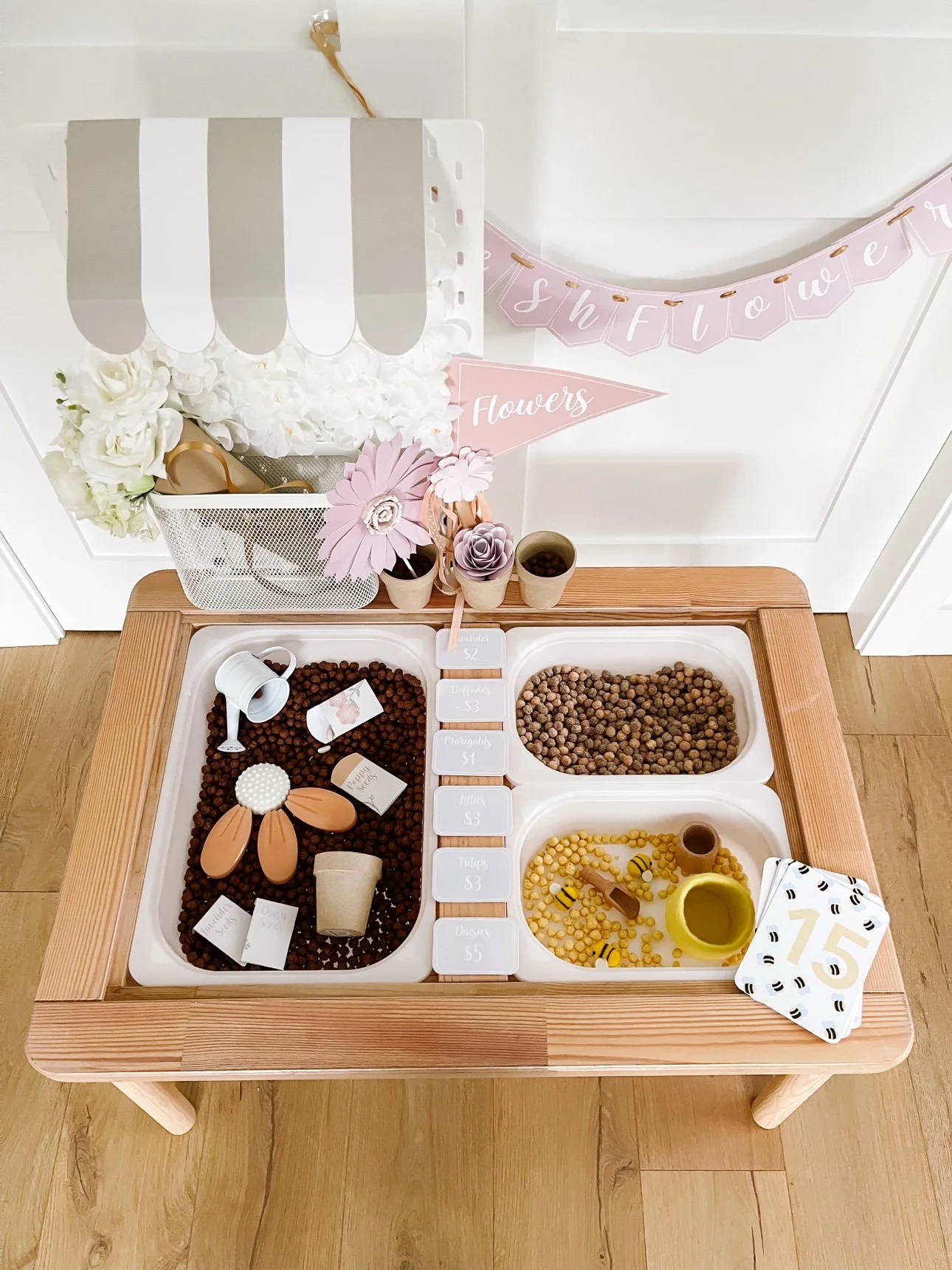
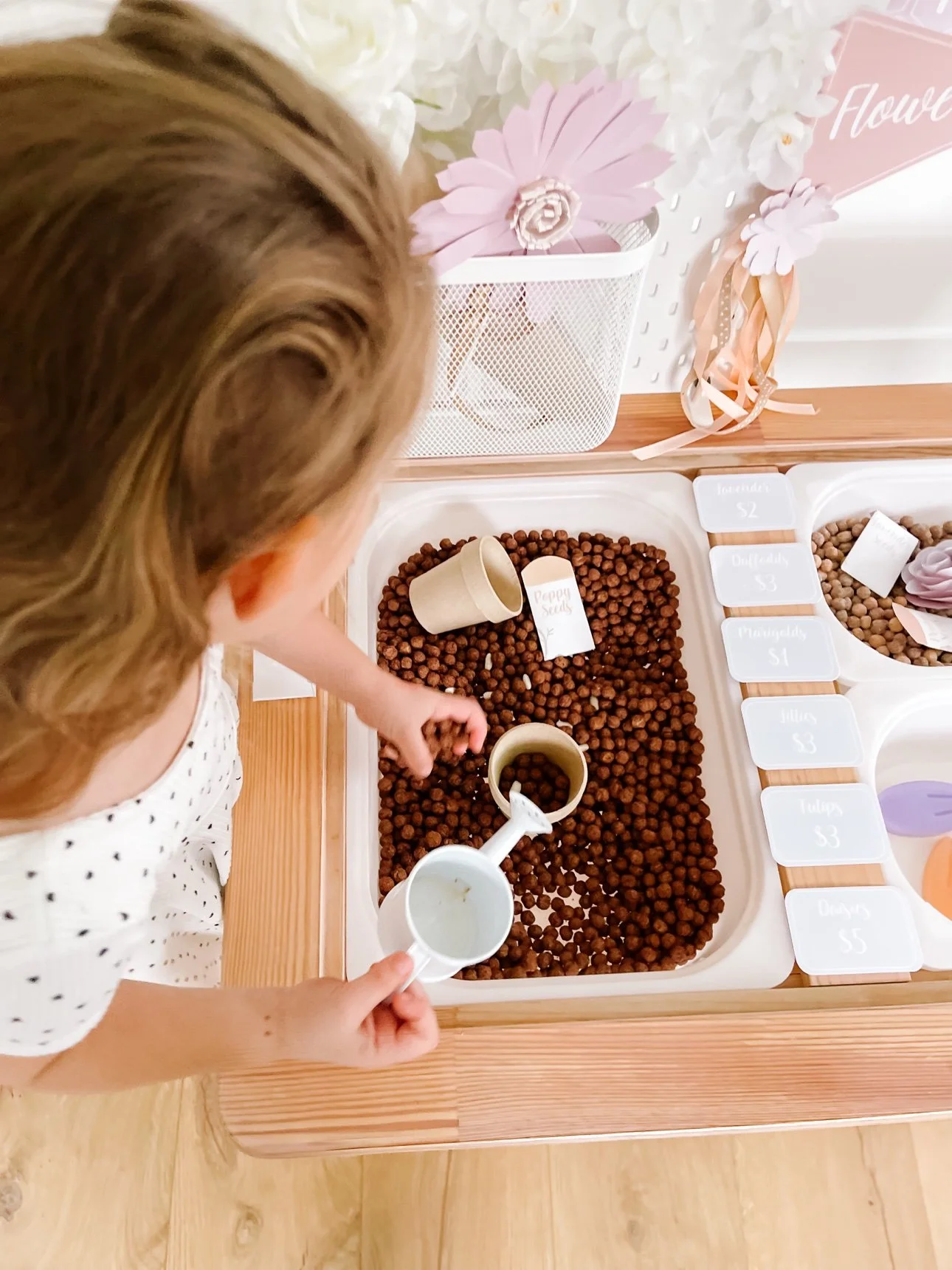
How they play it: the florist takes the order and writes it on the form; the customer describes the bouquet ("pink, six stems, for Grandma"); the delivery driver carries it to the next room. At four, the order form is the star of the show: your child asks the questions, writes down the answers, counts the stems, wraps the bouquet, and hands it over with a receipt. When my daughter was four, the flower shop was the game that made her slow down and listen — she asked every customer what the bouquet was for, and a birthday bouquet got different flowers than an I'm-sorry bouquet, in her very firm opinion. Our flower shop setup grew out of a little cart with a "Fresh Flowers" banner, and the order form is what made it a four-year-old game: writing down the order is what makes the florist feel like a florist.
Stretch it: add a delivery route with a map. Three deliveries, three houses (three rooms, or three chairs), and the driver has to plan the route in order — and when a customer is not home, the driver leaves a note and comes back later, which is a whole second game.

3. The donut shop: a menu, coins, and making change
Set out: playdough donuts or wooden donut rings, a tray as the display case, a menu board with flavors and prices, play coins, a cash register (a box with buttons, or a toy phone), order slips, and a little bell for "order up!"
How they play it: the baker makes the donuts; the cashier takes the order and the money; the customer pays — and at four, the paying is the game. "That will be three dollars, please" — and then the counting: one, two, three coins, and is that enough? When my daughter was four, the donut shop was where counting finally had a reason. She would not hand over a donut until the coins were counted out on the counter, and if the customer paid with a five, she worked out the change with enormous concentration, coin by coin. Our donut shop setup ran out of the FLISAT table with a menu board, a register, and an order clipboard, and the menu with prices is what made it a four-year-old game: the numbers on the menu are the whole point now.
Stretch it: add a dozen deal and a loyalty card. "Buy five donuts, get the sixth free" — and a punch card the cashier stamps each visit. The loyalty card gives the shop a regular customer (a stuffed animal who comes every day), and a regular is a storyline that keeps the game going for a week.

4. The market stand: handmade signs and counting change
Set out: a small table or blanket as the stand, baskets of play fruit and vegetables — felt, wooden, or real produce past its prime — hand-lettered signs with the farm's name and prices, paper bags for shoppers, play money, and a little water bin for "washing" the produce.
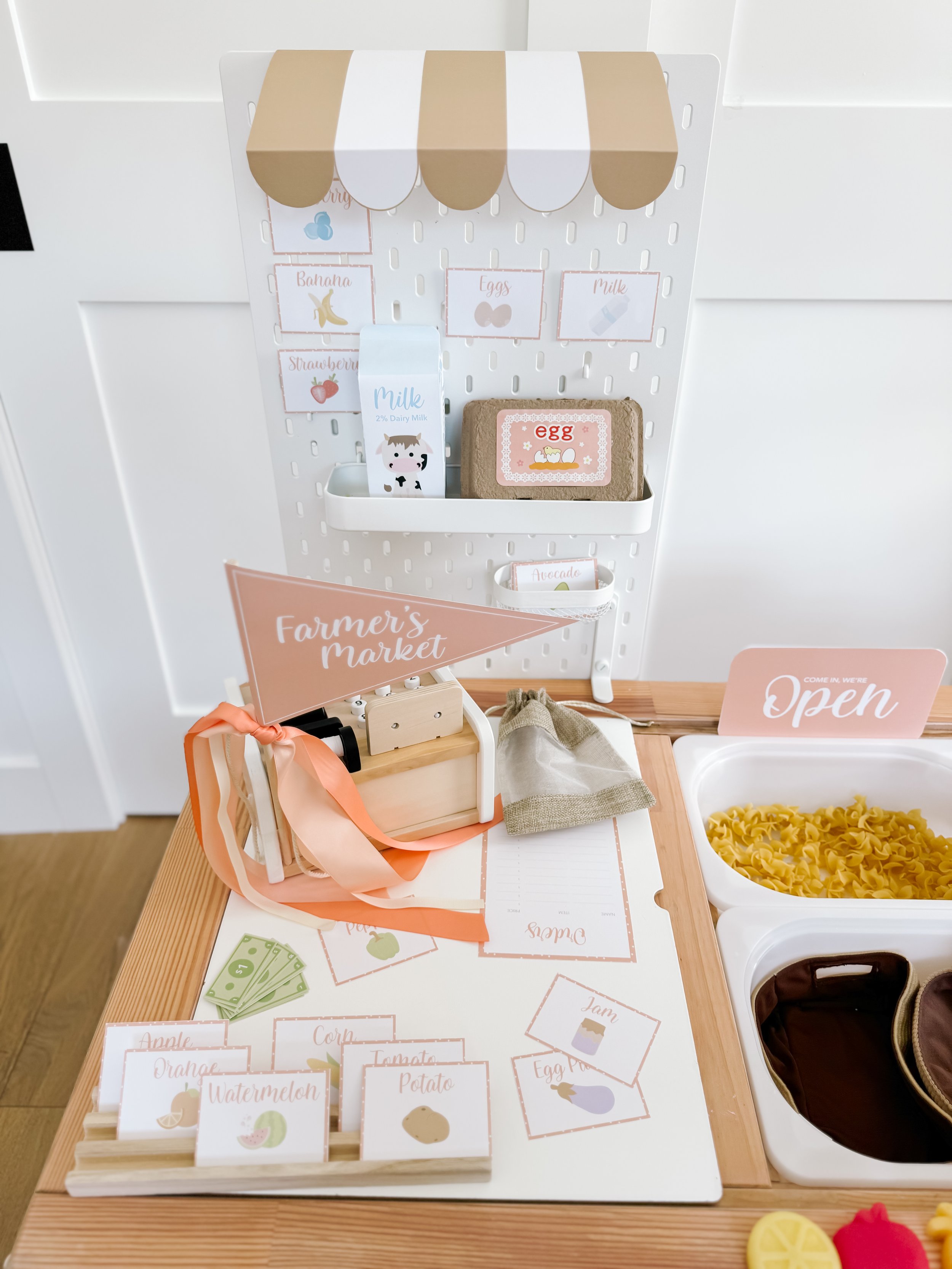
How they play it: the farmer stacks the produce and writes the signs; the shopper gets a list and a budget; the cashier counts the money and makes change. At four, the signs are the game: your child writes "Apples $2" and "Corn $3" in her own handwriting, and the signs make the stand feel like a real business — because she made them. When my daughter was four, the market stand was the loudest game we had — she called out her specials in a full market voice, and then she got very serious about the change. "You gave me five and the apples are two, so you get three back," she would announce, counting the coins into the customer's hand like a professional. Our market stand setup worked beautifully with a pegboard of produce cards and a coin purse, and the handmade signs are what made it hers.
Stretch it: add a scale and price by weight. "Apples are two dollars a pound" — and the shopper has to weigh the bag, read the number, and work out the price with the farmer. Weighing turns the market into a measuring game, and four-year-olds love a scale.
5. Camping: a packing list and campsite jobs
Set out: a blanket fort or a small tent, a flashlight, a backpack, a packing list with pictures and checkboxes, a toy campfire (stones in a circle, tissue-paper flames, or a few battery candles), marshmallows on sticks, a bin of "firewood" (sticks and blocks), and job cards: Camp Leader, Cook, Ranger.
How they play it: the crew checks the packing list together — tent, flashlight, snacks, marshmallows — and then everyone takes a job. The camp leader pitches the tent; the cook builds the fire and roasts the marshmallows; the ranger checks the trail and keeps the campsite tidy. At four, the packing list is the game: your child reads it out loud, checks each box, and will not leave for the campsite (the living room) until every item is packed. When my daughter was four, camping was the game that taught her to plan — she packed the backpack the night before, checked the list twice, and announced at breakfast that the ranger had spotted a bear (a stuffed one, behind the sofa) and the whole crew had to decide what to do about it. Our camping setup grew out of a little small-world campsite with a tent, a fire ring, and a stream, and the job cards are what made it a team game instead of a solo one.
Stretch it: add a campfire story round. Once the fire is built and the marshmallows are roasted, everyone sits in a circle and tells one part of a story, taking turns — and a story told by a whole crew, one sentence each, is cooperative play at its best.

6. The pumpkin patch: weighing pumpkins and counting the harvest
Set out: a pile of pumpkins — real mini pumpkins, playdough pumpkins, or orange balls — a kitchen scale, a price list by size ("small $2, medium $4, large $6"), a wheelbarrow or basket, paper bags, play money, and a hand-lettered "Pumpkin Patch" sign.
How they play it: the farmer picks the pumpkins and weighs each one; the shopper chooses a pumpkin and pays by its size; the scale operator reads the number and writes it on the price tag. At four, the weighing is the game: your child puts the pumpkin on the scale, watches the number, and announces "this one is a four!" like a real farmer. When my daughter was four, the pumpkin patch was the game where math stopped being abstract — a big pumpkin cost more than a small one, and she could see why, because she had weighed them both herself. Our pumpkin patch setup ran out of the FLISAT table with a menu board, a scale, and a bin of sunflower-seed "soil" for digging, and the price-by-size list is what made it a four-year-old game: the numbers meant something you could hold.
Stretch it: add a pumpkin contest. Biggest pumpkin, smallest pumpkin, funniest shape — and the farmer judges each one and writes a ribbon for the winner. Judging takes comparing, measuring, and deciding, and four-year-olds take judging very seriously indeed.

7. The bakery: a written menu and a cash register
Set out: a tray of playdough "baked goods" or a few real muffins, paper bags, a written menu with three or four items and prices, price tags, order slips, a cash register, receipts, and an apron. One FLISAT bin can be the display case and the other the kitchen.
How they play it: the head baker writes the day's menu; the cashier takes the order, rings it up, and gives a receipt; the customer pays and takes the bag. At four, the menu is written by the baker herself — in her own handwriting, with prices she chose — and the register is the part she guards most jealously. When my daughter was four, our bakery play finally had a real system: she wrote the menu every morning, changed the prices when she felt like it ("muffins are three dollars today, yesterday they were two"), rang up every order, and handed over a receipt with enormous ceremony. Our full bakery play post shows the setup this little shop grew out of, with the printable signs and tags that became our menu and price cards.
Stretch it: add a special-order book. A customer orders a birthday cake for tomorrow — the baker writes it in the book, with the date, the flavor, and the customer's name — and tomorrow the game resumes with that cake to make. A written order that survives overnight is a storyline, and four-year-olds remember their orders.

8. The grocery store: shopping lists, price tags, and a budget
Set out: a shelf or bookcase as store shelving, empty food boxes and play food, a basket or small cart, a shopping list with pictures and words on it, coupons, price tags on every shelf, a checkout spot with a scanner, and play money in a wallet.
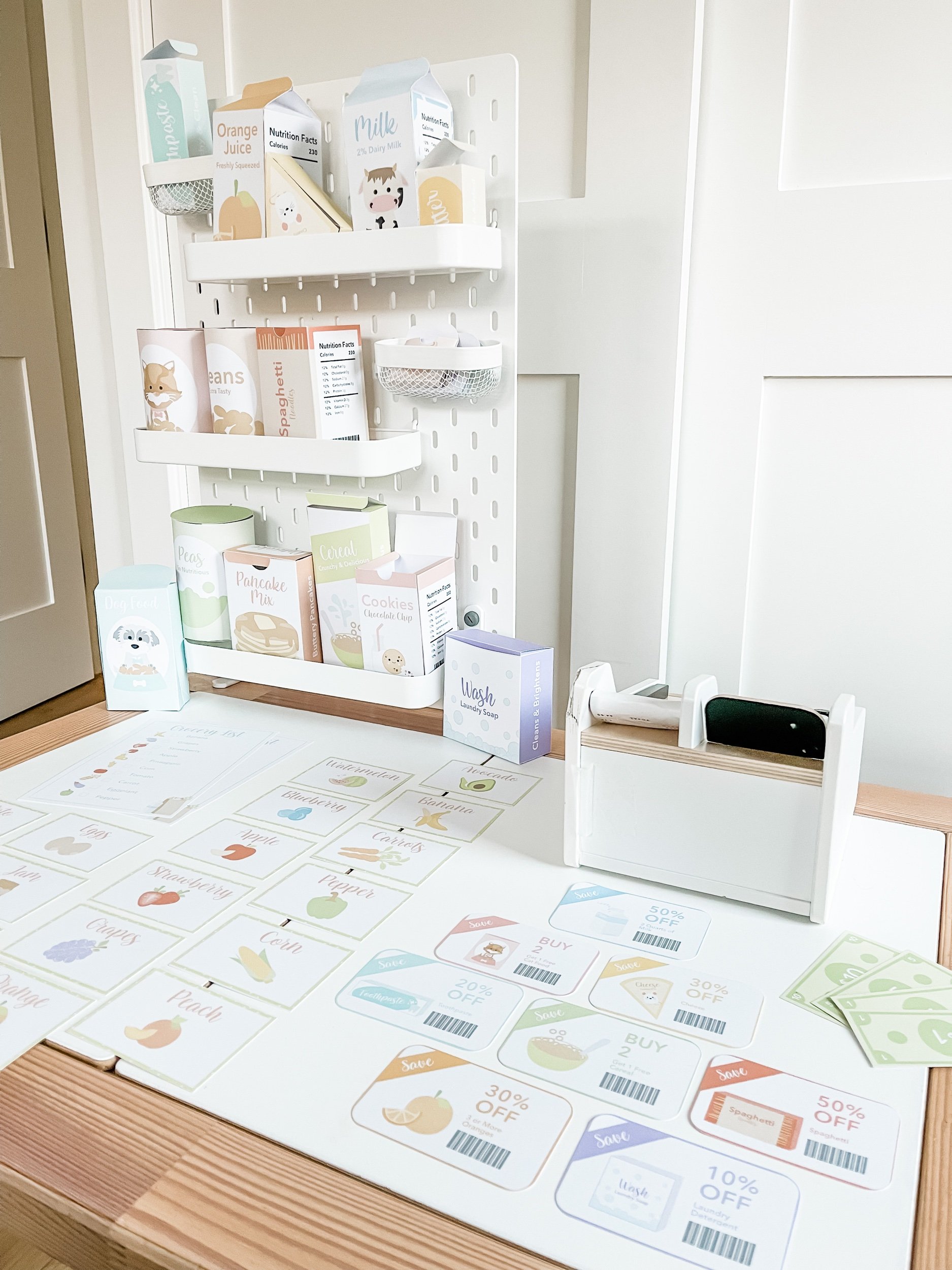
How they play it: the shopper gets a list and a budget; the stocker puts the price tags on the shelves; the cashier scans, bags, and announces the total — and then checks it against the budget. At four, the budget is the game: "You have ten dollars — what can you buy for dinner?" turns the shop into a planning game, and choosing between two coupons is decision-making that feels like a treat, not a lesson. When my daughter was four, the grocery store was the game where she wanted to be the cashier most of all — she scanned every item, announced the total in her loudest shopkeeper voice, and if the total went over budget, she helped the shopper put something back, like a professional. Our grocery store play post shows the shelving setup we used, built around printable food boxes, coupons, and a grocery list she took very seriously.
Stretch it: add a weekly shop for a stuffed-animal family. The family needs dinner for four, a snack, and a birthday treat — and the shopper has to plan the whole list, stay in budget, and explain her choices to the cashier. Planning a shop for someone else is the most grown-up game on this list, and four-year-olds rise to it.
Keep it going: rotate the props, not the shop
Four-year-olds play longer than three-year-olds, but they still get bored of the same shop — just on a slower schedule. The trick is to change one thing at a time, not the whole world:
- Rotate the product line, not the shop. Same counter, new theme: pies in the fall, donuts in the spring, a flower shop in May, a construction site when the blocks come out, a campsite when the blanket fort goes up, a pumpkin patch in October. Each theme feels brand new while you reuse every prop.
- Add one new piece of paperwork. A new form — a delivery slip, a change order, a loyalty card, a receipt book, a packing list — can revive a tired setup for another week, because the paperwork is where the new challenge lives. At four, a new form is a new job.
- Swap the roles, not the game. The same bakery plays completely differently when the child who was the head baker becomes the cashier. The role swap is free, it takes ten seconds, and it doubles the playtime — because every role has its own lines to learn, and at four, learning the other person's job is the point.
- Introduce a rush hour. "Oh no, three customers just walked in at once!" Playful time pressure practices prioritizing and working memory — and kids find it hilarious. The rush hour works in every shop on this list, which is why it is the easiest stretch in the book.
- Combine two worlds. A bakery counter inside a grocery store, a flower shop next to the donut shop, a pumpkin patch beside the market stand, a campsite with a little shop for supplies. Combined worlds double the playtime of both, because each world gives the other customers — and the delivery run between them is a whole game on its own.
- Let it stay up. If you can, leave the shop standing for a few days. A setup that survives overnight gets revisited in the morning with the same customers and the same unfinished orders — and a four-year-old who remembers yesterday's storyline is a storyteller in training.
- Invite a friend or a sibling in as a second role — and hold a team meeting. Two four-year-olds in one shop need a plan: who is the baker, who is the cashier, and when do they swap? Agree on the roles before the game starts, set a timer for the swap if you need to, and let the negotiation be part of the play. At four, the team meeting is a real skill: sitting down, deciding who does what, and sticking to it. The argument about who gets to be the boss is not a failure of the game — it is the game, and it is where the cooperation gets practiced.
What you actually need (and what you don't)
You don't need a play kitchen, a toy cash register, or a single purpose-bought toy to run a great four-year-old pretend game. Our longest-running games used a low table, playdough, paper bags, a notepad, play money, and printables for the pieces that make a shop feel real — signs, price tags, order forms, menus, job cards, and recipe cards. The printables are what transform a pile of props into a world: they give your child the paperwork of the job, and that paperwork is where so much of the early literacy and math lives. At four, the paperwork is not decoration — it is the game.
If your child is deep in a pretend-play phase and you want the whole thing done for you — construction site, flower shop, donut shop, market stand, campsite, pumpkin patch, bakery, grocery store, and dozens more — that's exactly what our printable play bundles were made for. One download, one printing session, and the shop is open for months of play.
Every world in one bundle
Our Ultimate Pretend Dramatic Play Bundle includes 75+ printable play kits — construction, flower shop, donut shop, market stand, camping, pumpkin patch, bakery, grocery store, and dozens more — with every sign, price tag, order form, job card, and recipe card done for you. Print once, play for months. $99 (compare-at $335).
Just want the pie shop?
If pies are the whole bakery as far as your little one is concerned, our Pie Baking Dramatic Play Printables have the pie-shop signs, order forms, and recipe cards to open a dedicated pie counter — no bundle required.
A tiny fall shop for little bakers
Our Mini Fall Pretend Play Bundle is a small, seasonal set — perfect for a four-year-old's first real shop, when a written menu, a cash register, and a customer who changes her mind are the whole game.
Free: Fall Pies Recipe Cards
Want to try the recipe-card magic before you buy anything? Our free Fall Pies Recipe Cards give your little baker real recipes to "read" and follow — apple, pumpkin, and more — and they're the same cards that made our pie shop play stretch for weeks. At four, a recipe card is a script with numbers on it: read it out loud, count the ingredients, follow the steps, and serve it with pride.
How is pretend play different at 4 than at 3?
At three, pretend play is a story with a script and a sequence. At four, the story gets a crew: your child assigns roles, hands out job cards, writes real forms (blueprints, order slips, packing lists), counts money and makes change, and plays as a team with a friend or sibling instead of just taking turns. The games run longer — twenty to forty-five minutes, and sometimes across days — because the sequence has more steps and more people in it.
What if my 4-year-old only wants to be the boss?
That is completely normal — the boss is the most fun role, and every four-year-old knows it. The fix is a job card and a timer, agreed before the game starts: "You are the foreman for ten minutes, then I am the foreman and you are the builder." A timer helps, and so does making the other roles fun — the delivery driver gets the truck, the cashier gets the money, the customer gets to order the silliest things and change her mind.
How do I help two 4-year-olds play pretend together without a fight?
Hold a team meeting before the game starts: decide the roles out loud, write them on job cards, and agree on when they swap. "You are the florist, you are the delivery driver, and after the next delivery, you swap" gives both children a turn at the role they want, and the swap becomes part of the game instead of a fight. If it still falls apart, step in as a customer — a third role with no power to argue over — and let them both serve you.
Do 4-year-olds need to read to use menus and order forms?
No. At four, menus and order forms work with pictures, numbers, and a child's own handwriting — a drawing of a donut on the menu, a wobbly "3" on the order form, a checked box on the packing list. Your child "reads" the menu by remembering what each picture and number means, and "writes" the order by making marks that mean something to her. That is exactly how early literacy grows: marks that carry meaning, made for a real reason, for a waiting customer.
What if my 4-year-old's game falls apart the minute a friend joins?
That is completely normal too — cooperative play is a skill, and it arrives in stages. A four-year-old who runs a beautiful solo shop may still struggle when a friend wants to be the boss too. The best way to practice is a small crew with clear jobs: you take a role, the friend takes a role, and your child is the one handing out the job cards. Being the one who assigns the roles gives her the control she wants, and the friend gets a real job to do — and once they have played the game together once, the next time is a much smaller step.
However you set it up — a construction site on the FLISAT table, a flower cart in the corner, a donut shop with a real menu and real coins, a pumpkin patch with a scale, or a campsite in a blanket fort — a four-year-old's pretend game is one of those rare activities that's as rich as it is simple. Hand out the job cards, hang the sign, put out the order forms, and let your little crew take it from there. And if you try one of these games, I'd love to hear which world your four-year-old opened first — and who got to be the boss.