
Pretend Play Ideas for 2-Year-Olds: 8 Simple First Pretend Games
Two-year-old pretend play looks nothing like preschooler pretend play, and that is exactly the point. There is no elaborate shop with a price list and a rush hour. There is a baby doll being fed the same cracker three times, a phone call to Grandma that is mostly "hi hi hi," and a pot being stirred with enormous concentration. These 8 pretend play ideas for 2-year-olds are the first pretend games — simple imitation, one prop at a time, five to ten minutes of play — and they are some of the sweetest play there is. When my daughter was two, this was the whole show, and I still think about it.
What pretend play looks like at two
At two, pretend play is imitation, not invention. Your toddler is not running a bakery with a business plan — she is copying what she has seen you do, one small piece at a time. She stirs a pot because she has watched you stir a pot. She holds a phone to her ear because she has watched you hold a phone to her ear. She feeds her baby because she has been fed, a thousand times, by someone who loves her.
That is why the games below are so small. A 2-year-old does not need a world; she needs one prop and one familiar action. The magic is in the repetition — the same cracker fed to the same doll, the same "hi" into the same phone, the same pot stirred for the fourth time. Repetition is how a two-year-old practices. Each replay is a little more confident, a little more detailed, a little more hers.
Two things are worth knowing before you start. First, two-year-olds mostly play beside other children rather than with them — parallel play is the norm, and it is real play, not a stage to rush through. Second, five to ten minutes is a full game at this age. If she stirs the pot for six minutes and wanders off, the game worked. You do not need to stretch it. You just need to be ready when she comes back for round two.
Set up any first pretend game in 2 minutes
Before you pick a game, gather the kit that works for all eight:
- One prop, not ten. A single doll, a single pot, a single phone. A pile of props overwhelms a two-year-old; one prop invites her in.
- A low, defined space. A low table, the FLISAT sensory table with one bin as the "kitchen," or a blanket on the floor. Boundaries make the game feel real — and keep the props from scattering across the house.
- Real things where you can. A real (empty) pot, a real spoon, a real cup. Toddlers can tell the difference between a real kitchen tool and a toy one, and the real one is almost always more interesting.
- A spot to sit with them. At two, pretend play works best when you play along for the first minute or two — you take the first pretend bite, you answer the first phone call — and then you step back and let them run it.
- One piece of "paperwork" if they are ready for it. A single menu card, a single recipe card, or a single shopping list. Not a whole shop — just one card that makes the game feel official. Our sensory bin ideas for 2-year-olds use the same one-prop-at-a-time approach, and the two kinds of play pair beautifully on the same afternoon.
8 pretend play ideas for 2-year-olds
1. Feeding the baby
Set out: a baby doll or a favorite stuffed animal, a small bowl, a spoon, and a cloth for wiping the baby's mouth. A high chair for the doll is lovely if you have one; a folded towel as a "bib" works just as well.
How they play it: your toddler spoons pretend food into the baby's mouth, wipes the baby's face, and tells the baby "more?" — often in the exact voice you use at their own mealtimes. When my daughter was little, feeding her baby was the first pretend game she played on her own, and the narration was the whole point: she repeated every phrase she had heard at the table, in order, like a tiny recording of our dinner routine.
Ways to stretch the play: add a second course. A cracker, then a "drink" from a small cup, then a wipe of the mouth. Three steps, in order, is a full routine for a two-year-old — and routines are what they are practicing.
2. Pretend phone calls
Set out: a toy phone, an old phone with the battery out, or a wooden block held to the ear. That is the whole setup, and it is enough.
How they play it: your toddler dials (or pretends to), holds the phone up, and says "hi!" — then listens, nods, and says "hi!" again. When my daughter was two, her phone calls were almost entirely "hi" and "bye" and "okay," said with total confidence to whoever she had decided was on the other end — usually Grandma, sometimes a bear. The conversation is simple because the joy is in the form: holding the phone, taking a turn, saying goodbye and hanging up.
Ways to stretch the play: be the person on the other end for the first call. Answer with a real greeting, ask one question ("Are you having lunch?"), and say goodbye. Then hand them the phone and let them call someone else — the second call is always longer than the first.
3. Stirring an empty pot in the play kitchen
Set out: a real pot or a play pot, a wooden spoon, and a low surface to stir on. A few dry beans or a little water in the pot adds sound and weight — keep it simple, one ingredient at a time.
How they play it: your toddler stirs, tastes (with the empty spoon, very seriously), stirs again, and announces "done!" or "hot!" When my daughter was little, stirring was the game she came back to more than any other — she would stir an empty pot for ten minutes straight, narrating the whole time, completely absorbed. The stirring is the cooking at this age; there does not need to be a recipe or a finished dish.
Ways to stretch the play: add a "serving" step. A small bowl, a spoonful from the pot, and a delivery to a stuffed animal at the table. Stir, serve, eat — three steps, and suddenly the kitchen has a customer.
4. Pushing a stroller or shopping cart
Set out: a toy stroller, a small shopping cart, or a basket on wheels, with a doll or a stuffed animal riding inside. A clear path through the room — around the coffee table, down the hallway — is the whole "set."
How they play it: your toddler pushes the stroller around the house, stops to check on the passenger, adjusts the blanket, and pushes on. When my daughter was two, the stroller walk was a daily ritual: the same loop, the same stops, the same careful tucking-in of the blanket at the same corner of the couch. The repetition was the game. She was practicing the whole routine of taking care of someone smaller — and she took it very seriously indeed.
Ways to stretch the play: add a destination. "Let's take the baby to the shop" turns a walk into an errand, and an errand into a story. The shop can be the next idea on this list.
5. The tiny bakery (2–3 items only)
Set out: a tray, two or three playdough "baked goods" (or a few real muffins), a paper bag, and one menu card. That is the entire bakery. Resist the urge to add more — three items is a full shop for a two-year-old.
How they play it: your toddler is the baker; you are the customer. You point to one item, they hand it to you (sometimes after a long, careful selection process), and you say thank you. When my daughter was little, our bakery play started exactly this small — three items on a tray, one customer, one transaction — and it was plenty. Our full bakery play post shows where that little tray eventually grew, but the two-year-old version needs none of it: a tray, three things, and a customer is a bakery.
Ways to stretch the play: add a price tag with a single number on it — "one" or "two" — and let your toddler hand you the tag along with the item. One number, one item, one sale.

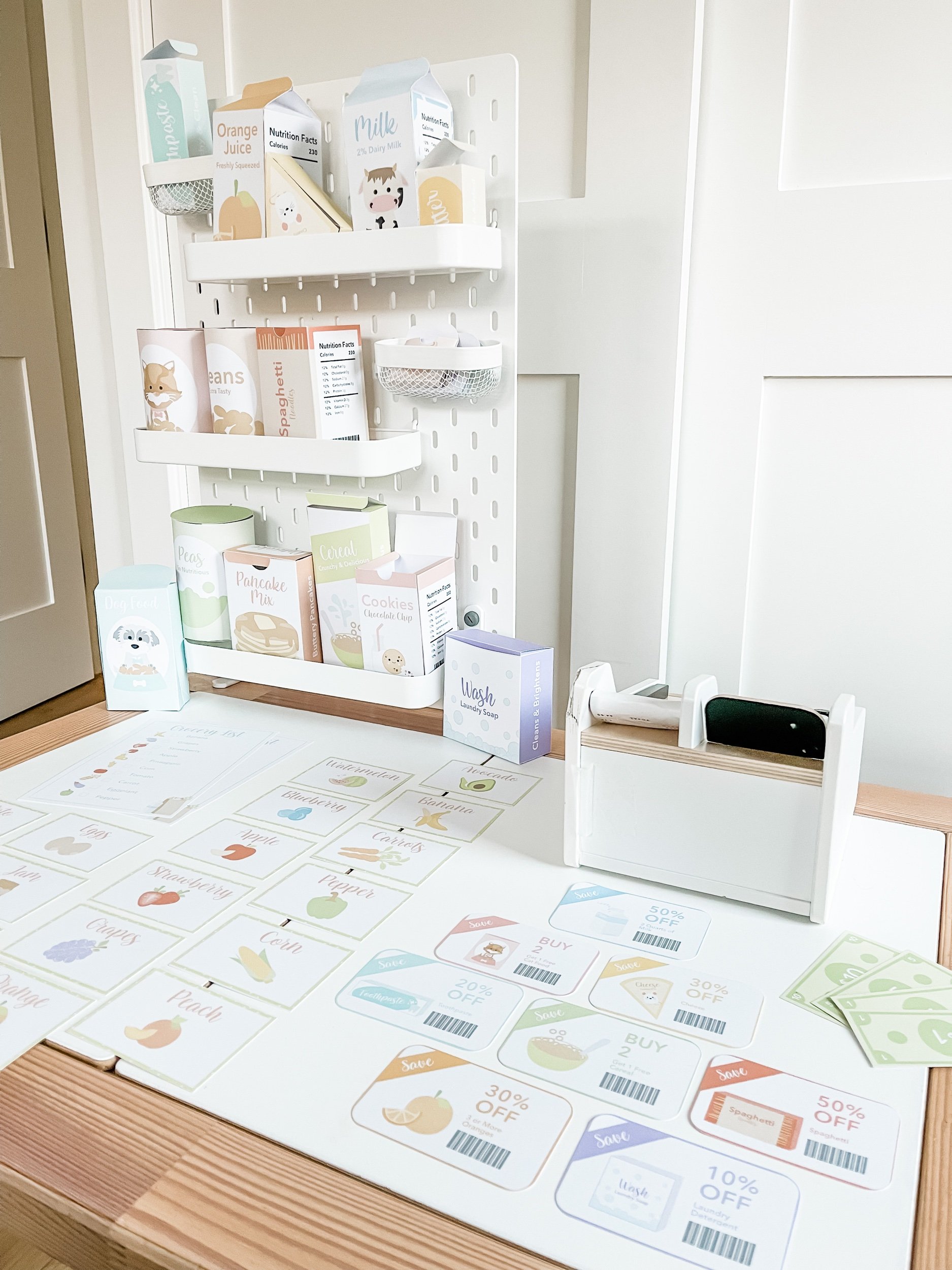
6. The tiny grocery shop (2–3 items only)
Set out: a low shelf or a small box as the "store," two or three play foods or empty food boxes, and a basket. One shelf, three items, one basket — a complete grocery store.
How they play it: your toddler stocks the shelf, you shop with the basket, and they watch you choose with enormous interest. When my daughter was two, she restocked the shelf more than she "sold" anything — putting the three items back in their spots, in the same order, every single time. That restocking was the play: sorting, placing, arranging, and then doing it all over again. Our grocery store play post shows the bigger version we built later, but the two-year-old shop is just a shelf and three things.
Ways to stretch the play: add a shopping list with two pictures on it — an apple and a banana, drawn or cut from a flyer. "Can you find the apple?" turns shopping into a matching game, and matching is a game a two-year-old can win.
7. Doctor checkup on a teddy
Set out: a stuffed animal as the patient, a spoon as the "thermometer," a few cotton balls or bandages, and a small bag or basket to carry it all in. One patient, one tool at a time.
How they play it: your toddler listens to the teddy's chest (with the spoon, or just an ear pressed close), wraps a bandage around a paw, and declares the teddy "all better." When my daughter was little, the doctor game always followed a real appointment — she would come home and immediately give her bear the same checkup she had just had, in the same order, with the same phrases. Replaying a real experience is how a two-year-old makes sense of it, and the teddy is the perfect patient: endlessly cooperative, never in a hurry.
Ways to stretch the play: add a waiting room. Two chairs, one patient waiting, one patient being seen. "Bear is next" is a tiny lesson in taking turns — and the bear never minds waiting.
8. Pouring pretend tea, then tucking the dolls in
Set out: a small teapot (or a little pitcher), two or three tiny cups, and two dolls or stuffed animals. A small blanket for bedtime, folded nearby. This is a two-part game: tea first, then bed.
How they play it: your toddler pours the tea — slowly, carefully, sometimes missing the cup entirely, which is part of the fun — and the dolls "drink." Then it is bedtime: the dolls get tucked under the blanket, a pat on the back, and a "night night." When my daughter was two, the tea party always ended in bedtime, and the bedtime was the part she loved most — she would tuck her dolls in with the same slow care she had been tucked in with herself, and then peek to see if they were asleep yet. Our café setup shows the bigger version of this game, and our small-world play ideas use the same tiny-cup, tiny-world logic for even smaller scenes.
Ways to stretch the play: add a "menu" with one picture on it — a teapot, drawn on a card. The server shows the menu, pours the tea, and then the dolls are tired and it is time for bed. Tea, then bed: a whole day in the life of a doll, in ten minutes.

How to keep first pretend play going (without pushing it)
- Play along for the first minute, then step back. Take the first pretend bite, answer the first phone call, and then let them run the game. Your job is the opening line, not the whole script.
- Repeat the game tomorrow. Two-year-olds love the same game on repeat — the same pot, the same doll, the same "hi" into the phone. Repetition is not boredom at this age; it is mastery.
- Add one thing, not five. When a game starts to fade, add a single new prop — one cup, one bandage, one menu card — and the game is new again. Five new things at once is overwhelming; one new thing is an invitation.
- Let them be the grown-up. When your toddler is feeding the baby or pouring the tea, let them be in charge. Correcting how they hold the spoon or pour the cup ends the game; watching them do it their way keeps it going.
- Name what you see, briefly. "You are feeding the baby!" "You poured the tea!" A short, warm narration tells them you are watching and you love what they are doing — and it gives them words for the game they are playing.
- Let it end at ten minutes. A short game that ends happily is better than a long game that ends in tears. When they wander off, the game worked. Put the pot away and be ready for the next round.
What you actually need (and what you don't)
You don't need a play kitchen, a toy cash register, or a single purpose-bought toy to run a great first pretend game. Our longest-running two-year-old games used a real pot, a wooden spoon, a doll, a toy phone, and a blanket — things we already had. The pieces that make a game feel real are the prop and the routine: one familiar object, one familiar action, repeated until it is theirs.
If your two-year-old is deep in a pretend-play phase and you want the whole thing done for you — bakery, grocery store, café, and dozens more, sized up for when they are ready for the bigger worlds — that is exactly what our printable play bundles were made for. Start with one small set now, and the bigger shops will be waiting when they are.
Every world in one bundle
Our Ultimate Pretend Dramatic Play Bundle includes 75+ printable play kits — bakery, pie shop, donut shop, grocery store, café, and dozens more — with every sign, price tag, order slip, and recipe card done for you. Start with one tiny shop at two, and grow into the whole bundle as they do. $99 (compare-at $335).
Just want the pie shop?
If pies are the whole bakery as far as your little one is concerned, our Pie Baking Dramatic Play Printables have the pie-shop signs, order forms, and recipe cards to open a dedicated pie counter — no bundle required.
A tiny fall shop for little bakers
Our Mini Fall Pretend Play Bundle is a small, seasonal set — perfect for a two-year-old's first shop, when three items on a tray is the whole bakery and a single menu card makes it feel official.
Free: Fall Pies Recipe Cards
Want to try the recipe-card magic before you buy anything? Our free Fall Pies Recipe Cards give your little baker real recipes to "read" and follow — apple, pumpkin, and more — and they're the same cards that made our pie shop play stretch for weeks. Start with one card on the tray; that's all a two-year-old needs.
When do toddlers start pretend play?
Most toddlers start their first pretend games around 18 months to 2 years — feeding a doll, holding a phone to their ear, stirring an empty pot. At two, the games are simple imitation: one familiar action, repeated. They don't need a script or a setup, just one prop and a routine they've watched you do a hundred times.
What are the first pretend play schemas for 2-year-olds?
The first ones are almost always the routines of daily life: feeding a baby, making a phone call, cooking in a pot, pushing a stroller, pouring a drink, putting a doll to bed. These are called pretend schemas — small, repeatable actions your toddler copies from the world around them. Each one is a complete game on its own.
How long should a 2-year-old play pretend?
Five to ten minutes is a full game at two. If your toddler stirs the pot for six minutes and wanders off, the game worked. Short, happy play sessions that end on their own terms build the habit far better than a long session that ends in frustration.
Do I need a play kitchen for pretend play at 2?
No. A real pot and a wooden spoon on a low table — or in one FLISAT bin — is more interesting to a two-year-old than a toy kitchen. The prop that matters is the one they can actually use: stir it, pour it, serve it. One real tool beats a whole toy set at this age.
What if my 2-year-old doesn't pretend play yet?
That is completely normal — pretend play arrives on its own schedule, and some two-year-olds are still mostly exploring, dumping, and carrying things around, which is its own kind of play. The best way to invite it is to play alongside them for a minute: take a pretend bite, answer a pretend phone call, stir the pot yourself and offer them the spoon. Often they join in once they see the game — and if they don't today, they'll try again tomorrow.
However you set it up — a pot on the kitchen floor, a doll in a stroller, three muffins on a tray — a first pretend game is one of those rare activities that's as simple as it is sweet. One prop, one familiar action, and a toddler who is suddenly the grown-up in the room. And if you try one of these games, I'd love to hear which one your two-year-old played first.