
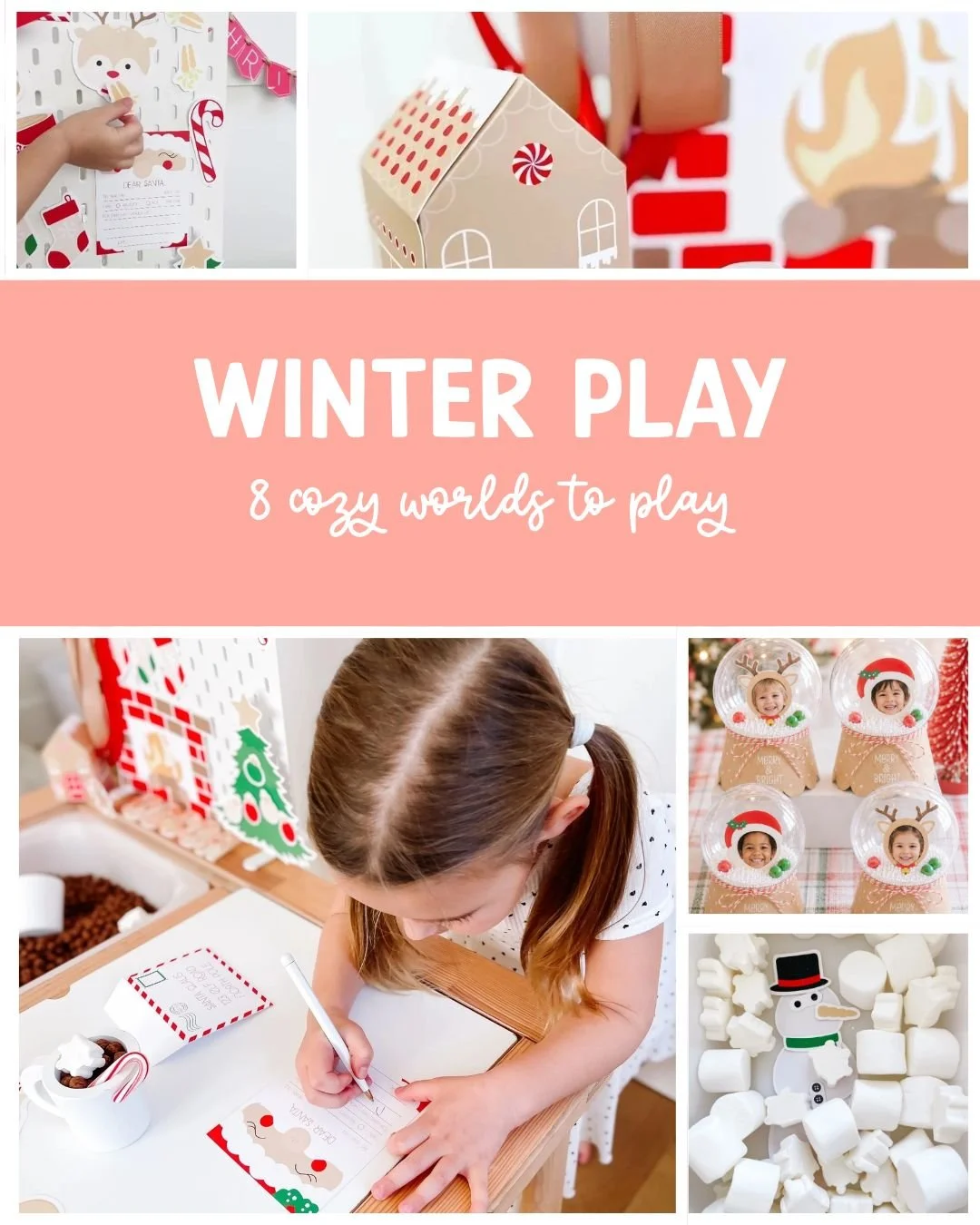
Winter Pretend Play Ideas for Toddlers: 8 Cozy Worlds to Play
Winter is the season when the play moves indoors, the afternoons get long, and a toddler needs somewhere to go — so we gave her somewhere to go. A hot cocoa café in the FLISAT table. A gingerbread bakery with a line out the door. A reindeer stable, a winter market, a snowman-building station, and a post office that only delivers letters to Santa. These eight winter pretend play ideas for toddlers are the ones that actually worked at our house: simple setups, things you probably already own, and play that lasted longer than the setup took. When my daughter was little, winter pretend play was our answer to the gray-afternoon slump — a tray, a few props, a role to step into, and suddenly she was the barista, the baker, the elf, and the vet, all before dinner.
What makes winter pretend play work
Winter gives toddlers a whole world to step into, and the world is already in their heads. They know what a café is — somebody takes your order, somebody makes the drink, somebody hands it over with a smile. They know what a bakery smells like, what Santa's workshop is for, what a reindeer eats. Pretend play works when the role is already familiar, and winter roles are the most familiar roles of all: the person who serves the cocoa, the person who wraps the present, the person who feeds the reindeer before the big night.
That is why these eight worlds all follow the same shape: one small place, one clear job, and a few props that do the talking. A toddler does not need a whole winter village. She needs a counter to stand behind, a cup to hand over, and someone — you, a stuffed animal, a little brother — to play the customer. The talking is the play. When my daughter was little, the cocoa café was never really about the cocoa. It was about the ordering: "What would you like today?" and the very serious business of writing it down on a little notepad, even before she could write. We made talking part of the play, and the chatter was half the fun — she spoke early because we made talking fun, and every one of these worlds is built to keep the conversation going.
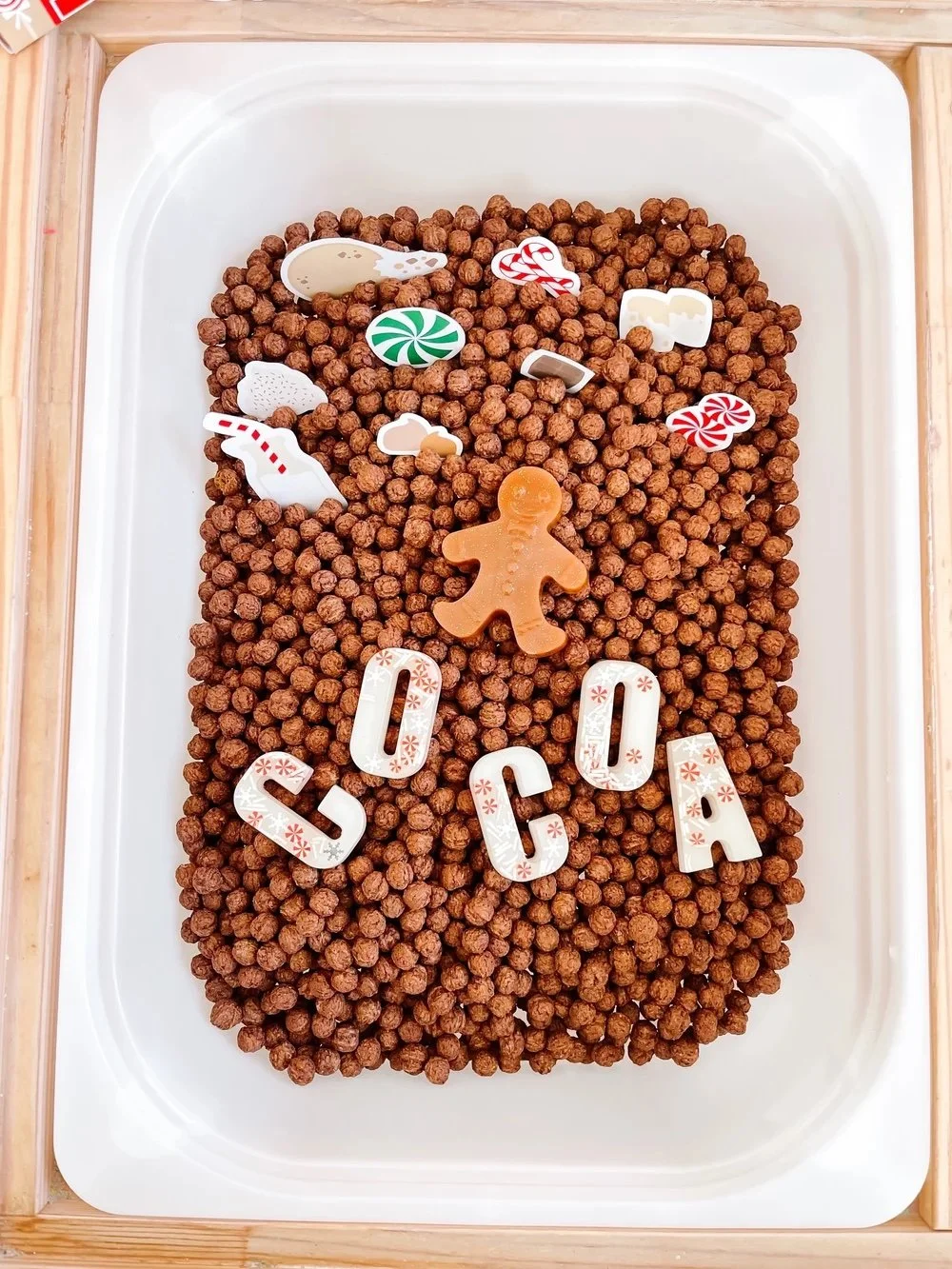
A quick note, the way I'd say it to a friend: stay nearby for every setup here, and keep the props large — big cups, big scoops, big pretend food, nothing small enough to be mouthed whole, and no small parts for a toddler who still puts everything in their mouth. No water beads anywhere in these worlds. The bins below use dry fillers like brown cereal, cotton balls, and white pom-poms, and the play food is the chunky kind a little hand can grip. If your youngest is still at the mouthing stage, keep the loose fillers in a sealed bag or skip them and play with the props on the bare table — the roles still work, and you can come back to the bins when the mouthing has eased.
You don't need eight kinds of props or a Pinterest-perfect setup. You need one corner of the table, one world, and a toddler who gets to choose the role. Every idea below works with what you already have — change the props, not the world, and the same setup plays differently every day of the week. Our winter roundup has the full cold-weather collection these worlds belong to, and our Christmas sensory bin ideas has the bins that pair with them, one for every world below.
Set it up in 10 minutes
Every world in this post follows the same ten-minute recipe, and once you have done it twice you will not need the recipe anymore. Pick the world. Clear one corner of the table or one bin in the FLISAT table. Put down three things: something to hold (a cup, a basket, a tray), something to serve or sort (cereal, cotton balls, pom-poms, play food), and something to say (a little sign, a notepad, a menu card). Then give your toddler the role — "You are the barista today" — and step back. The first two minutes are yours. The rest is theirs.
Three habits make the ten minutes work. First, set it up the night before when you can, so the world is waiting in the morning instead of competing with breakfast. Second, keep a basket of the reusable props — the cups, the scoops, the little notepad, the play food — in one place, so a new world is a new arrangement of the same basket, not a new shopping trip. Third, let the same world run for three or four days before you swap it. A toddler plays deeper on day three than on day one, because by day three she knows the role by heart and starts inventing the details — the regular customer, the secret menu item, the reindeer who only eats carrots. Our pretend play ideas for 4-year-olds has the same slow-play thinking for the older end of the toddler years, and our sensory bin ideas for 4-year-olds has the bins that grow with it.
8 winter pretend play ideas for toddlers
1. Hot cocoa café
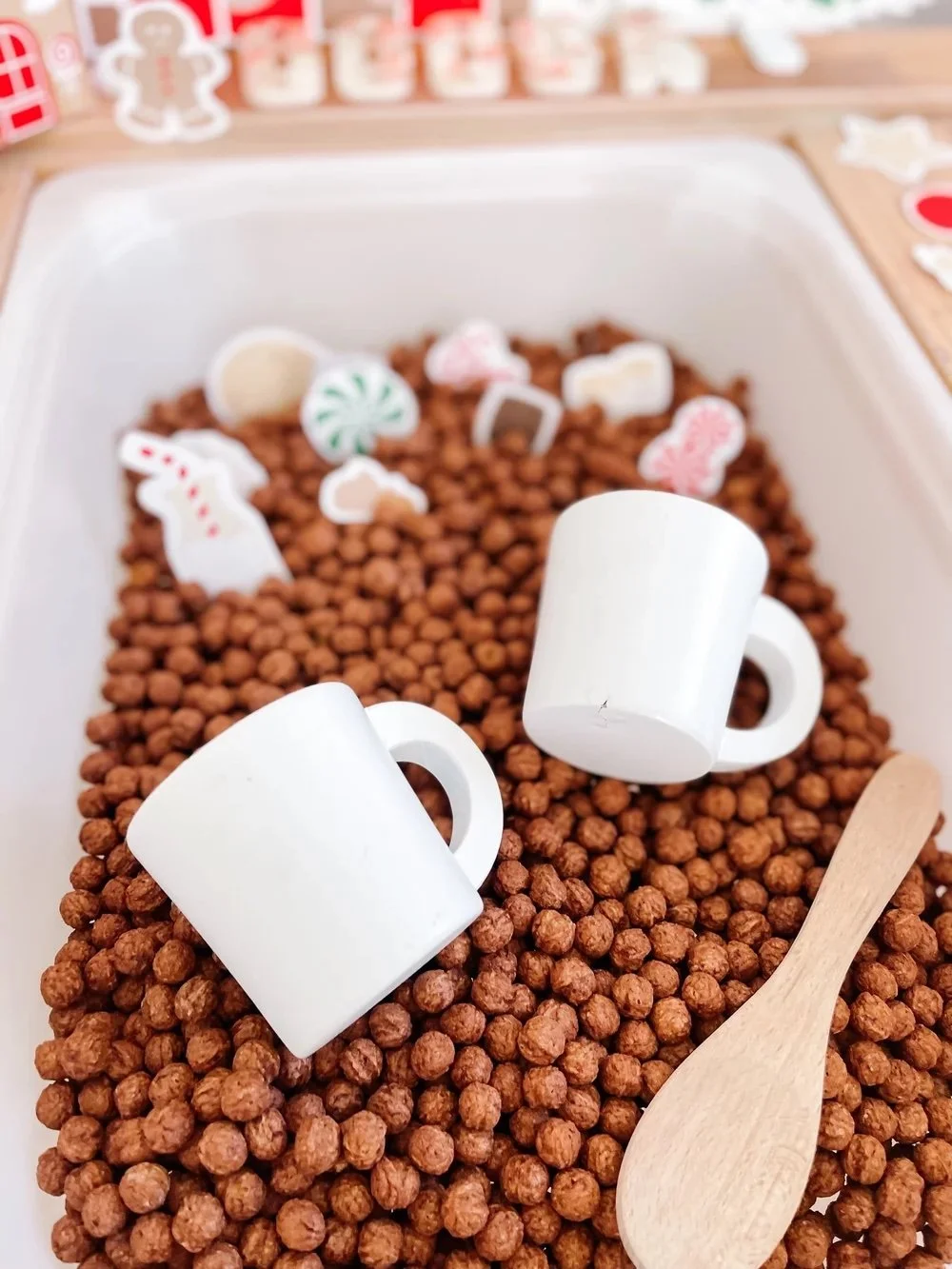
What you need: a FLISAT table or a tray, two or three small mugs, a wooden spoon, a scoop, a bin of brown cereal or cocoa-colored pom-poms for the "cocoa," a little notepad and a chunky crayon for taking orders, and a strip of paper that says COCOA for the café sign. Optional: a few candy-cane cutouts or paper marshmallows for toppings.
What to do: set the bin in one side of the FLISAT table and the mugs on the other, and tape the COCOA sign where the customers can see it. Your toddler is the barista. You are the first customer. Order out loud — "I'd like a hot cocoa, please, with two marshmallows" — and let the barista scoop the cocoa, stir it with the wooden spoon, and hand it over with both hands. Then switch roles, and let your toddler be the customer who orders the fanciest cocoa on the menu. Our full café setup lives on our pretend café post, and our hot cocoa post has the cocoa bin that started the whole game.
What to say: "Welcome to the cocoa café! What would you like today?" "Would you like marshmallows on top?" "That will be two snowflakes, please." The ordering is the game — the back-and-forth, the listening, the remembering what the customer asked for — and a toddler who takes your order seriously is practicing conversation without ever knowing it.
Why it works: the café is the friendliest pretend world there is, because every toddler has watched someone order a drink. The steps are clear — take the order, make the drink, hand it over — and the steps repeat, which is exactly what a toddler loves. The scooping is good hand practice, the stirring is a satisfying job, and the handover is the moment the whole game pays off. When my daughter was little, the café was the world she came back to most, because she got to be the one in charge — the one who knew the menu, the one who decided how many marshmallows.
Try it like this: write the menu together on a little card — cocoa, cocoa with marshmallows, cocoa with a candy cane — and let your toddler point to the order instead of saying it, if the words are still coming. Put a stuffed animal in the customer chair so the café has a regular. Stretch the play: add a tip jar (a small cup with a few large play coins), a "closed" sign to flip at the end of the day, and a second customer — the café gets busier, the orders get longer, and the barista gets a whole afternoon of work.

2. Gingerbread bakery
What you need: a FLISAT table or a tray, a rolling pin (a real one, or a chunky play one), play dough or salt dough in brown and white, gingerbread-man cookie cutters, a baking tray, a spatula, and a few paper cupcake liners. Optional: a printed bakery menu card and a little "OPEN" sign.
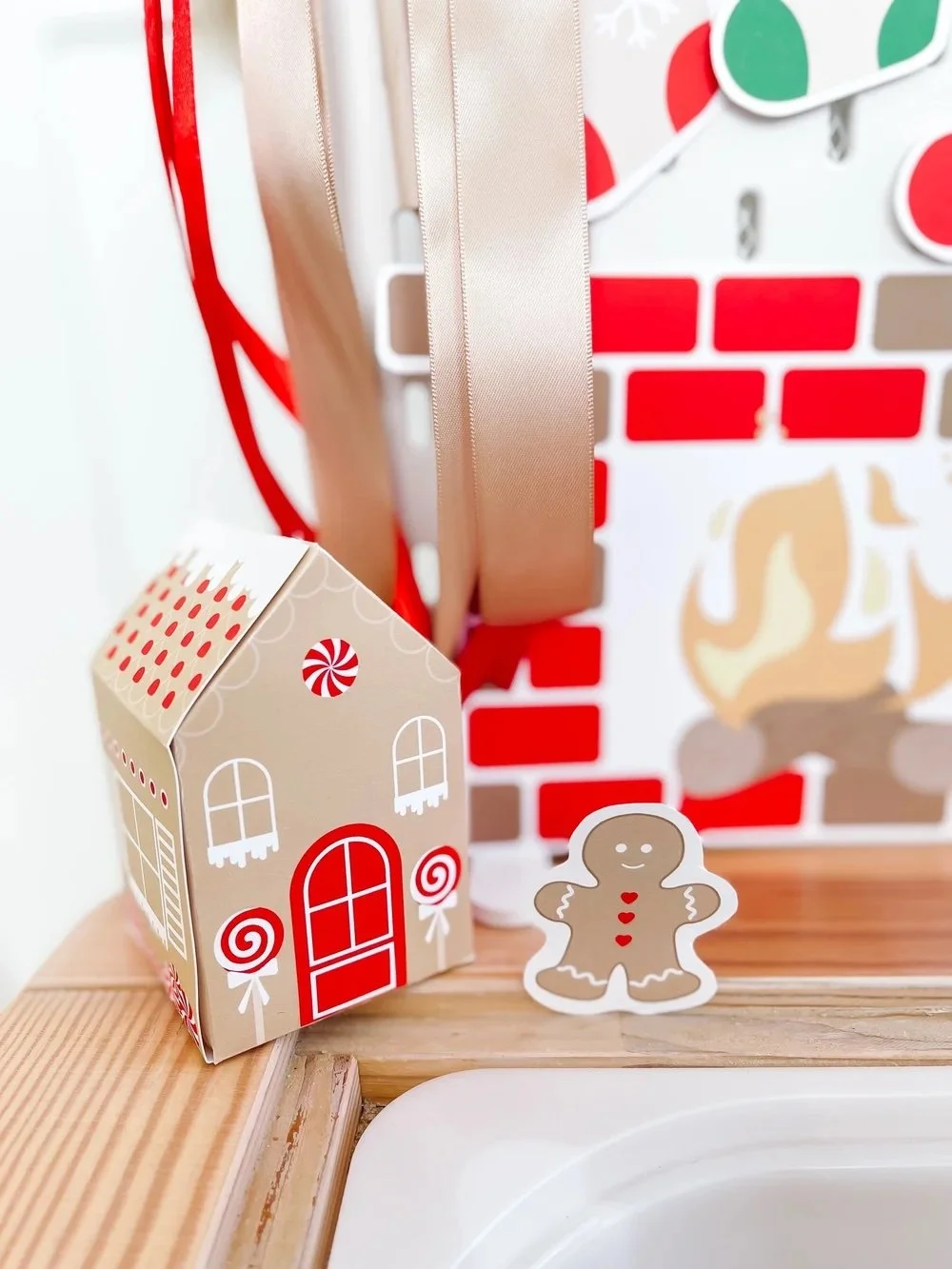
What to do: roll out the dough, press the gingerbread cutter into it, and lift the little man onto the baking tray — that is the whole job, and a toddler will do it approximately four hundred times. Then the bakery opens: take orders, slide the tray into the pretend oven (the other FLISAT bin, or a cardboard box with a flap), wait for the timer to ding, and serve the gingerbread men on a plate. Our full bakery setup lives on our pretend bakery post, with the FLISAT table dressed as a bakeshop.
What to say: "Welcome to the bakery! We have gingerbread men today — would you like one with buttons or one with a bow tie?" "The oven is hot, so we wait for the ding." "That gingerbread man is for the reindeer — he likes the one with extra buttons." The bakery is a naming game in disguise: every gingerbread man gets a description, and the description is the order.
Why it works: rolling and cutting is the most satisfying hand work a toddler can do — the dough pushes back just enough, the cutter makes a perfect shape every time, and the tray fills up with something to be proud of. The bakery also has the clearest beginning, middle, and end of any world in this post: make it, bake it, serve it. When my daughter was little, the gingerbread men always got names before anything else happened to them, and the one with the bow tie was always the one who went everywhere with her.
Try it like this: make the dough the night before so the bakery opens with the fun part — the rolling and cutting — instead of waiting. Keep a little dish of buttons (large ones, nothing small enough to mouth) for decorating, and let your toddler choose the buttons for each man. Stretch the play: add a delivery round — box up the gingerbread men in a little paper bag and deliver them to the stuffed animals around the house, one stop at a time. The bakery becomes a delivery service, and the delivery route is a whole second game.
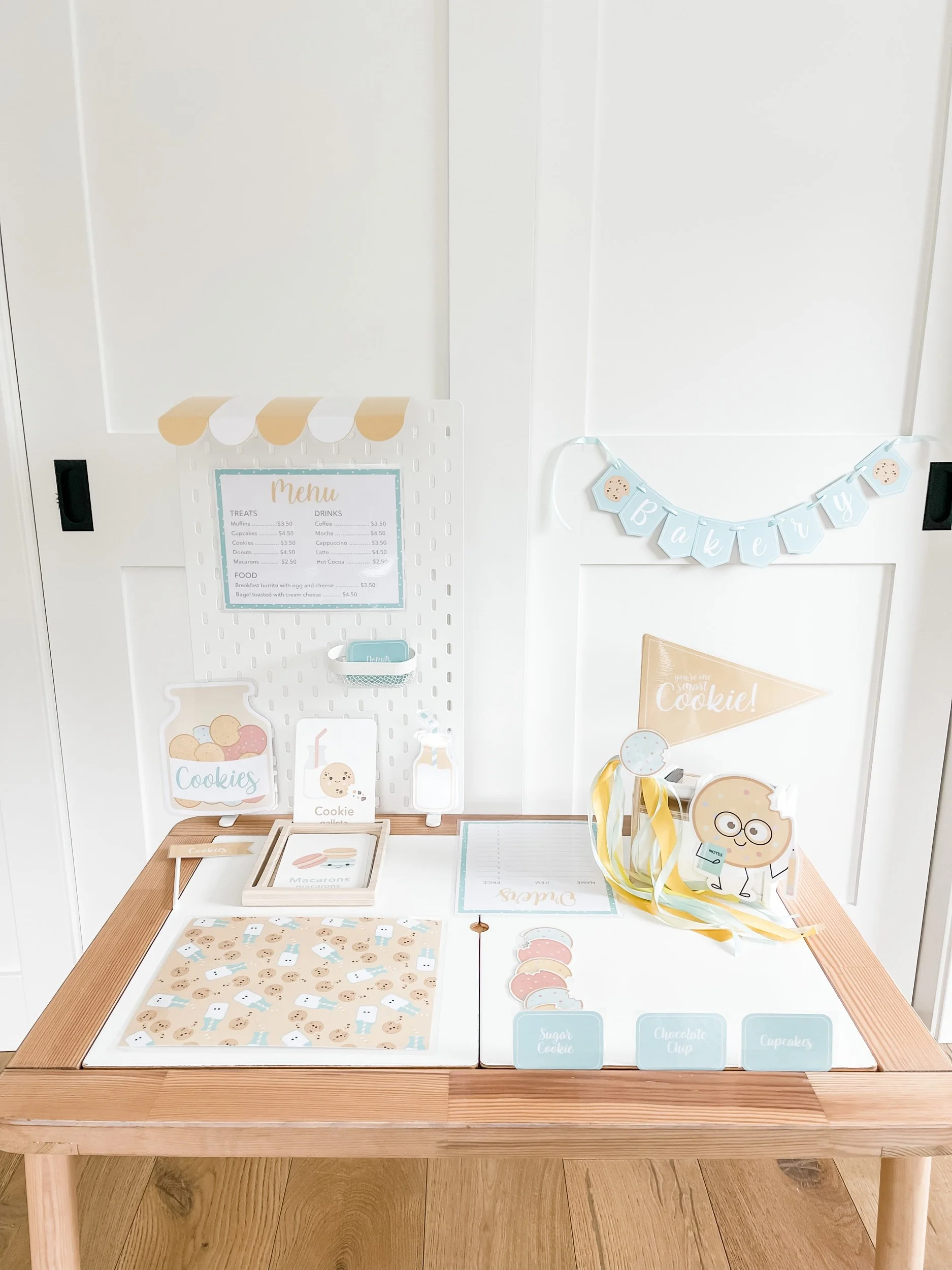
Pie Baking Dramatic Play Printables — $5
If the bakery takes hold, our Pie Baking Dramatic Play Printables give it a menu to follow — recipe cards, pie labels, and order slips, so the baking becomes a follow-the-card game with a beginning, a middle, and a warm pie at the end.
Free: Winter Pie Recipe Cards
Before you buy anything, try the free version — our Winter Pie recipe cards are the same follow-the-card game, free in Sprout, so you can see whether your toddler is a recipe-card baker before the bakery expands.
3. Santa's workshop — gift-wrapping station
What you need: a tray or a low table, three or four small boxes (tissue boxes and cracker boxes are perfect), wrapping paper or plain colored paper, tape, ribbon, a few large stickers, and a notepad for the nice list. Optional: a red headband or a paper elf hat, and a little bell to ring when a present is finished.
What to do: the workshop opens when the first box needs wrapping. Your toddler is the elf. Wrap the box — paper around, tape on the ends, ribbon across the top — and then check the nice list, write the name on a little tag (or draw a picture of who it is for), and set the finished present in the delivery pile. Then do it again, because the workshop never has just one present to wrap. Our Christmas sensory bin ideas has the workshop bin this world grew out of — wrapping, unwrapping, and re-wrapping the same three presents, then solemnly delivering them to every stuffed animal in the house.
What to say: "This present is for Grandma — what color paper should we use?" "The ribbon goes this way, then we tie it — can you hold it while I tie?" "Ring the bell! Another present is ready for the sleigh." The wrapping is the job, but the choosing is the game: who is it for, what color, what ribbon, and the little tag that says it all.
Why it works: wrapping is the most forgiving craft in the winter drawer — the paper does not have to be straight, the tape does not have to be neat, and a present wrapped by a toddler looks exactly like what it is: a present wrapped with love. The workshop also gives a toddler the best feeling in pretend play, which is making something for someone. When my daughter was little, the workshop presents were always the ones she took most seriously — because they were for her people, and the wrapping was the gift before the gift.
Try it like this: pre-cut the paper into box-sized sheets so the wrapping starts with the fun part, and keep the tape on a dispenser your toddler can pull. Let the elf choose the paper for each present — one color per person, so the delivery pile is a rainbow by the end. Stretch the play: add a delivery round — load the presents into a laundry basket sleigh and deliver them around the house, one stop at a time, ringing the bell at every door. The workshop becomes a delivery service, and the route is a whole second game. The presents were the whole game — the wrapping paper was just the workshop floor.
4. Reindeer stable — feed the reindeer
What you need: a tray or a bin, a reindeer face drawn on a piece of cardboard or a paper plate (two antlers, two eyes, a red nose), orange paper carrots or orange pom-poms for the reindeer food, a scoop, and a few stuffed animals to be the stable's other residents. Optional: a little sign that says REINDEER STABLE and a handful of cotton balls for snow.
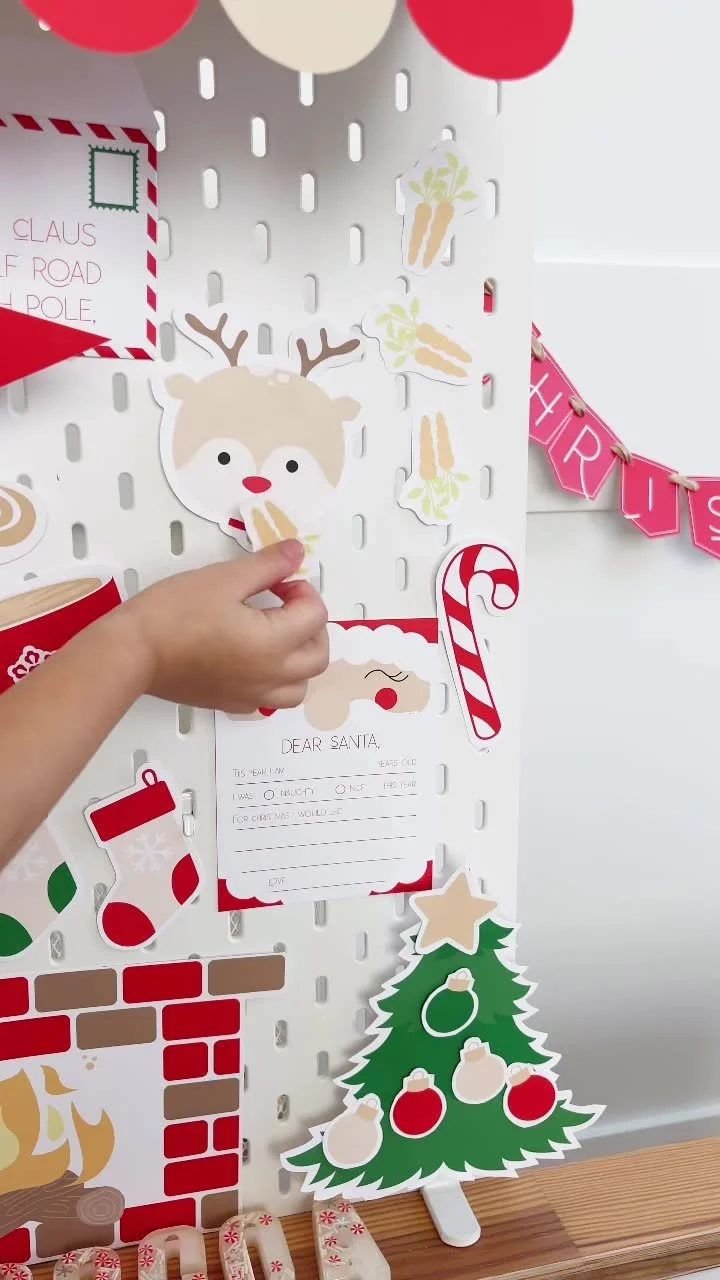
What to do: prop the reindeer face up at one end of the tray and put the carrots in a pile at the other. Your toddler is the stable keeper. Scoop up a carrot, carry it over, and feed it to the reindeer — through the mouth cutout if you made one, or just up to the face with a very serious "here you go." Then check on the other animals, top up the food, and do it again, because reindeer are always hungry before Christmas. The reindeer face in the photo below is the one from our Christmas setup — a child's hand feeding a paper carrot to the reindeer on the pegboard, the moment the whole stable game clicked.
What to say: "The reindeer are hungry — can you feed this one a carrot?" "This one only likes the crunchy carrots." "Shh — that one is sleeping. Let's feed the other one first." The stable is a caring game: the animals need something, and your toddler is the one who provides it.
Why it works: feeding is the simplest pretend job there is, and the simplest jobs are the ones a two-year-old can own completely. The reindeer does not talk back, the carrot always fits, and the game repeats as many times as the carrots last. It is also a counting game in disguise — one carrot per reindeer, two carrots for the hungry one, none left for the sleepy one — and the counting happens inside the feeding, which is the only way a toddler ever wants to count.
Try it like this: make the reindeer face from a paper plate the night before — two antlers from brown paper, a red pom-pom nose, and a mouth hole big enough for a carrot to pass through. Keep the carrots in a little bucket so the stable keeper has to carry them over, one scoop at a time. Stretch the play: add a vet check — after feeding, the stable keeper checks each reindeer's antlers, listens to its heartbeat with a play stethoscope (or a wooden spoon held to the chest), and stamps a little "healthy" card. The stable becomes a clinic, and the clinic is world number six.
5. Winter market / holiday shop
What you need: a low shelf or a table edge, a basket or a shopping bag, play food or real pantry items in their boxes (oatmeal, crackers, tea), a few pinecones and cotton balls for the winter display, and a little sign that says WINTER MARKET. Optional: large play coins and a small cash box.
What to do: set the shelves like a little shop — the pantry boxes in a row, the pinecones in a basket, the cotton balls in a bowl like snow. Your toddler is the shopkeeper. You are the shopper with a list: "I need oatmeal, and a pinecone, and — oh no, I forgot the cocoa." The shopkeeper finds each item, puts it in the bag, and takes the coins at the end. Then switch, and let your toddler be the shopper with the longest list in the world. Our pretend grocery store post has the full shop setup this market grew out of — the pegboard shelves, the baskets, and the very serious business of stocking them.
What to say: "Welcome to the winter market! What are you looking for today?" "The cocoa is on the top shelf — can you reach it?" "That will be three snowflakes, please." The market is a sorting game in disguise: the food goes on one shelf, the winter things on another, and the shopkeeper is the one who decides where everything lives.
Why it works: a shop is the pretend world every toddler already understands, because they have been to one a hundred times. The steps are clear — find it, bag it, pay for it — and the steps repeat with every customer, which is exactly what a toddler loves. The market also has the best prop in the whole post: real pantry boxes, which are free, sturdy, and endlessly rearrangeable. When my daughter was little, the shop was the world that lasted longest, because the shelves could be restocked a hundred different ways and the game was never quite the same twice.
Try it like this: write the shopping list together with pictures instead of words — a drawn oatmeal box, a drawn pinecone, a drawn mug — so your toddler can read the list herself. Put one item "out of stock" on purpose, so the shopkeeper has to suggest something else. Stretch the play: add a delivery window — the shopkeeper packs the bag, ties it with ribbon, and delivers it to the front door like a holiday order. The market becomes a delivery service, and the delivery route is a whole second game.
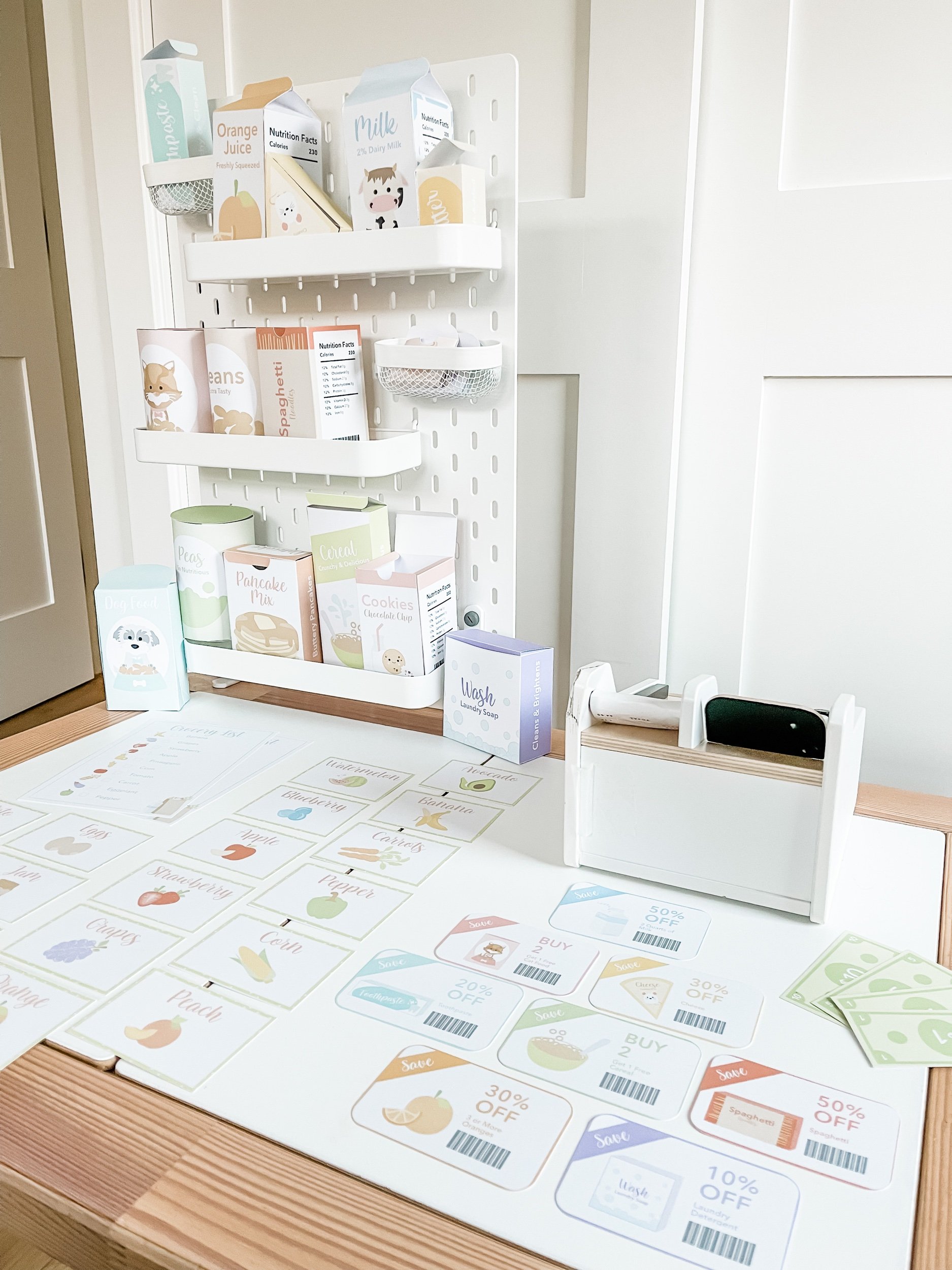
Winter Printable Dramatic Play Bundle — $30
The café, the bakery, the workshop, the market — our Winter Printable Dramatic Play Bundle is the printable set that dresses all of them: signs, menus, order slips, and labels for every winter world in this post, ready to print and set on the table.
6. Arctic animal rescue — winter vet clinic
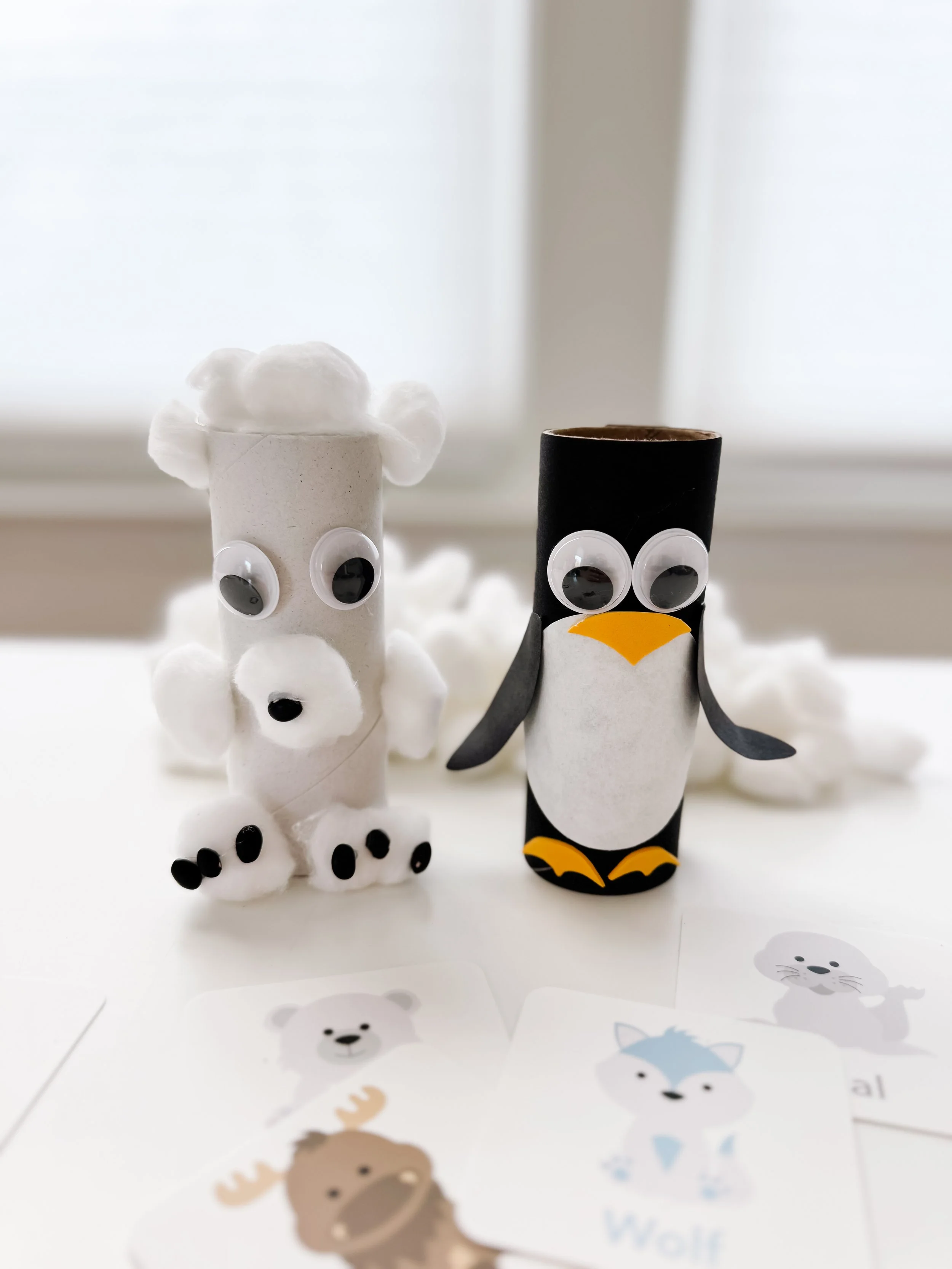
What you need: a tray or a bin, white filler (cotton balls, white pom-poms, or shredded white paper), a few stuffed arctic animals or the toilet-roll polar bear and penguin from the craft table, a wooden spoon as a stethoscope, a few bandages (real ones, the fun patterned kind), and a little card that says VET CLINIC. Optional: a small flashlight for checking ears and a towel to wrap the patients in.
What to do: bury the animals in the white filler so only a paw or an ear is showing, and let your toddler dig them out — that is the rescue. Then the clinic opens: lay each animal on the towel, listen to its heartbeat with the wooden spoon, wrap the sore paw in a bandage, and tuck the patient into bed (a shoebox with a washcloth blanket). The polar bear and penguin in the photo below are the toilet-roll animals from our craft table, and they make excellent patients — they stand up on their own, they have faces to look at, and they never complain about the bandages.
What to say: "We found a polar bear in the snow! Can you dig him out?" "His paw is sore — can you wrap it gently?" "He needs a check-up — what does his heartbeat sound like?" The clinic is a caring game, like the stable: the animals need something, and your toddler is the one who provides it.
Why it works: the rescue is the hook — digging an animal out of the snow is a treasure hunt, and every dig is a surprise. The clinic is the payoff — the wrapping, the listening, the tucking-in — and both halves ask for gentle hands, which is the whole point. A toddler who wraps a bear's paw carefully is practicing the same careful fingers that hold a crayon, inside a game where being gentle is the job. When my daughter was little, the animals always got names before anything else happened to them, and the polar bear was always the one who needed a scarf.
Try it like this: start with one patient, not five — a single rescue, a single bandage, a single tucking-in — and let your toddler ask for the next one. Keep the bandages in a little basket so the vet can choose the pattern, and keep the flashlight in the vet's pocket for the ear checks. Stretch the play: add a waiting room — the other animals sit in a row on the towel, each with a little number card, and the vet calls them in one at a time. The clinic gets a queue, the queue gets a routine, and the routine is a whole second game.
7. Snowman building station
What you need: a bin or a tray, white filler (cotton balls, white pom-poms, or a bag of marshmallows), a paper snowman cutout (three circles stacked, a carrot nose, button dots, a smile), a few small hats (a sock, a paper cup, a twist of tissue paper), and a scoop. Optional: a little sign that says SNOWMAN STATION and a handful of large black buttons for eyes.
What to do: stand the paper snowman up in the middle of the bin, and let your toddler bury him in the white filler, dig him out, and build him again — that is the whole game, and it lasts approximately forever. Then the station opens for business: build a snowman for every stuffed animal in the house, give each one a different hat, and line them up in a row like a snowman choir. The marshmallow snowman in the photo below is the one from our Christmas setup — a paper snowman standing in a bin of white marshmallows, ready to be built, buried, and built again.
What to say: "This snowman needs a hat — which one should he wear?" "Oh no, he fell over in the snow! Can you build him again?" "This one is for the bear — he likes the green scarf." The building is the game, and the rebuilding is the game too — a toddler who builds the same snowman four hundred times is not repeating herself, she is getting better at it.
Why it works: the snowman station is a craft and a sensory bin in one, which is why it lasts longer than either one alone. The making is quick — cut, draw, stand him up — and then the bin takes over: scooping the filler, burying the snowman, finding him again. It is the softest bin of the season, and the marshmallows are, technically, edible, which removes the usual "don't put that in your mouth" negotiation. When my daughter was little, the burying was always the best part.
Try it like this: draw the snowman's face together before you cut him out — the face is the part a toddler cares about most. Stand him in the middle of the bin and let your toddler bury him up to his hat, then dig him out with a scoop. Stretch the play: when the marshmallow play winds down, the same paper snowman can live on the fridge with a loop of tape — and the bin can be refilled with cotton balls for a second round, with a new hat for every rebuild.
8. Winter post office — letters to Santa
What you need: a tray or a low table, paper and chunky crayons, envelopes (or folded paper with a flap), large stickers for stamps, a shoebox with a slot cut in the top for the mailbox, and a little sign that says NORTH POLE POST. Optional: a red bag for the mail carrier and a bell to ring when the mail is collected.
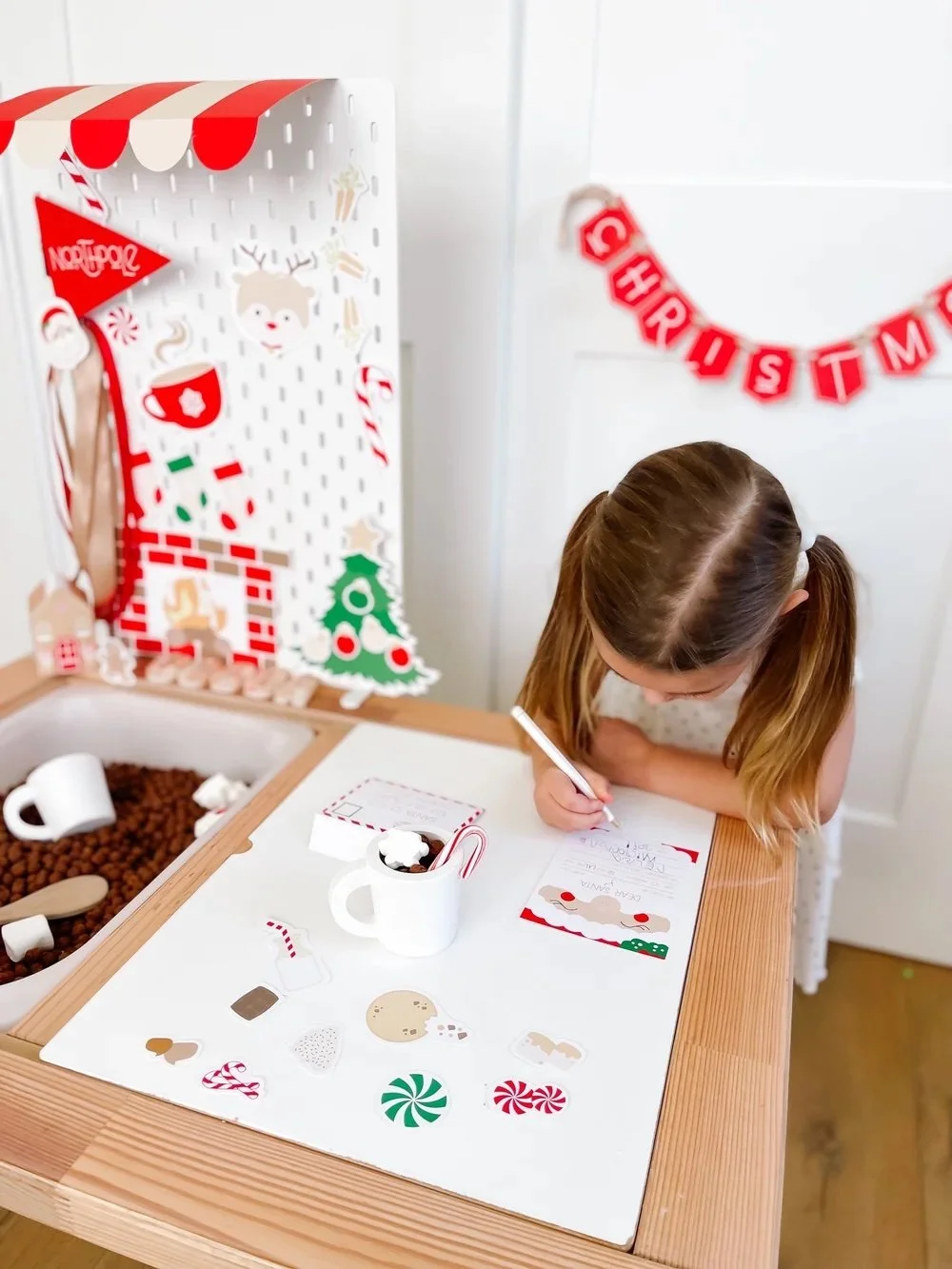
What to do: the post office opens when the first letter needs writing. Your toddler is the letter writer — draw a picture of what she wants, or dictate it while you write the words — then fold it, tuck it in the envelope, stick on the stamp, and drop it in the mailbox with a very satisfying thunk. Then switch roles: your toddler is the mail carrier, the red bag goes over the shoulder, the mailbox is emptied, and the letters are delivered — to Santa, to Grandma, to the reindeer, to the snowman. The letter-writing in the photo below is the one from our Christmas setup — a child looking down, writing her Dear Santa letter, the most serious job in the whole winter.
What to say: "What should we tell Santa? Draw it here, and I'll write the words." "Don't forget the stamp — the letter can't fly without a stamp." "Knock knock — special delivery for the reindeer!" The post office is a writing game in disguise: the drawing is the message, the envelope is the package, and the delivery is the payoff.
Why it works: the post office has the clearest beginning, middle, and end of any world in this post: write it, send it, deliver it. A toddler who writes a letter is doing the most grown-up thing in the house, and the mailbox slot makes it real — the letter goes in, and it is gone, and somebody, somewhere, is going to read it. When my daughter was little, the letters were always the ones that came back out of the keepsake box first, year after year — because a letter a toddler wrote is the one grandparents keep.
Try it like this: start with a drawing, not words — a picture of a doll, a picture of a train, a picture of the snowman — and write the words underneath together, one at a time, out loud. Keep the envelopes big and the stickers bigger, so the stamping is the fun part. Stretch the play: add a reply — the next morning, a letter from Santa (or from the reindeer, who writes in very large letters) is waiting in the mailbox, and the post office has a reply to deliver back. The post office becomes a correspondence, and the correspondence is a whole second game.

Ultimate Pretend Dramatic Play Bundle — $99
If winter pretend play takes hold at your house, our Ultimate Pretend Dramatic Play Bundle is the whole year of it — 75+ pretend-play kits, including the café, the bakery, the market, and the workshop, so the next world is always one print away.
A week of winter pretend play
Here's what the eight worlds look like when they run as a week, with the same table and the same basket of props:
- Monday — the café. Open the hot cocoa café in the morning, take orders all afternoon, and let the barista serve every stuffed animal in the house before dinner.
- Tuesday — the bakery. Roll the dough, cut the gingerbread men, bake them in the pretend oven, and deliver a bag to every room in the house.
- Wednesday — the stable and the clinic. Feed the reindeer in the morning, then open the vet clinic in the afternoon — the stable keeper becomes the vet, and the reindeer become the patients.
- Thursday — the workshop and the post office. Wrap the presents in the morning, write the letters in the afternoon, and deliver them both before bedtime — the workshop and the post office are the same delivery route.
- Friday — the market and the snowman. Stock the winter market in the morning, build the snowmen in the afternoon, and let the market's pinecones become the snowmen's hats by the end of the day.
One table, five days, eight worlds — and the only thing you bought was the paper. If you want more setups to run this week, start with our Christmas sensory bin ideas, then pick a world from our pretend play ideas for 4-year-olds and see how long the winter play lasts.
Keep it playful — the rule that matters most
Here's the thing I learned the slow way: the moment a winter world stops feeling like play, a toddler stops playing in it. The café, the bakery, the workshop — they all work because they're hidden inside a game a child chose.
So keep it light. Offer the bakery, but don't insist on all twelve gingerbread men — if the bakery turns into a delivery service with a snowman driver instead, the delivery service is the game now. Open the post office, but let the letter writer set the pace — if the letter to Santa turns into a letter to the reindeer instead, that's the letter. The worlds in this post are starting points, not assignments, and the best winter pretend play I ever saw at our house was the day the café, the bakery, and the stable all merged into one very busy little town.
Winter pretend play ideas for toddlers FAQ
What are the best winter pretend play ideas for toddlers?
The hot cocoa café and the gingerbread bakery are the best places to start — one counter, one clear job, and props you already own. Both take about ten minutes to set up, both give a toddler a role to step into, and both grow: the café gets a tip jar and a regular customer, the bakery gets a delivery round. The reindeer stable is the simplest of all — one reindeer face, a pile of paper carrots, and a toddler who feeds them.
What age can toddlers start pretend play?
Most toddlers start simple pretend play around age 2 — feeding a stuffed animal, stirring a pretend pot, handing over a cup — and the worlds in this post are built for ages 2 to 5, with the roles getting longer and the stories getting bigger as the child grows. Keep the props large, stay nearby, and skip the loose fillers until the mouthing stage has eased. Our sensory bin ideas for 4-year-olds has the older end of the same winter play.
How do I set up pretend play without buying lots of props?
Start with what you already own: real mugs, a wooden spoon, a rolling pin, pantry boxes, a shoebox for a mailbox, and a tray. One basket holds the reusable props — the cups, the scoops, the notepad, the play food — and every new world is a new arrangement of the same basket, not a new shopping trip. The printables in this post dress the worlds up, but the worlds work without them.
How long should a pretend play setup last?
Let the same world run for three or four days before you swap it. A toddler plays deeper on day three than on day one, because by day three she knows the role by heart and starts inventing the details — the regular customer, the secret menu item, the reindeer who only eats carrots. When the play goes quiet, that is the world telling you it is done — pack it up, and open the next one.
What if my toddler won't stay in the role?
That is normal, and it is not a failure — a toddler who abandons the bakery to become a delivery driver has not quit the game, she has improved it. Follow her lead: the café that becomes a vet clinic is still a café, just with more patients. The worlds in this post are starting points, and the best play happens when the child takes the role somewhere you did not plan.
Free: Winter Printable Play Mats
Give the winter worlds somewhere to land — our free Winter Printable Play Mats sit right on the tray as counting mats and sorting trays, so whatever your toddler serves, wraps, or delivers has a place to go, and the counting games have a place to start.
The cocoa was never just cocoa — it was the order, the stirring, the handover, and the regular customer who came back every afternoon, all on one tray on the table. Start with one world this week: set up the café in the FLISAT table and take the first order, or prop up the reindeer face and feed him a paper carrot. That's how our winter pretend play worked when my daughter was little: one corner of the table, eight ways to play with winter. If you want more setups to pair with the worlds, start with our Christmas sensory bin ideas, then open the whole collection with our winter roundup.