
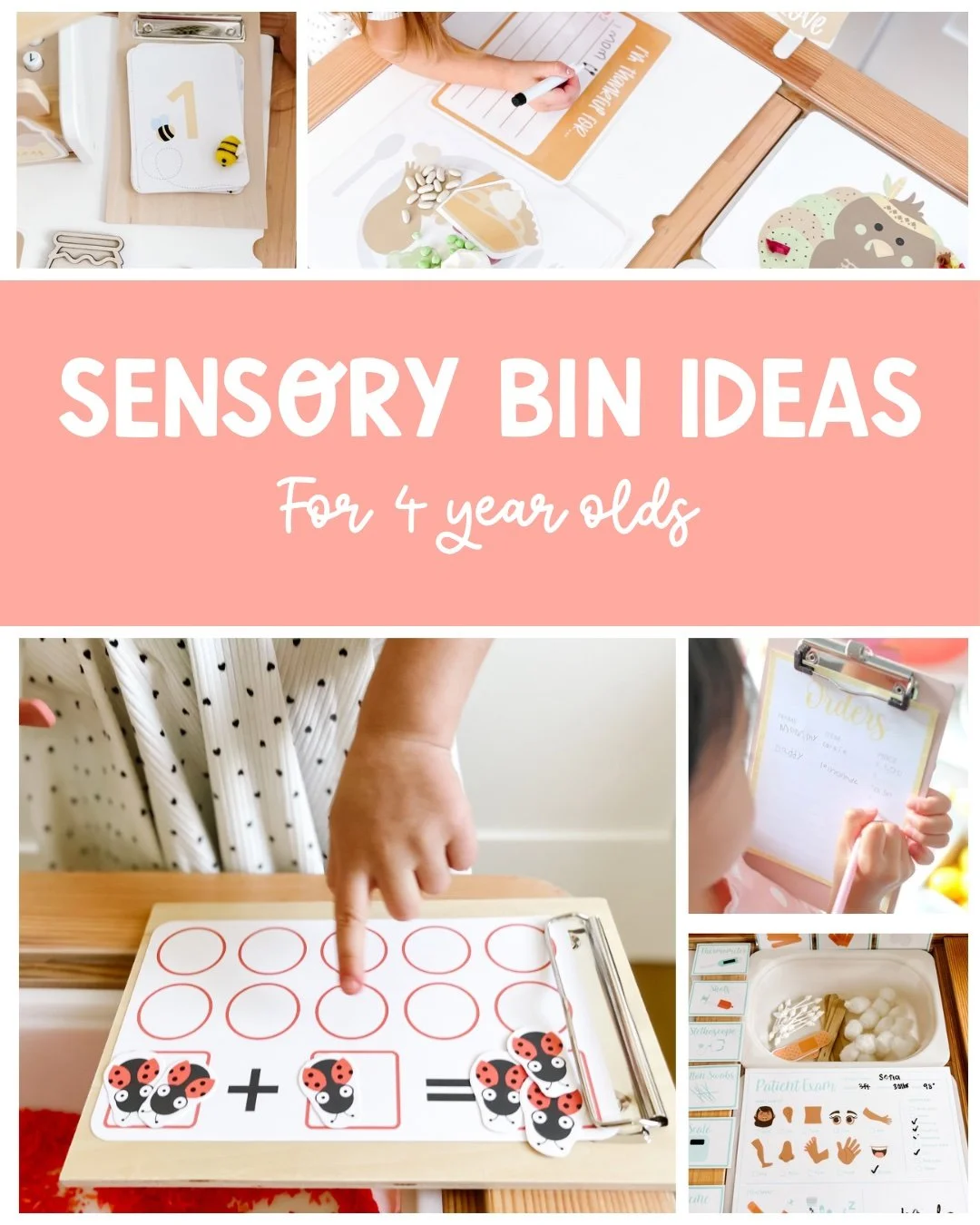
Sensory Bin Ideas for 4-Year-Olds: 9 Bins for Stories, Letters & Early Math
Four is when sensory bins grow up. At two, the whole game was scooping and dumping — and that was enough. At three, sorting and counting showed up. At four, something bigger arrives: your child starts inventing the game themselves. They give the animals names, they argue about who gets to be the shopkeeper, they want to know what happens next in the story. When my daughter was four, our bins stopped being something I set up for her and became something we built together — a shop with prices, a map with clues, a garden with rows that had to be planted just so. These 9 sensory bin ideas for 4-year-olds are built for exactly this age: longer attention spans, stronger hands, a real interest in letters and numbers, handwriting sneaking into the play, and pretend play that runs for half an hour instead of five minutes.
What changes at four — and how the bins change with it
A bin that works at four looks different from one that worked at three, and the differences are all good news:
- Stories replace scenes. Four-year-olds don't just arrange the animals — they decide what the animals are doing, what went wrong, and how it gets fixed. Give them a beginning and they will invent the middle and the end.
- Letters become toys. At four, letters stop being abstract shapes and start being something to hunt for, collect, and spell with — especially the letters of their own name. Our Letter of the Week series grew out of exactly this stage.
- Math gets a job. Counting to 10, simple prices, "one more" and "how many left" — at four, numbers finally have something to do, and a shop bin gives them a reason to count that isn't a worksheet.
- Writing becomes part of the game. Order pads, exam forms, menus, thankful cards — at four, writing stops being a separate lesson and starts being something the game needs. A shopkeeper writes the order because the cook needs to read it. A doctor fills in the exam form because that's what doctors do. The writing is real because the job is real.
- Tools get finer. Droppers, tweezers, and tongs are genuinely fun at four instead of frustrating — and they quietly build the same hand strength that cutting practice builds. (Our scissor skills post covers the cutting side of that same hand-strength story.)
- Play gets cooperative. Four-year-olds can finally play a bin game with someone — one sorts while the other delivers, one hides while the other hunts. Jobs and turns are the whole game now.
- Setups get multi-step. Follow the recipe card, plant the rows, then water them. Four-year-olds can hold a three-step plan in their heads, and bins are a perfect place to practice it — because the steps are fun, not chores.
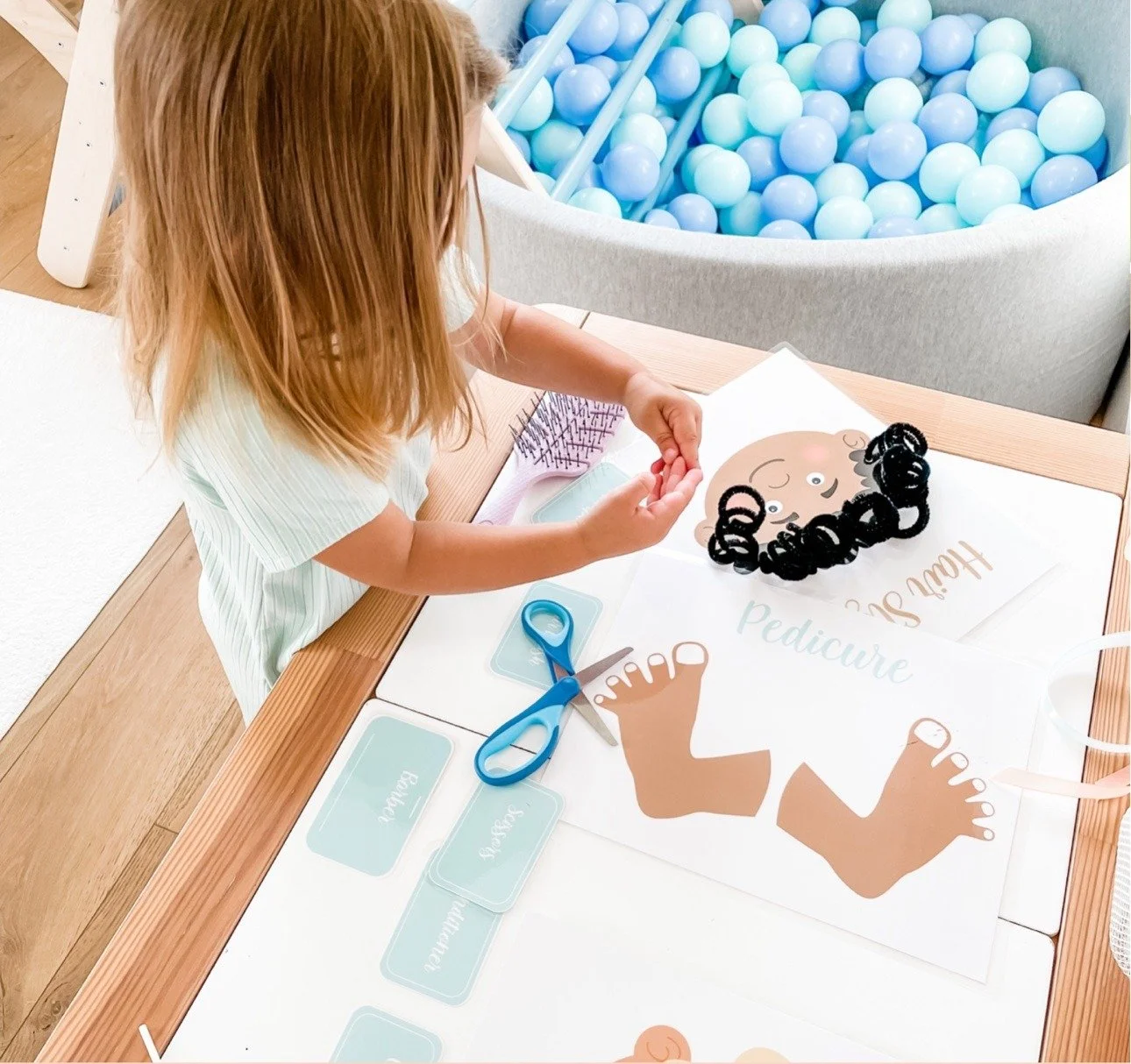
The salon is where the fine-motor work hides best: trimming paper hair, cutting toenails off a pedicure card, brushing and styling — all scissor and hand practice that feels like playing shop.
One thing that does not change: stay nearby. Four-year-olds mouth less, but small pieces still deserve a grown-up in the room, and the best stories still happen when you are sitting right there listening to them unfold.
9 sensory bin ideas for 4-year-olds
1. The letter hunt bin
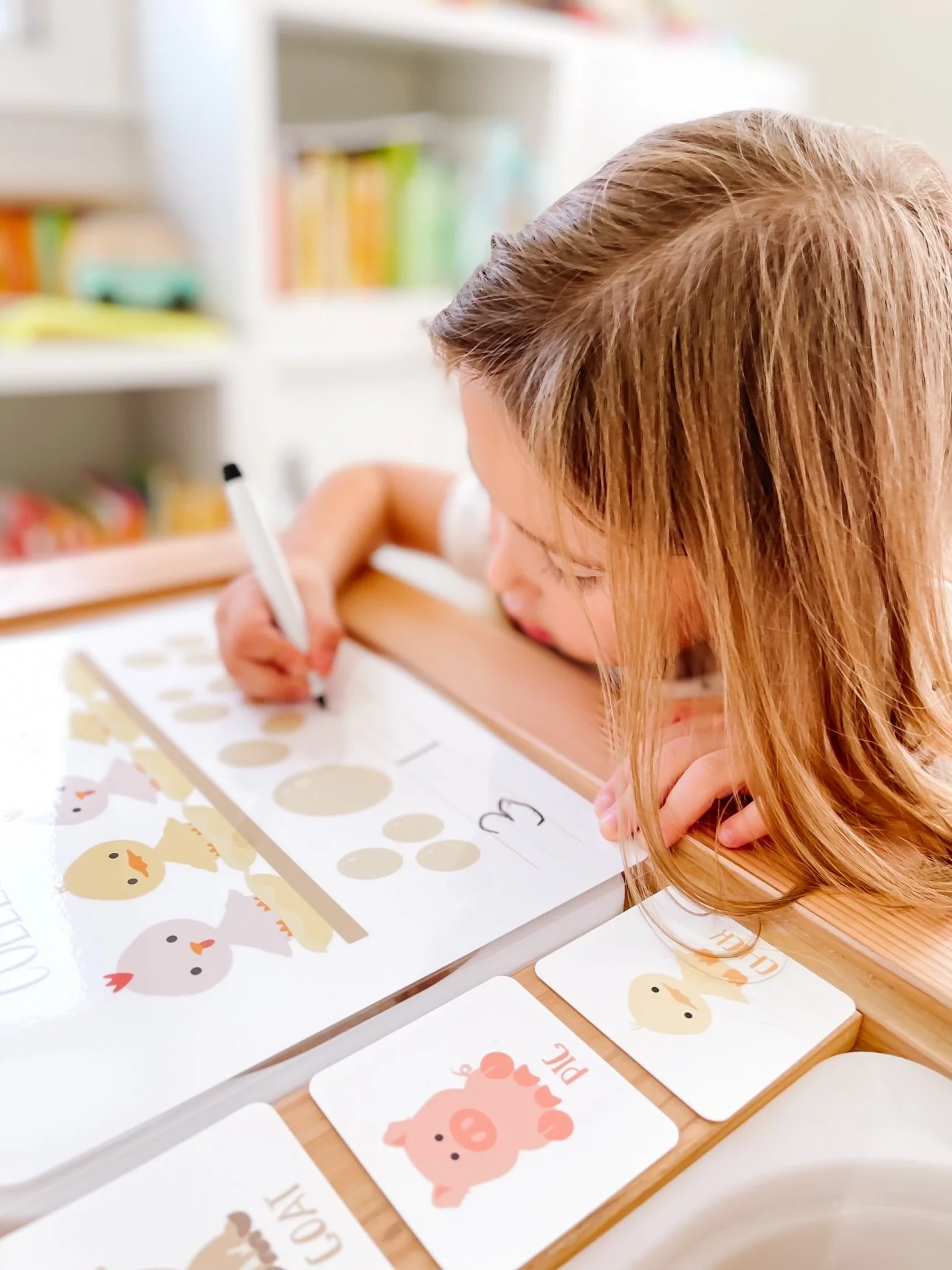
Setup: A base of dried rice or lentils, a set of farm animal word cards (PIG, CHICK, GOAT…), a few small animal figures to match them to, and a write-and-wipe board with a marker. Hide the word cards in the filler. The first game: dig out a card, read the word, find the matching animal. The next game: write the word — or count the eggs and write the number — on the board.
Why it works for 4s: At four, letters are personal — the letters of their name are the most exciting letters in the world, and a bin turns letter recognition into a treasure hunt instead of a lesson. The farm version adds the missing piece: the writing. When my daughter was four, the letter hunt was the first bin game she asked for by name, and the first one where she kept score herself: every letter found went into its cup with a little announcement, like a newscaster reporting breaking news. Writing the number next to three eggs is counting and handwriting in the same move — and because the board wipes clean, a wobbly 3 is just a reason to try again.
Make it last: When name letters get easy, hide a whole short word and let your child dig it out in order. Or flip it: you hide, they hunt, then they hide and you hunt — and the hiding is half the game.
Letter of the Week 26 Week Bundle — $26
If the letter hunt takes hold, our Letter of the Week bundle gives you 26 weeks of letter play in one set — one printable kit per letter, A through Z, for just $26.
2. The number shop bin
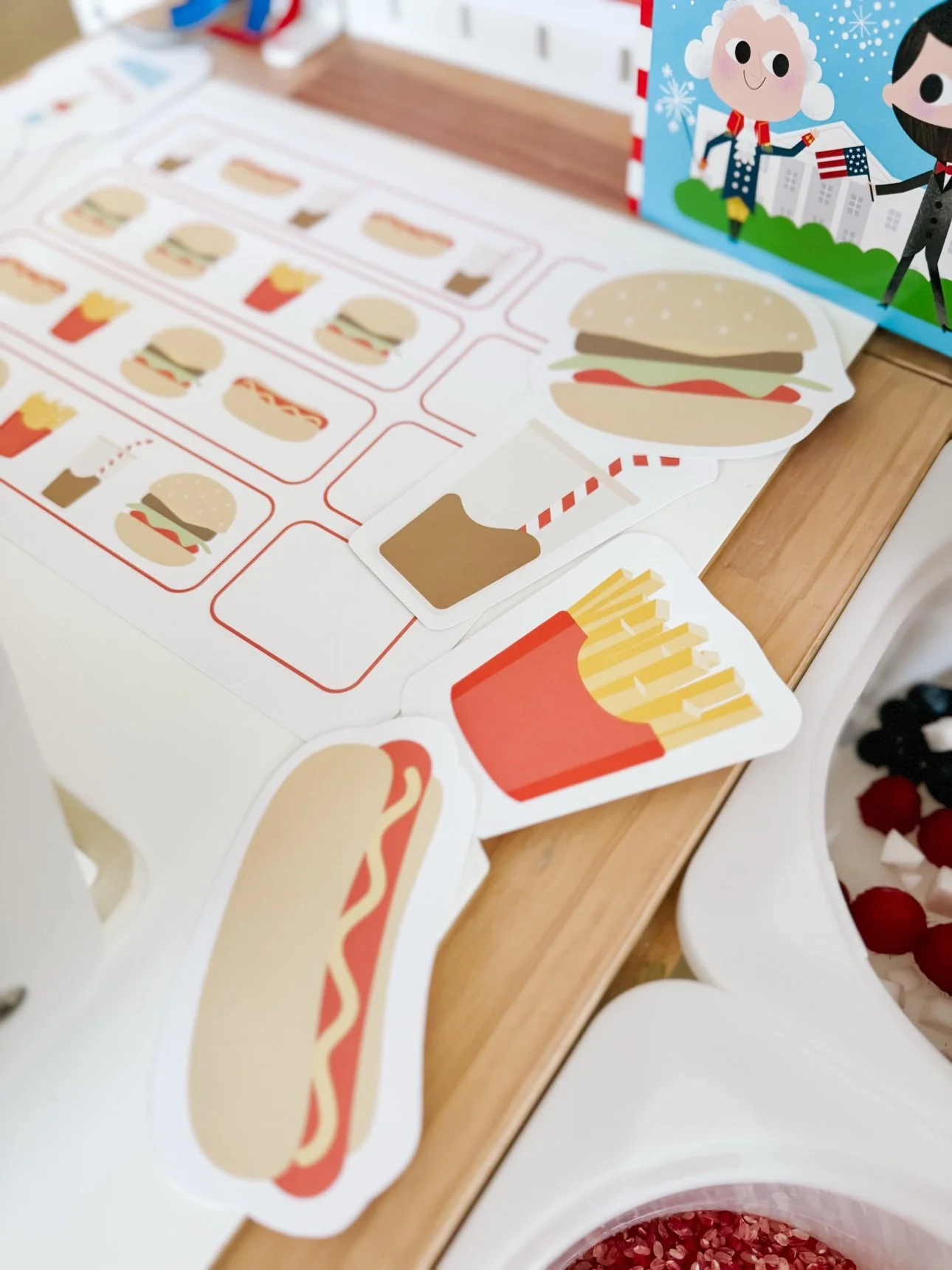
Setup: A base of dried beans or large pasta, a set of burger shop order cards (each one shows a combo — burger, fries, hot dog, drink), large food cut-outs to fill the orders with, play coins or paper money, and little price tags. The game: a customer orders from the card, your child fills the tray, counts out the coins, and takes the next order.
Why it works for 4s: Four is when counting stops being a song and starts being a tool, and a shop is the perfect excuse to use it. Counting out five coins for a toy apple is real math with a real reason, and the shopkeeper role is pure pretend play. The order card is what makes it a four-year-old game instead of a three-year-old one: your child has to read the card, match the items, and check the tray — three steps, in order, because the customer is waiting. When my daughter was little, counting worked best tucked inside play she already loved — scooping beans into a cup while we counted together out loud — and our teaching your toddler to count post has more of these play-first counting ideas. At four, the shop adds the missing piece: a reason to count correctly, because the customer is waiting.
And when the shop is running smoothly, the math gets bigger: a ladybug addition board — two ladybugs plus one more — turns the same counting into adding, with counters to move and a sum to solve.
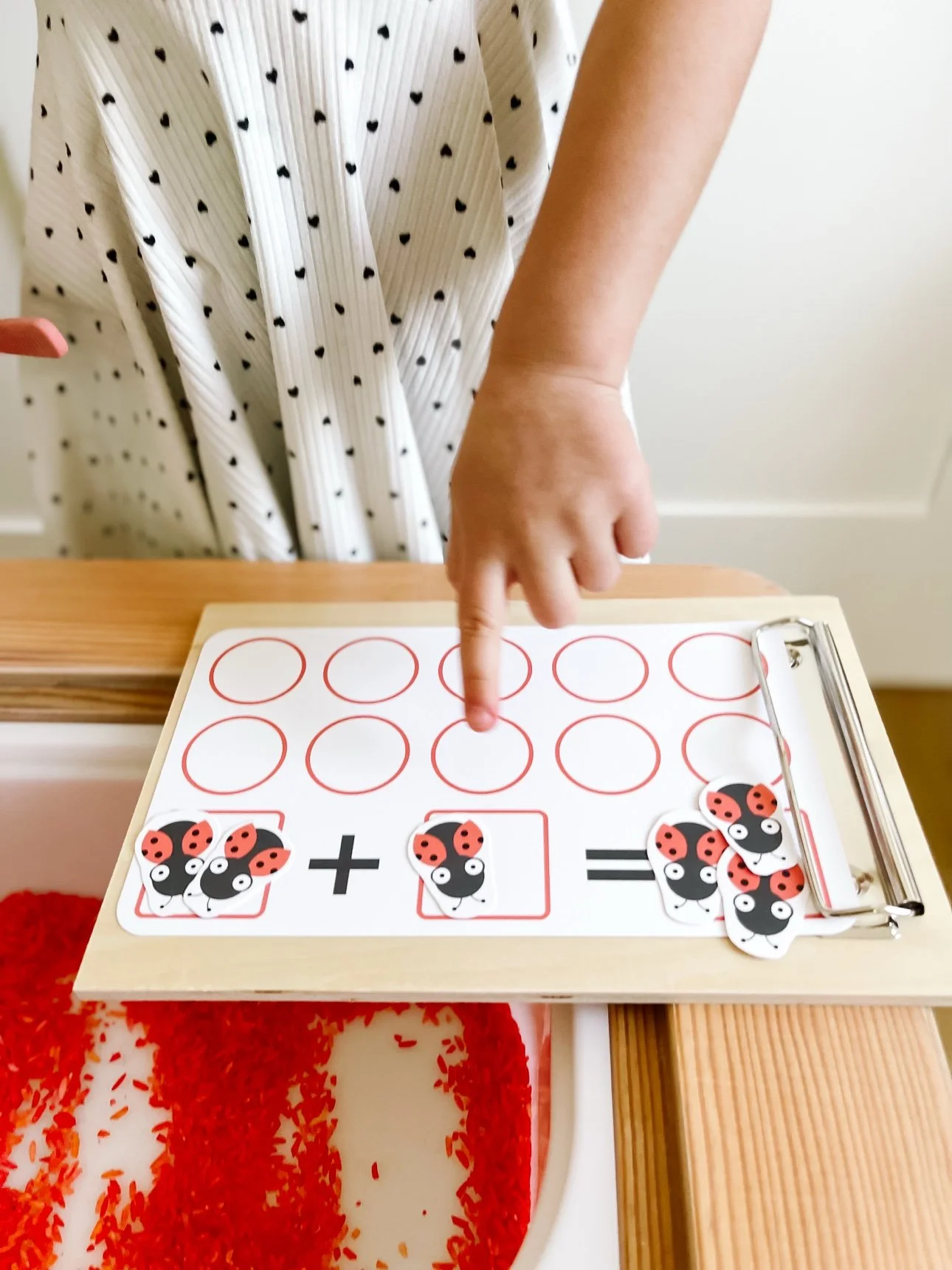
Make it last: Add "one more" problems once the prices are easy: "You have 3 coins and the apple costs 5 — how many more do you need?" Or swap roles and let your child be the customer who checks your counting.
Counting Sensory Kit — $15
Our Counting Sensory Kit pairs the counting game with ready-to-play pieces — the objects, the cups, and the counting cards in one kit, so the shop is set up in two minutes.
3. The story starter bin
Setup: A small-world scene in a bin or tray — a unicorn castle backdrop, cotton-ball clouds, star wands, a rainbow, and a few unicorn and rainbow scene cards — plus 3–4 story prompt cards (a piece of paper that says "A unicorn finds a key…" or "It starts to rain…"). Your child builds the scene, draws a card, and tells what happens next.
Why it works for 4s: Four-year-olds are natural storytellers, but an empty page is intimidating and a blank bin is not. The scene gives them characters, the card gives them a beginning, and the rest pours out. When my daughter was four, the story bin was where her longest play happened — twenty, thirty minutes of one continuous tale, with plot twists I genuinely did not see coming. Our small world play ideas guide has more scenes to build from when this one runs dry.
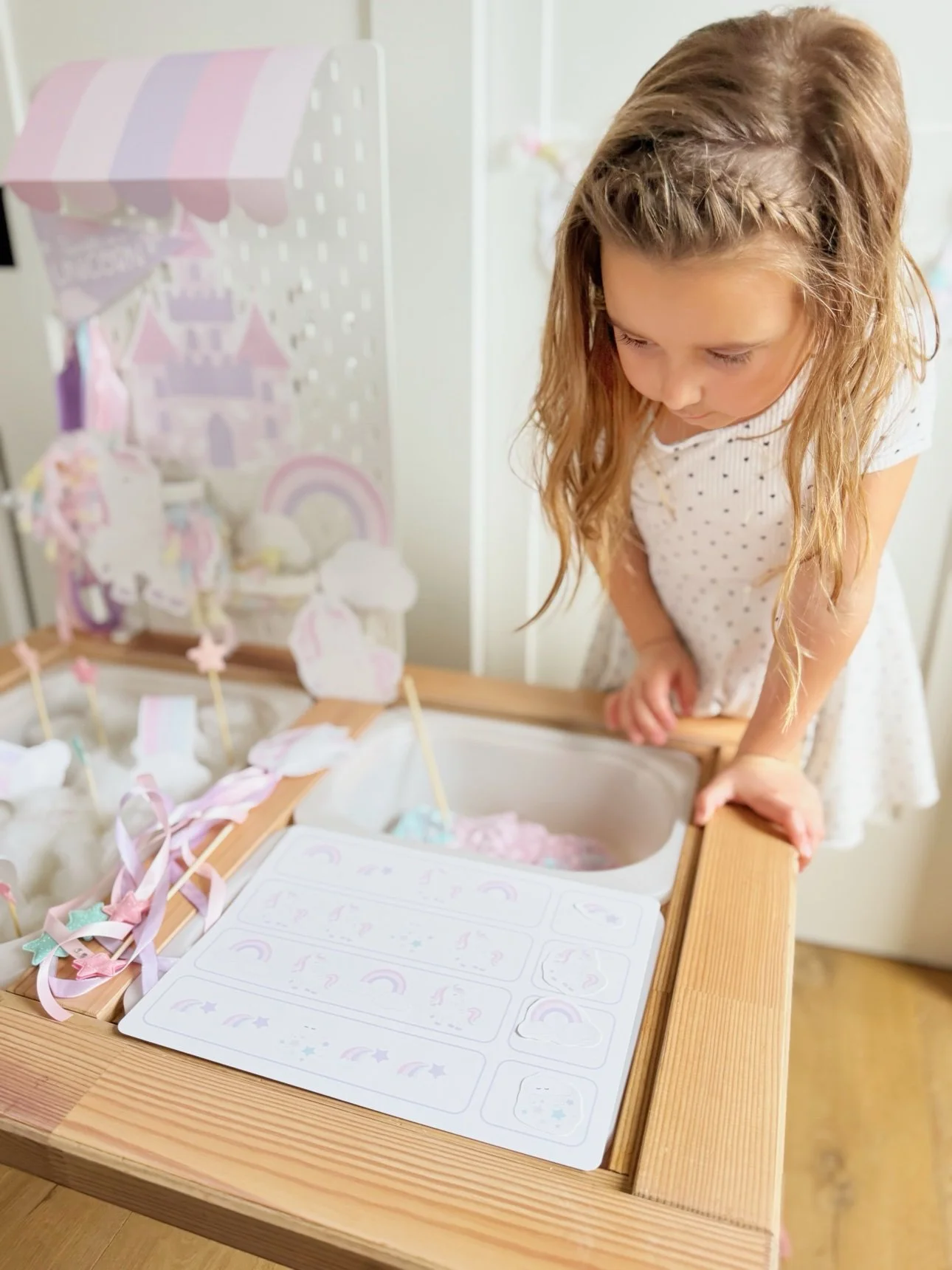
Make it last: Write down the story as your child tells it, then read it back at bedtime. Hearing their own tale read aloud is the moment storytelling clicks as something they made — and they will want to make another one tomorrow.
4. The color lab bin
Setup: A shallow bin with an inch or two of water, a few clear cups, droppers, and food coloring (or liquid watercolors). The game: predict, then mix. What happens when yellow meets blue? What does red + white make? A little mixing chart (a piece of paper with two color dots and an arrow) turns guesses into experiments.
Why it works for 4s: Droppers are the star tool of four — squeezing, aiming, and releasing one drop at a time is exactly the right difficulty, and it builds the same finger strength as cutting and writing. The color mixing is the hook: four-year-olds love a surprise they caused themselves, and green appearing from yellow and blue never gets old. Stay nearby (water + food coloring), and put an old shirt or apron on — the lab coats are part of the fun.
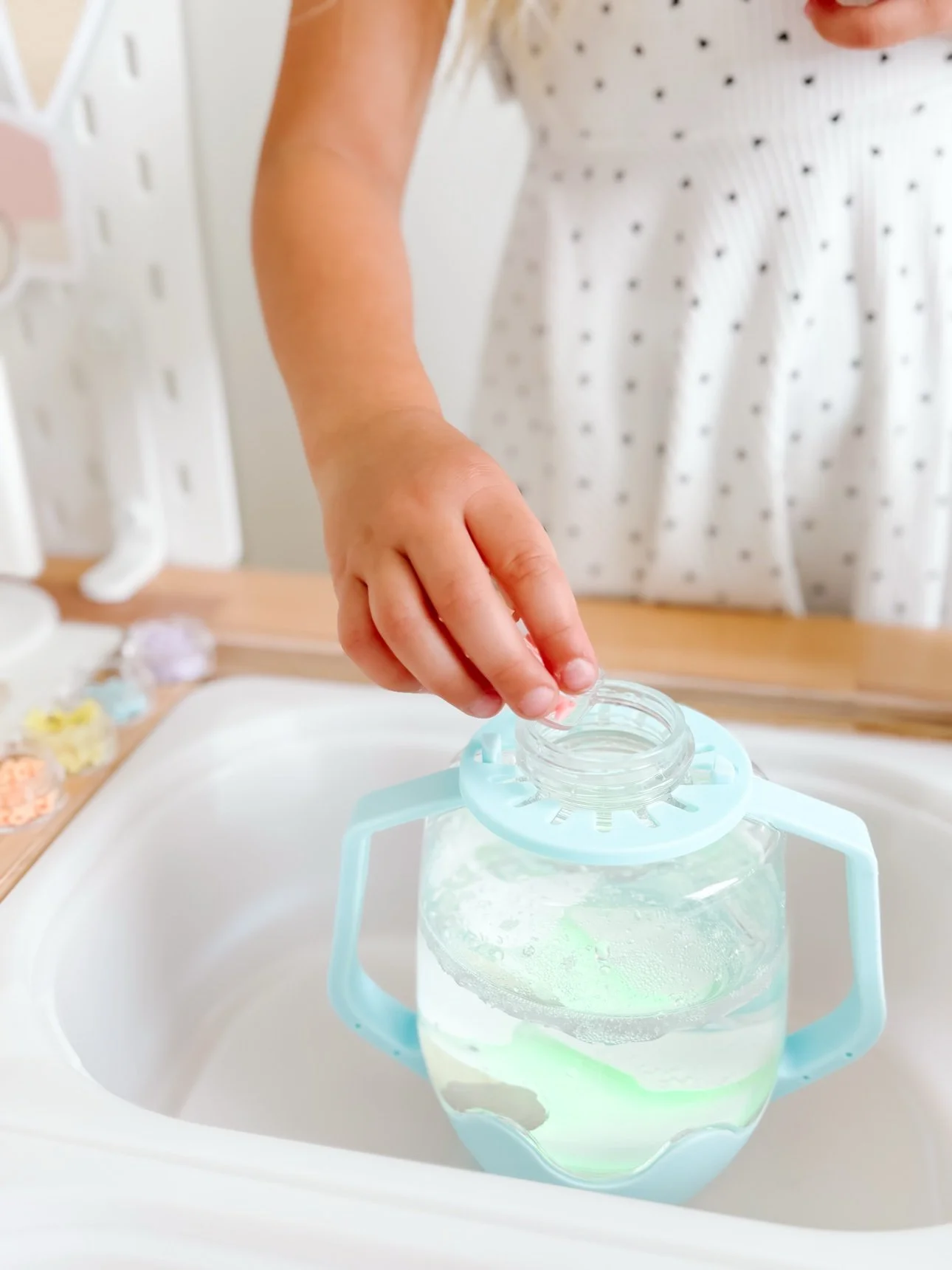
Make it last: When the basic mixes get easy, add a "recipe" card: "2 drops yellow + 1 drop blue = ?" Following a recipe turns the lab into a multi-step game, which is exactly the skill four-year-olds are ready to practice.
5. The construction crew bin
Setup: Kinetic sand in a bin or tray, a few small trucks or diggers, some wooden blocks, and a "blueprint" card (a simple drawing of a road and a bridge). The job: build what the blueprint shows — a road for the trucks, a bridge over the "river" (a strip of blue paper), a tower that doesn't fall down.
Why it works for 4s: Four-year-olds love a job with a plan, and construction play is the rare bin game where the plan is the play. Following a blueprint means holding a picture in your head while your hands do something else — a genuinely tricky skill that feels like pure fun when trucks are involved. When my daughter was four, the construction bin was the one she played cooperatively: one child drove the truck, the other built the bridge, and the negotiations about where the road should go were the best language practice of the week.

Make it last: Swap the blueprint weekly — a taller tower, a longer bridge, a garage for all the trucks. Or add a "delivery" job: the truck has to carry five blocks across the bridge without dropping one.
6. The doctor's office bin
Setup: A Patient Exam form (write-and-wipe, so it can be filled in again and again), body-part and symptom checklists, treatment choices, a set of doctor word cards (Thermometer, Stethoscope, Bandages, Cotton Balls…), and a bin of cotton balls, tongue depressors, cotton swabs, and bandages. The game: the patient arrives — check what hurts, check the symptoms, pick the treatment, sign the form.
Why it works for 4s: The exam form is a multi-step game in disguise: read the checklist, find the matching part, mark the box, choose the treatment — four steps, in order, because that's how a check-up works. The word cards turn doctor vocabulary into something to sort and match, and the bin of supplies is a sorting game on its own (cotton balls here, bandages there). When my daughter was four, the doctor's office was the bin where the writing finally clicked: the form needed filling in, so she filled it in — name, height, temperature, and a signature at the bottom, like a real doctor.
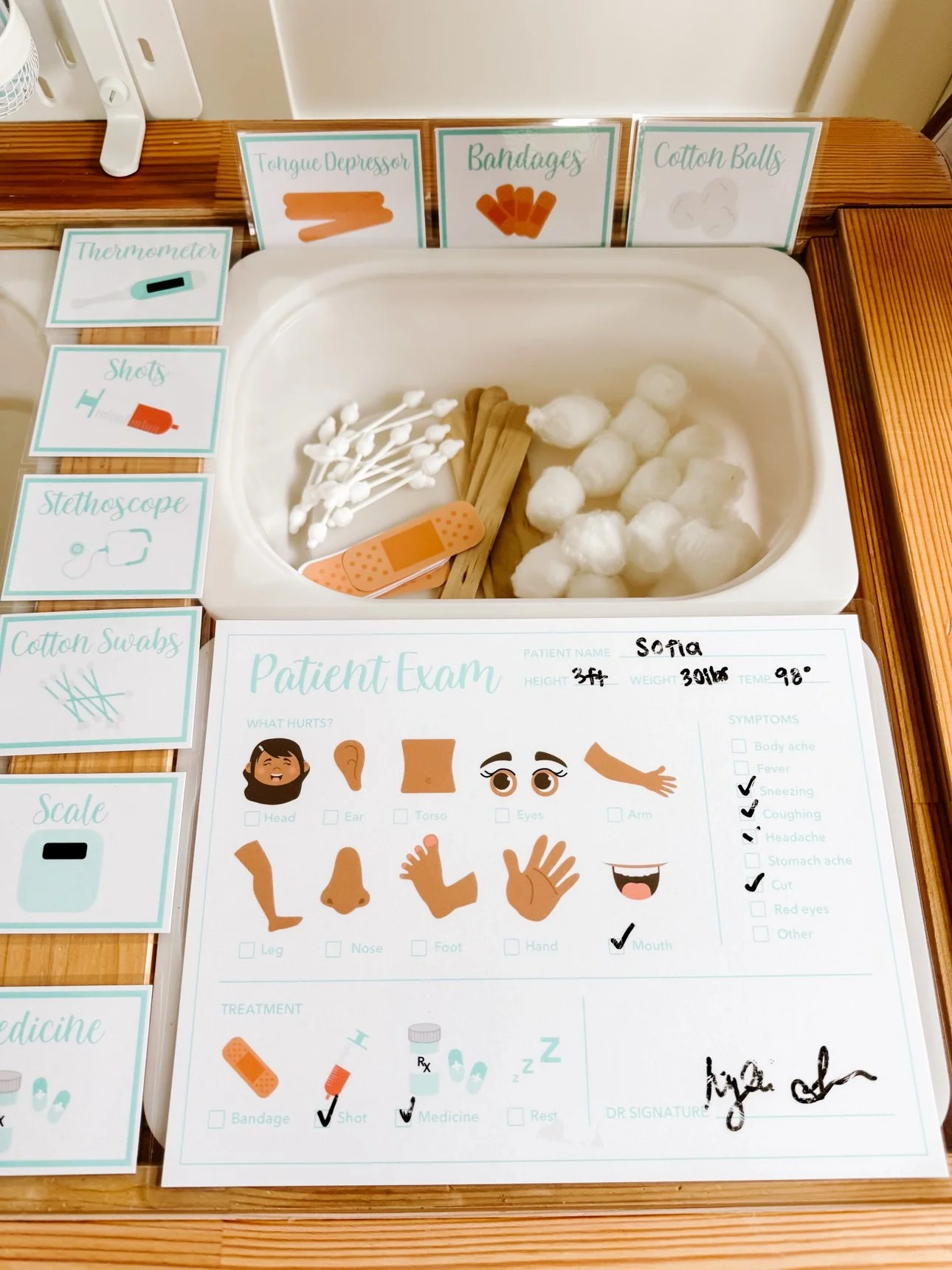
Make it last: Let your child be the patient next, or write a new exam form for a stuffed animal. A teddy with a sore ear and a cough needs the full check-up — and the form needs a whole new set of boxes checked.
7. The lemonade stand bin
Setup: An Orders clipboard (NAME / ITEM / PRICE columns), play money, a few cups, a pitcher, and some lemons. The game: take the order, write it down, count the money, deliver the drink. One child takes orders while the other pours, then swap — and the clipboard is the record of who ordered what.
Why it works for 4s: The lemonade stand is cooperative play in its purest form: it only works if both players do their job, and four-year-olds are finally ready to enjoy that. The order pad is the writing warm-up — names, items, and prices, all in a four-year-old's handwriting, because the stand needs a record. And the prices make the counting real: a cookie is $1.00, a lemonade is $0.50, and the customer is waiting for their change. If you have a younger sibling in the house, this is also the rare bin game where a two-year-old can "help" by carrying cups while the four-year-old does the writing — our 2-year-old bin guide has more on bins that work across ages.
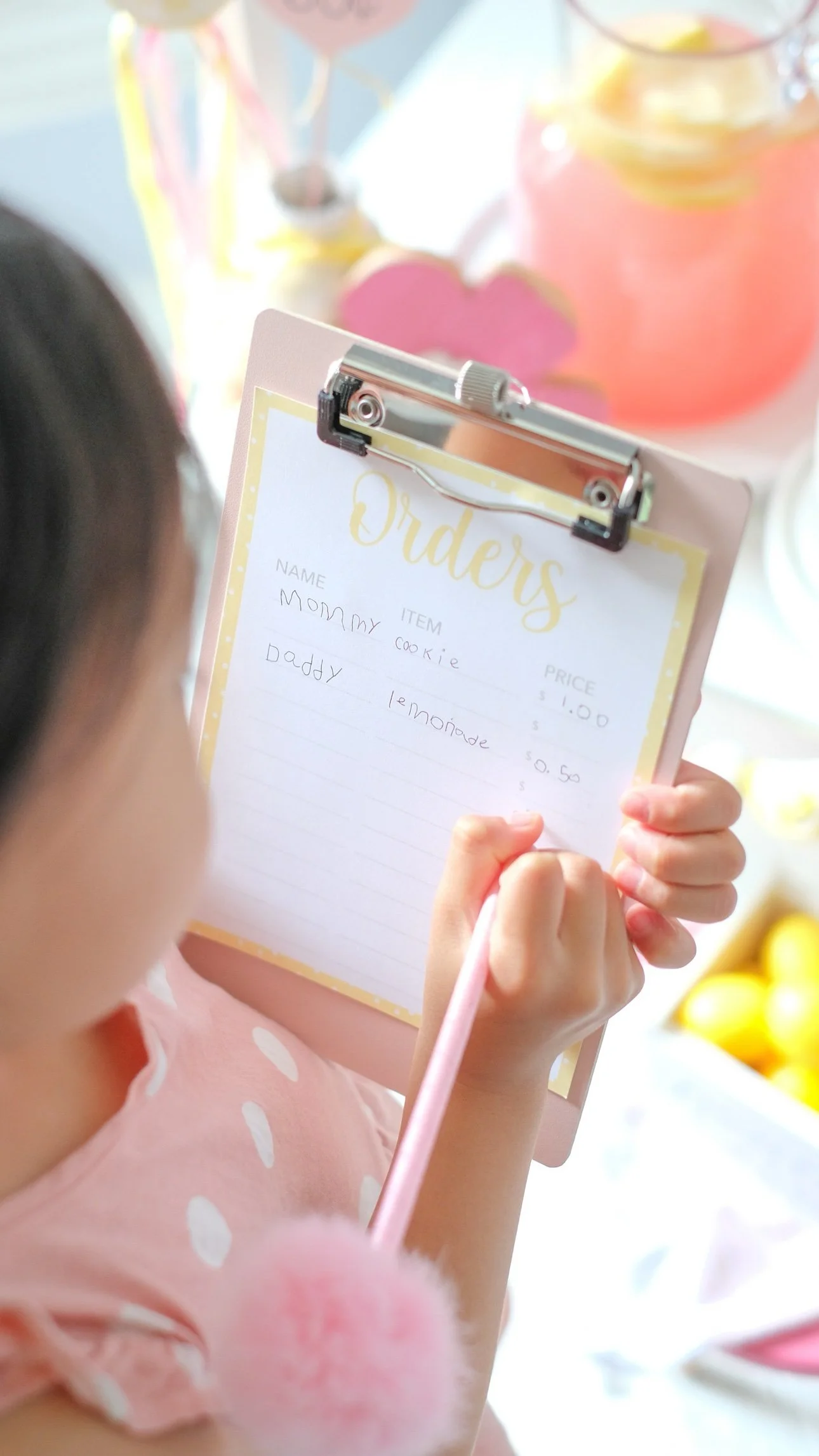
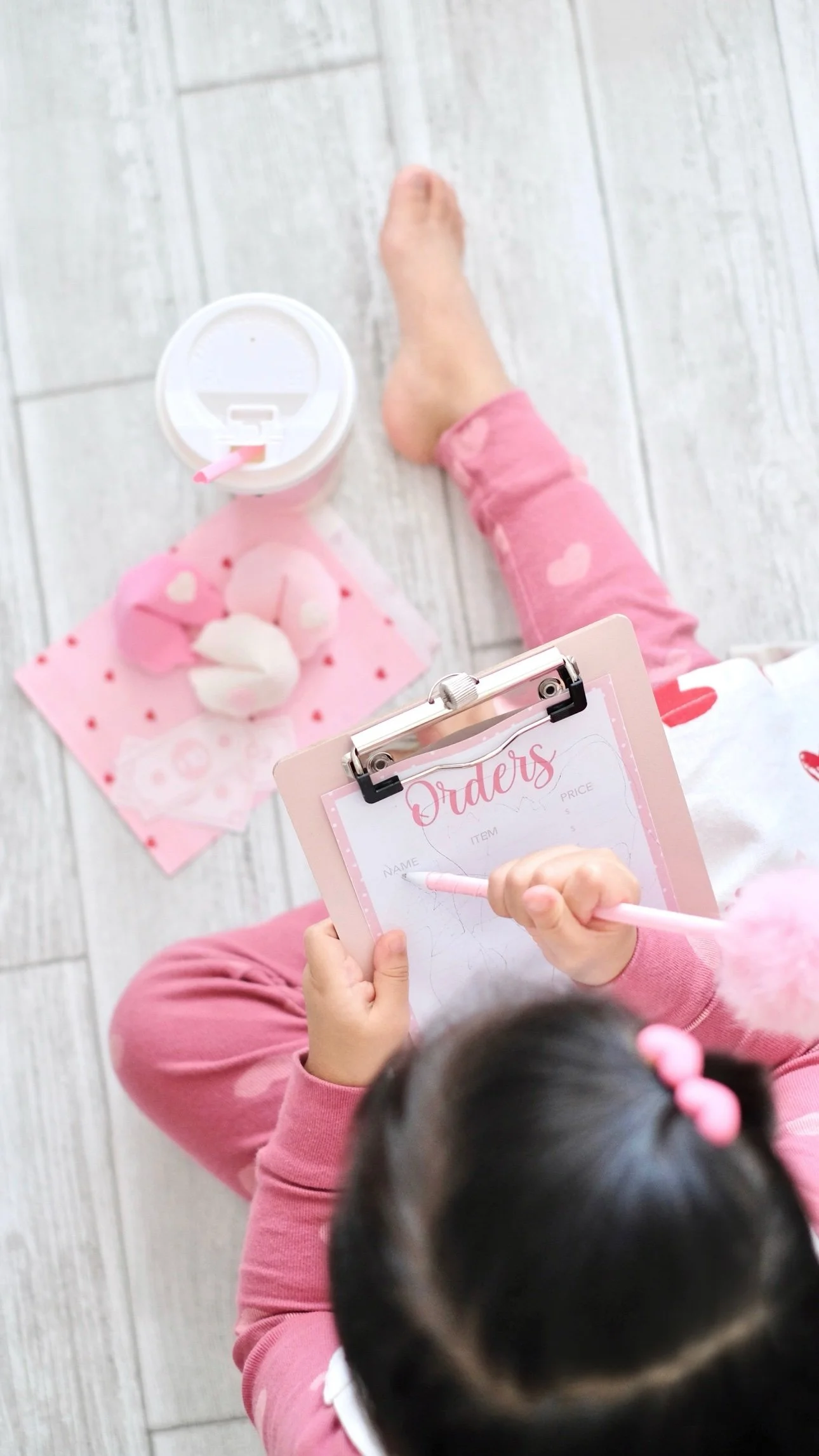
Make it last: Add a daily special — "today's special is lemonade + cookie for $1.50" — or let your child write the menu. Real names on real orders is the moment the game becomes personal.
8. The pie shop bin
Setup: A pie menu on the wall (Apple, Pecan, Pumpkin, Blackberry, Strawberry), an "I'm thankful for…" write-and-wipe card, a play plate with a pie slice and sides, a turkey craft board, and a bin of fall tissue-paper squares. The game: read the menu, take the pie order, write it down, serve the slice — then fill in the thankful card.
Why it works for 4s: The pie shop is the number shop's seasonal cousin, but the writing is the star here: the menu has to be read, the order has to be written, and the thankful card is a sentence your child actually wants to finish. Following a recipe card to "bake" the pie adds the multi-step layer — first the crust, then the filling, then the slice on the plate. When my daughter was four, the pie shop was our November bin: the menu changed with the season, the orders got longer, and the thankful card was the first piece of writing she ever asked to keep.
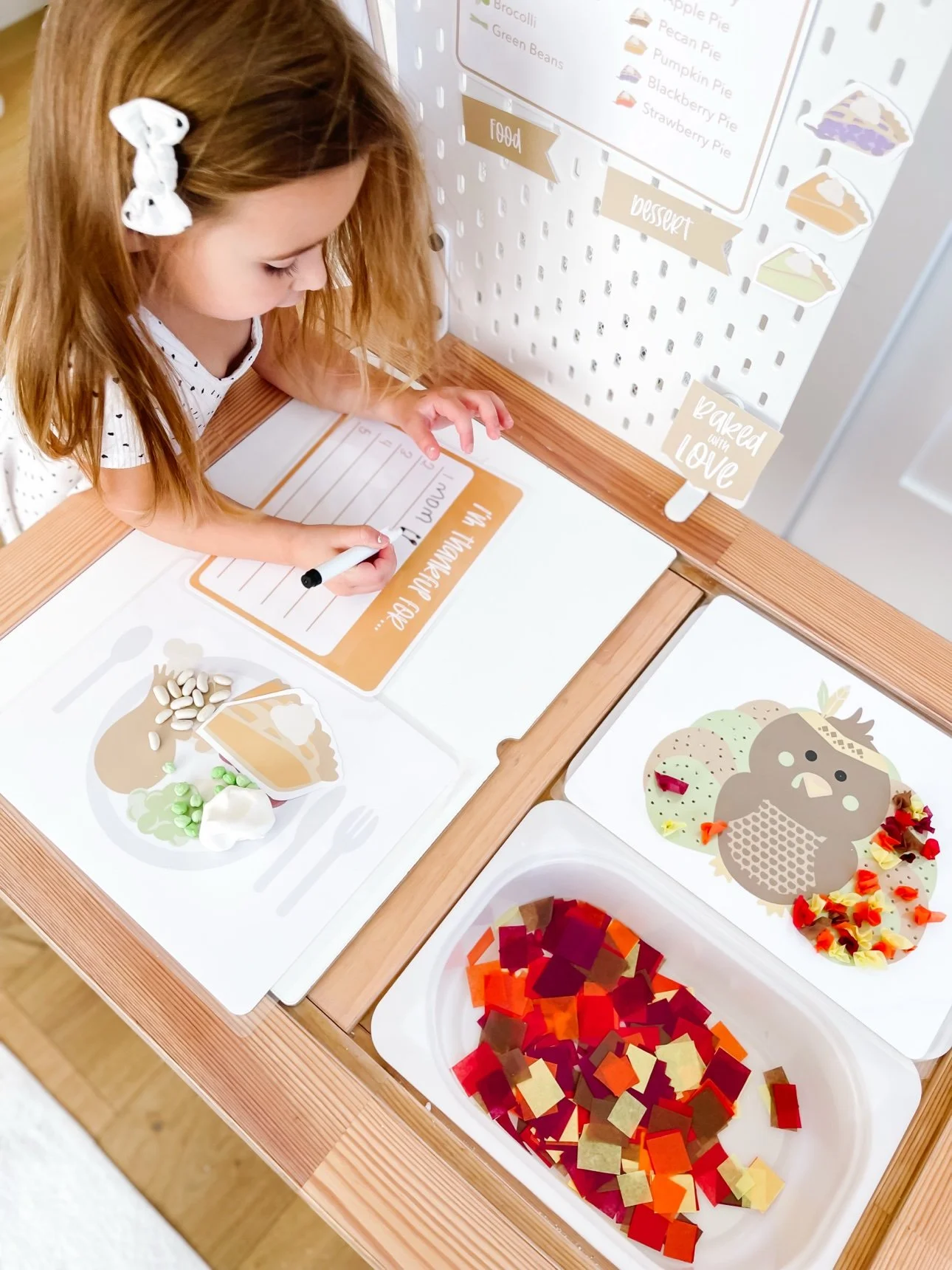
Make it last: Change the menu with the season — pumpkin pie in fall, strawberry in spring — or let your child invent a new pie flavor and add it to the board. A menu your child wrote is a menu they'll want to cook from.
Pie Making Sensory Kit — $32
If the shop and pretend play take hold (they did in our house), our Pie Making Sensory Kit gathers a whole pie-shop game into one ready-to-go kit — no prop hunt, no filler-dyeing.
Free: Winter Pie Recipe Cards
Want a ready-made multi-step bin game? Our free Winter Pie Recipe Cards turn the shop and bakery bins into a follow-the-recipe game — free to download from Sprout.
9. The garden rows bin
Setup: A base of brown rice or cocoa-tinted rice as "soil," a set of pom-pom "flowers" or small silk flowers, a few pebbles, and a dropper or tiny watering can. The game: plant the flowers in rows, count the seeds as you go, then water each row — and tomorrow, "harvest" them and plant again.
Why it works for 4s: Gardening is a multi-step game with a visible result, and four-year-olds love both halves: the careful planting (rows! counting! spacing!) and the payoff of a finished garden. The dropper watering is the fine-motor star here — one squeeze at a time, row by row — and the replanting means the same bin reinvents itself daily without a single new prop.
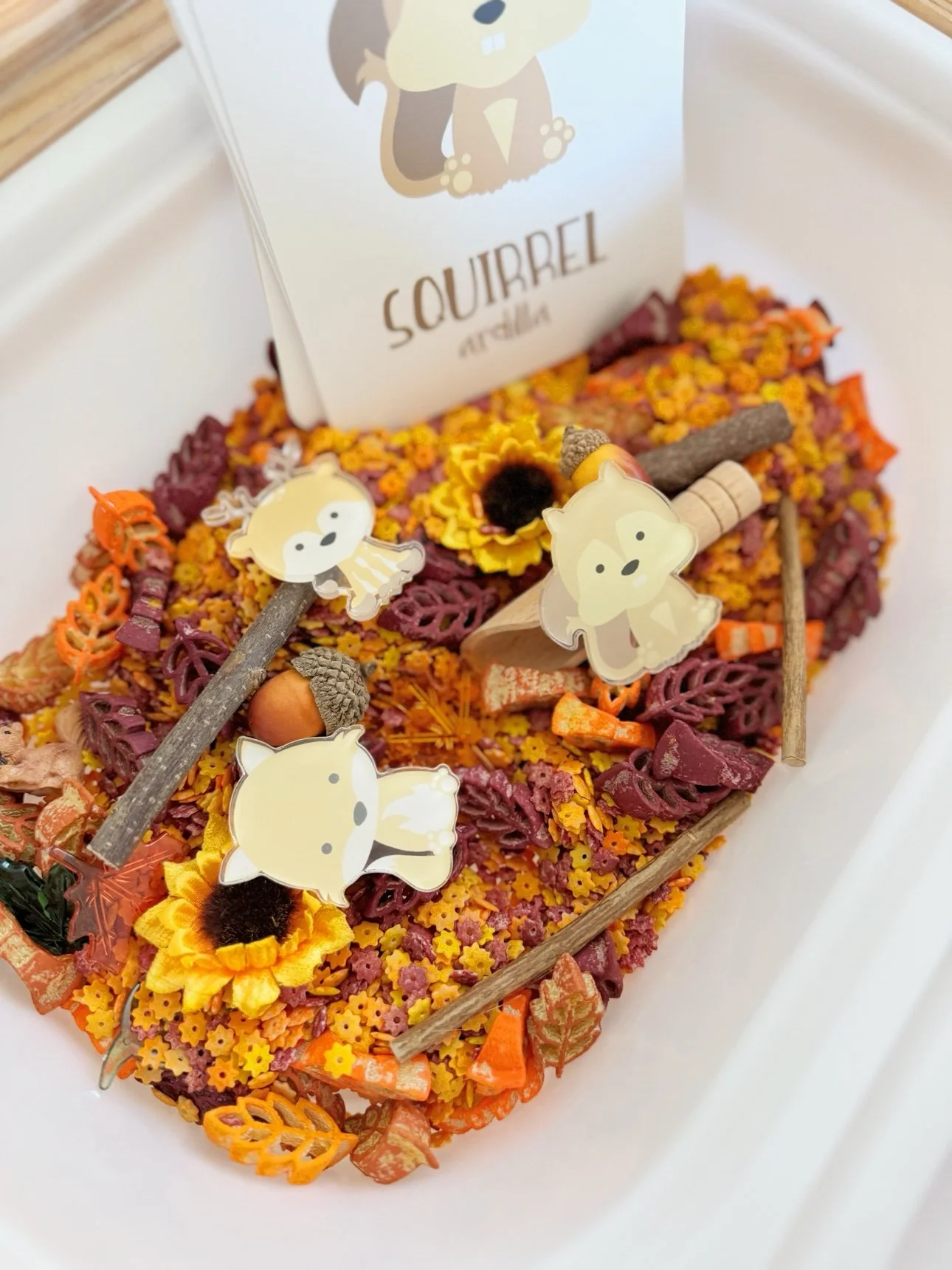
Make it last: Add a planting chart: three red flowers, two yellow, one purple. Following the chart turns planting into a counting and color game, and the chart can get harder as the gardener does.
How to run bins at four
Four-year-olds can handle more structure than two- and three-year-olds could — but the rule is still the same: fewer bins out, longer play. Keep two bins out at a time (one familiar favorite, one new challenge), and swap the new one weekly. Give the play jobs: one child sorts while the other delivers, one hides while the other hunts, one reads the recipe while the other measures. Jobs are what stretch twenty minutes into forty at this age — and they are also what make cleanup work: the shopkeeper puts the coins away, the gardener waters the rows one last time, the doctor files the exam forms, and the lemonade stand closes for the day.
And if a bin day falls apart — the map gets ignored, the shop becomes a dumping ground, the garden is planted upside down — that day still worked. At four, the mess is still part of the play, and the game you planned is never better than the game your child invented instead. Pour it back together, put the tray underneath, and let them go again tomorrow.
Free: Winter Printable Play Mats
Pair any bin on this list with our free Winter Printable Play Mats — sorting trays and counting mats that give the shop, the garden, and the doctor's office somewhere to go.
Sensory bins for 4-year-olds FAQ
How long will a 4-year-old play with a sensory bin?
Twenty to forty minutes is realistic at four — especially for story, shop, and doctor games, which have their own built-in reasons to keep going. If the play winds down sooner, that is normal too. A bin that gets played with for fifteen focused minutes beats a bin that sits untouched for a week.
Are small pieces safe for 4-year-olds?
Four-year-olds mouth far less than toddlers, but small pieces still need supervision. Keep beads, buttons, and small coins out of unsupervised play, stay in the room, and retire anything that could fit through a toilet-paper tube. Droppers and food coloring need an apron and a towel underneath — stains are part of the lab.
What if my 4-year-old just dumps everything?
Then the bin still worked. Dumping is sensory play, not failed sorting — and at four, dumping is often the start of a game, not the end of one. Offer the job once ("can you find all the red ones?"), and if they go back to dumping, let them. The structured game shows up on its own timeline, usually right after you stop pushing for it.
How do I keep sensory bins from taking over my house?
One bin, one tray, one job — and a rule that the bin lives on the tray. Fillers in zip bags, props in one basket, and a five-minute tidy at the end where your four-year-old is the shopkeeper closing up, the gardener watering one last time, or the lemonade stand closing for the day.
Can I reuse bin fillers?
Yes — dried lentils, rice, chickpeas, and pasta all store in zip bags and last for months. Toss anything that gets wet (except ice, obviously) or starts to smell, and refresh with a new bag of filler when the color or texture fades. Dyed rice and pasta keep their color for months if they stay dry.
Four is a wonderful age for sensory bins: the hands are stronger, the stories are longer, and the play finally has rules your child invents themselves. Start with the letter hunt or the number shop — the two bins where the new four-year-old skills show up fastest — and let the story scenes, the color lab, and the doctor's office follow. The bins will grow with them, one invented game at a time.