
Early Math Sensory Bins: 8 Ways to Teach Math Through Play
You don't need a worksheet to teach a toddler math — you need a bin, a scoop, and ten minutes. A sensory bin is already a math classroom in disguise: sorting pom-poms by color, counting scoops into a cup, pouring water from a jug to a bowl — that's real math, done with their hands. When my daughter was little, the counting didn't happen at a table with flashcards. It happened at the bin, mid-play — feeding the cows three scoops and the pigs two. These are the eight moves that turned our bins into math lessons without ever feeling like lessons.
Why a sensory bin is a natural math classroom
Math for a toddler isn't numbers on a page — it's amounts you can hold, compare, and move around. A sensory bin gives a child all of that at once: a pile of things to sort, count, pour, and share out, in a space where nothing is wrong and everything can be tried again. A worksheet asks a child to point at the bigger group. A bin asks them to make the bigger group, one scoop at a time.
It also works because the math hides inside play a toddler already wants to do. Sorting is a game, pouring is a game, and counting out loud while you scoop is just part of the game — nobody has to sit still or get the right answer. When my daughter was little, the bins that taught her the most math were the ones where I said the least. I set up the materials and counted out loud while I played beside her. The bin did the teaching. I just kept the lentils in the tray.

A quick note, the way I'd say it to a friend: stay nearby for every setup here, and size the pieces up for younger players — everything large, nothing small enough to be mouthed whole, and never use water beads. Supervise water play closely, in the tub or outside. If you want the full rundown on every filler before you choose one, our ultimate guide to sensory filler materials covers them all. For the counting side in more depth, our guide to teaching a toddler to count pairs with it perfectly.
You don't need eight bins. You need one bin and eight ways to play in it. Every move below works in the same bin of lentils, oats, or pom-poms — change the props, not the filler, and the same setup teaches a different kind of math every day of the week.
8 early math sensory bin ideas
1. Sort by color and size — the first math game
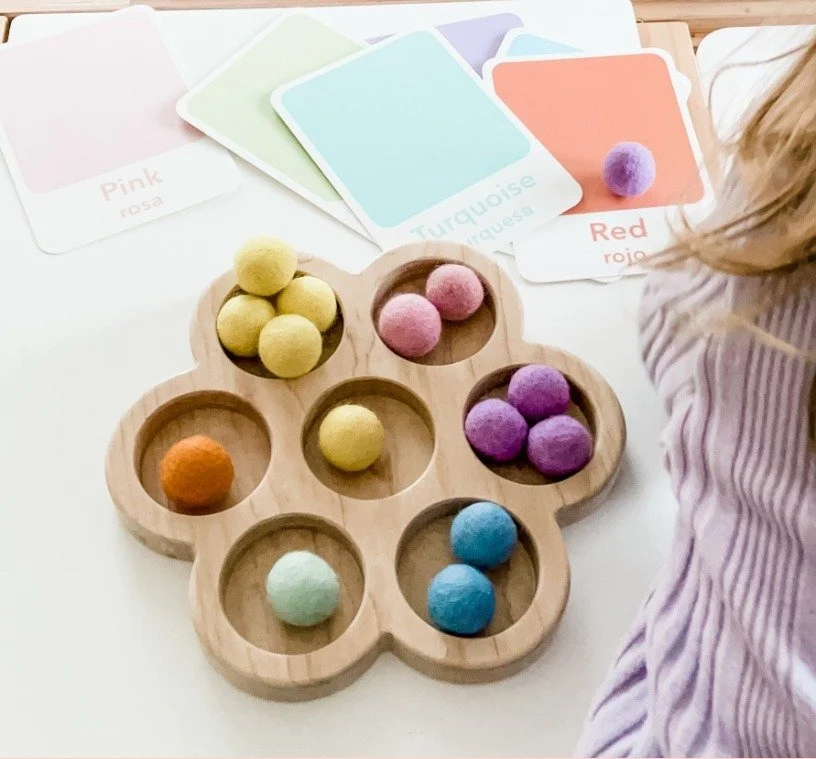
The bin: a dry filler (lentils, oats, or pom-poms) plus a mixed pile of objects in two or three colors, and a muffin tin, an egg carton, or a divided tray to sort into. Felt balls in three colors are the classic version — big, soft, and easy to grab — but colored pasta or pom-poms in a few sizes all work. Put the mixed pile in the bin and the empty tray beside it.
What it gives little hands a chance to practice: sorting — deciding that things belong together because they match. A toddler sorting red felt balls from blue ones is doing the same thinking that later groups numbers, shapes, and sets. Size sorting adds a second layer: big pom-poms in one cup, little ones in another.
How to extend it: start with two colors and two cups — red and blue is plenty for a two-year-old. When that gets easy, add a third color, then sort by size inside each color: big reds, little reds. Then add a rule that turns sorting into counting: "three red balls in the red cup." Lay color cards beside the tray and the sorting becomes matching, too.
Free: Winter Printable Play Mats
Give the sorting somewhere to go — our free Winter Printable Play Mats sit right in the bin and turn any filler on this list into a sorting and counting game.
2. Count objects onto cards — one-to-one counting, the hands-on way
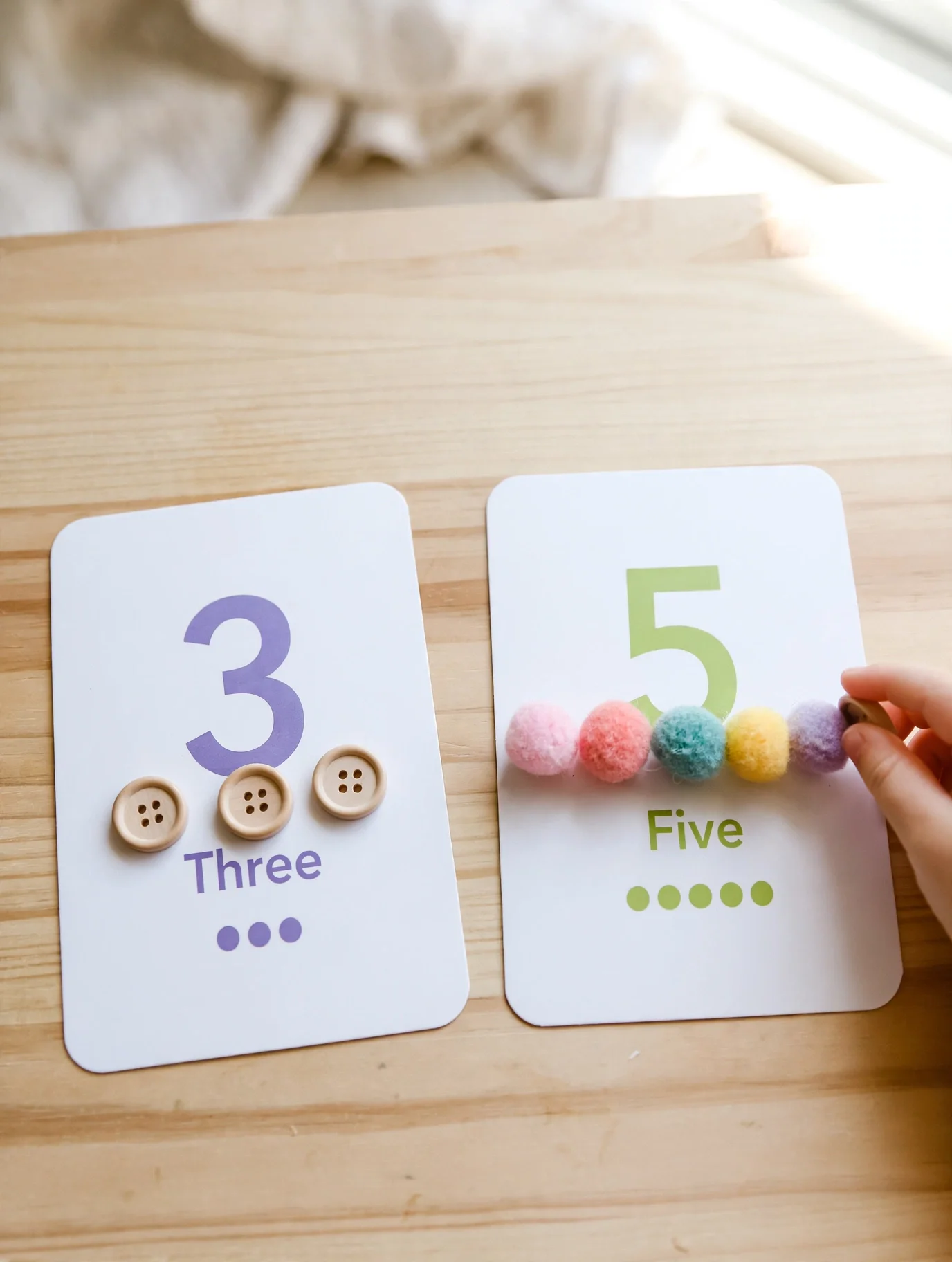
The bin: a dry filler plus a set of number cards and a pile of small counting objects — pom-poms, pasta shapes, or wooden pieces. Lay one card beside the bin at a time. The job is simple: put that many objects on the card. The card that says 3 gets three pom-poms. That's the whole game.
What it gives little hands a chance to practice: one-to-one counting — matching one spoken number to one object, which is the part of counting that trips toddlers up most. A child can recite "one, two, three" long before they can place exactly three objects on a card, and the bin is where the two skills meet. Placing each object one at a time slows the counting down to the speed the hands can follow.
How to extend it: start with cards 1 to 3, and count out loud together, touching each object as you say its number. When 1 to 3 is solid, add 4 and 5, then lay out two cards at once and ask which one has more. Swap the objects and the game feels new, but the counting stays the same. When the placing gets fast, add tongs or tweezers to place each object. Our sensory bin tools for toddlers has the full rundown on which tool fits which age.
Counting Sensory Kit — $15
When the counting game clicks, our Counting Sensory Kit gives it somewhere to go — number cards and counting objects for a count-and-match game.
Number Dot Cards — $10
Our Number Dot Cards pair with any bin on this list — match the dots to the numeral, then count the same number of objects onto the card.
3. AB patterns — red, blue, red, blue
The bin: a dry filler plus two colors of objects — red and blue pom-poms, or two colors of pasta — and a long, shallow tray or a strip of paper to lay the pattern on. Start the pattern yourself: red, blue, red, blue, and leave the next spot empty. The job is to finish it.
What it gives little hands a chance to practice: recognizing and continuing a pattern — the thinking underneath every sequence a child will meet later, from counting by twos to the days of the week. A pattern asks a child to look at what came before and guess what comes next, and guessing right feels like a magic trick the first few times.
How to extend it: start with AB — two colors, alternating, four or five objects long. When that's easy, stretch it to AAB or ABB, then to ABC with a third color. Then hand the pattern-making over: "you start one, and I'll finish it," then "make a pattern for me to finish." The day your toddler invents a pattern and asks you to complete it is the day the game has fully landed. If the pattern keeps falling apart, make it shorter — three objects that alternate is a win.
4. Measure and pour — volume, in a jug
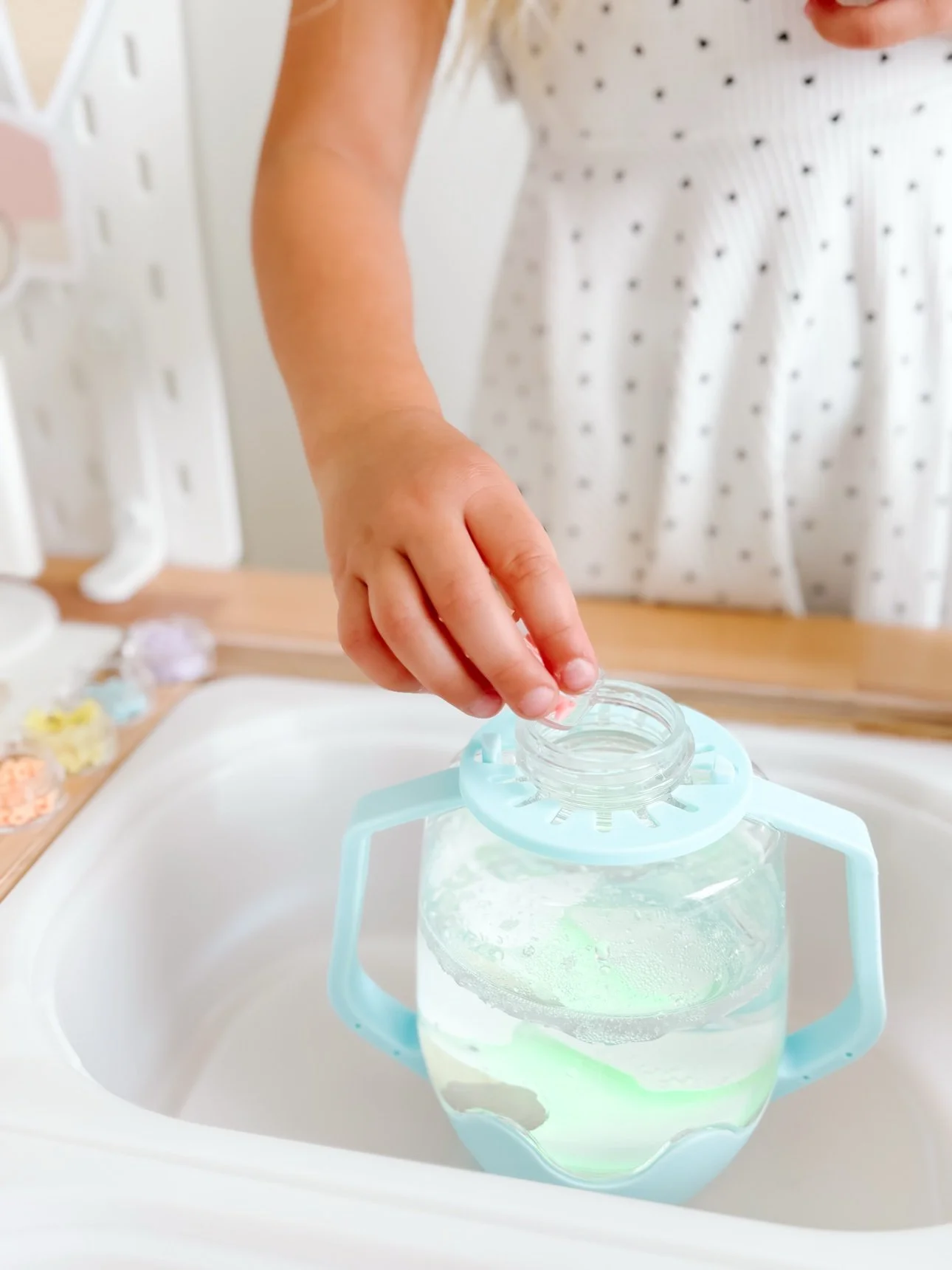
The bin: water (in the tub or outside) or a dry filler, plus a measuring jug, a measuring cup with markings, and two or three containers. The job is to fill, pour, and compare.
What it gives little hands a chance to practice: volume and capacity — full and empty, more and less, how much fits — learned in the hands, not from being told. A toddler pouring from a jug learns that a full jug is heavy and an empty one is light, and that a small cup fills faster than a big one. The measuring cup's markings turn the pouring into counting, too: fill to the 1 line, then the 2.
How to extend it: start with one jug and one container, half full — a full jug is too heavy to control, and a toddler who can't control the pour will stop pouring and start dumping. When the pour is steady, add a second container and ask which one holds more, then test it: fill the small one, pour it into the big one, and see how far it gets. Count the scoops out loud — "one scoop, two scoops, three" — and the pouring becomes a counting game. Then add a funnel and a narrow-necked bottle, which turns pouring into aiming. Our sensory bin tools for toddlers has the full rundown on pouring tools.
5. Compare more and less — two piles, one question
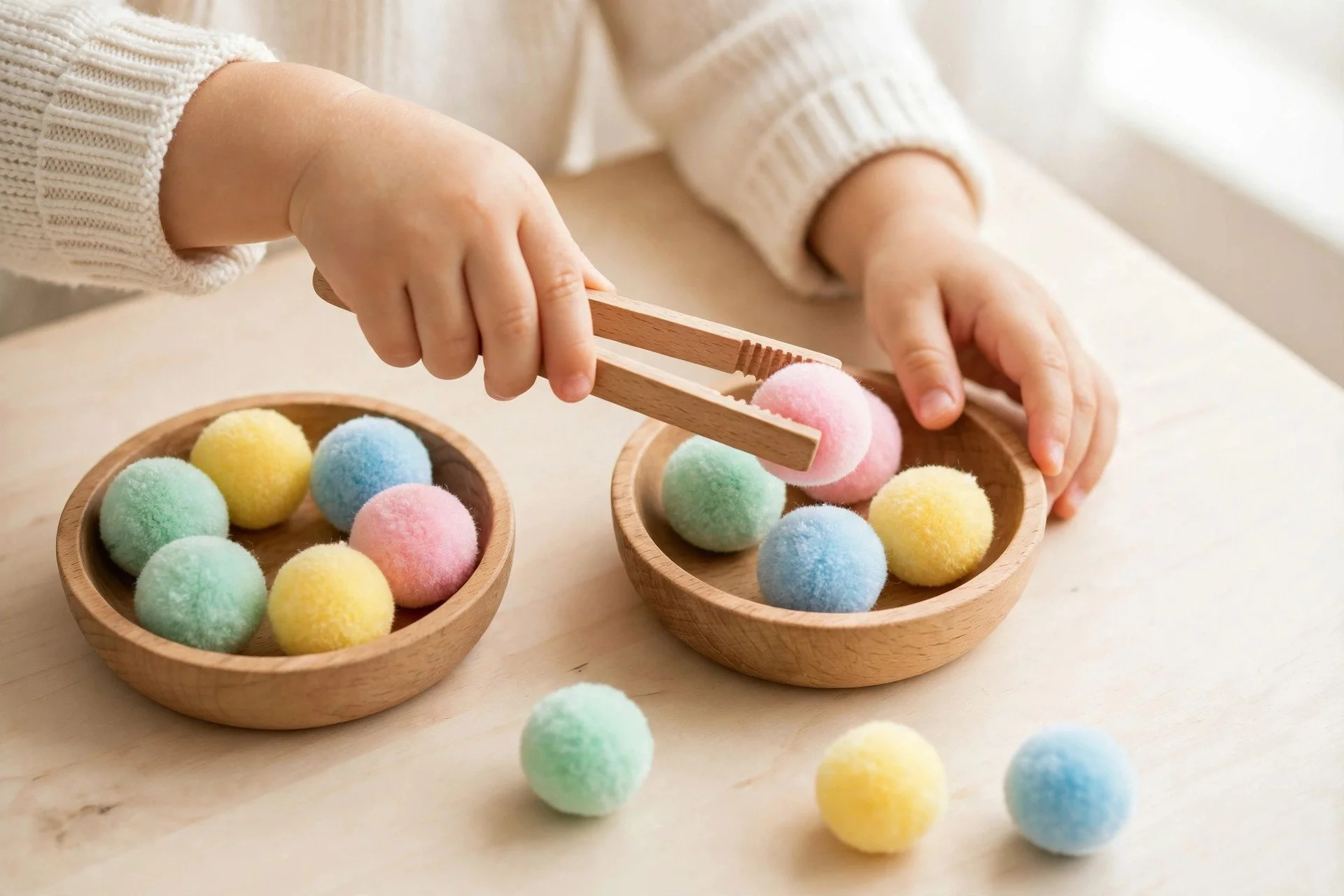
The bin: a dry filler plus two bowls and a scoop. Scoop a small pile into one bowl and a big pile into the other — or let your toddler do the scooping. Then ask the one question that runs this whole game: "which bowl has more?" Just look first — then count, and check whether the looking was right.
What it gives little hands a chance to practice: comparing amounts — the thinking underneath "more" and "less," "bigger" and "smaller." A toddler who can look at two piles and tell you which is bigger is doing real math, without a single numeral in sight. Moving a pile from one bowl to another, one scoop at a time, is also how a child learns that an amount stays the same amount even when it moves.
How to extend it: start with piles that are obviously different — two pom-poms in one bowl, ten in the other — so the answer is easy and the win is instant. Then make the piles closer — five and seven, then six and seven — until the looking isn't enough and the counting has to settle it. Then flip it: "can you make this bowl have less than that one?" and the child is subtracting, one scoop at a time, without anyone calling it that. Tongs make this game even better — moving pom-poms one by one is comparing at the slowest, clearest speed there is.
6. Number hunt — hide the numerals, find them, count them
The bin: a dry filler plus a set of number cards or wooden numerals, buried just under the surface. Hide the numerals 1 to 5 in the lentils or oats. The job is to dig them out, one at a time, and line them up in order on the tray. The hunt is the hook, and the lining-up is the math.
What it gives little hands a chance to practice: recognizing numerals and putting them in order — knowing that the squiggle called "3" comes after "2" and before "4." Digging for the cards adds the sensory part — the hands find what the eyes can't see — and lining them up turns a pile of found cards into a number line a child built themselves.
How to extend it: start with numerals 1 to 3, buried shallow, with the corners poking out so the first finds come fast. When the hunt gets easy, bury them deeper and add 4 and 5. Then add the counting step: find the 3 card, then count out three objects from the filler and lay them beside it. Then hide the cards and ask for them by number — "find the 4!" — which turns the hunt into a listening game, too. Our guide to teaching a toddler to count has more on how numeral recognition and counting grow together.
7. Shape sort — the bin becomes a shape tray
The bin: a dry filler plus chunky shape pieces — wooden circles, squares, and triangles, or shapes cut from foam — and a tray with matching shape outlines drawn or taped on it. The job is to dig a shape out of the filler, name it if you can, and put it on its matching outline. Circle on the circle, square on the square.
What it gives little hands a chance to practice: recognizing and matching shapes — sorting by a different rule, not by color or size, but by form. A toddler matching a wooden triangle to a triangle outline is learning that shapes stay the same shape even when they turn, flip, or hide in the lentils. It's also the move that teaches the language of math: circle, square, triangle, said out loud every time a piece lands.
How to extend it: start with two shapes — circle and square — with big, clear outlines on the tray. When those are easy, add the triangle, then the rectangle. Then hide the outline and sort by shape alone: all the circles in one cup, all the squares in another. Then count the shapes — "how many triangles did we find?" — and the shape game becomes a counting game. When the sorting is solid, build with the shapes: a house from a square and a triangle, a sun from a circle.
8. Simple shop math — pretend buying with play coins and cards
The bin: a playdough bakery or a pretend shop setup, plus play coins, paper price tags, and a small basket. Set out three or four "goods" — rolled playdough cookies, pom-pom "cupcakes," or the pieces from any bin on this list — and give each one a price: one coin, two coins, three coins. The job is to buy: hand over the coins, count them out, and take the cookie home. Then swap roles, and the toddler becomes the shopkeeper.
What it gives little hands a chance to practice: the earliest version of money math — counting out a price, handing over the right number of coins, and working out whether you have enough. A three-year-old counting out two coins for a cookie is doing the same thinking as a child counting objects onto a card, but now the counting has a purpose a toddler actually cares about: the cookie. It also practices the sequence of a transaction — choose, pay, receive.
How to extend it: start with prices of one and two coins, and one kind of coin, so the counting stays simple. When that's easy, add a three-coin item and ask "do you have enough?" — hand over a pile of coins and let the child count out the price and see what's left. Then add the shopkeeper's job: the child takes the coins and counts them into a bowl. When my daughter was little, the bakery game ran for a whole afternoon — roll the dough, cut the cookies, decorate them, price them, and serve them to a row of stuffed animals who always, always paid in full.

Free: Winter Pie Recipe Cards
If the bakery game takes hold, our free Winter Pie recipe cards walk you through a done-for-you winter pie setup, step by step.
One bin, three ages
You don't need a different bin for every age — you need the same bin, played three different ways:
- Age 2 — explore and sort. The game is the filler itself: scooping, pouring, dumping, and sorting into two cups. Count out loud while you play beside them — "one scoop, two scoops." If you're just starting out, our free Toddler Starter Kit has the first setups to try.
- Age 3 — count and match. Add the number cards and counting objects from move 2, the two-bowl comparing game from move 5, and the AB patterns from move 3. The child is ready for a goal now — "put three on the card," "which bowl has more?"
- Age 4 — play the bigger games. The number hunt from move 6, the shape sort from move 7, and the shop from move 8 all belong here, with our sensory bin ideas for 4-year-olds for the bigger storylines and our Christmas sensory bin ideas for the seasonal version. A four-year-old can run a whole shop and invent their own rules.
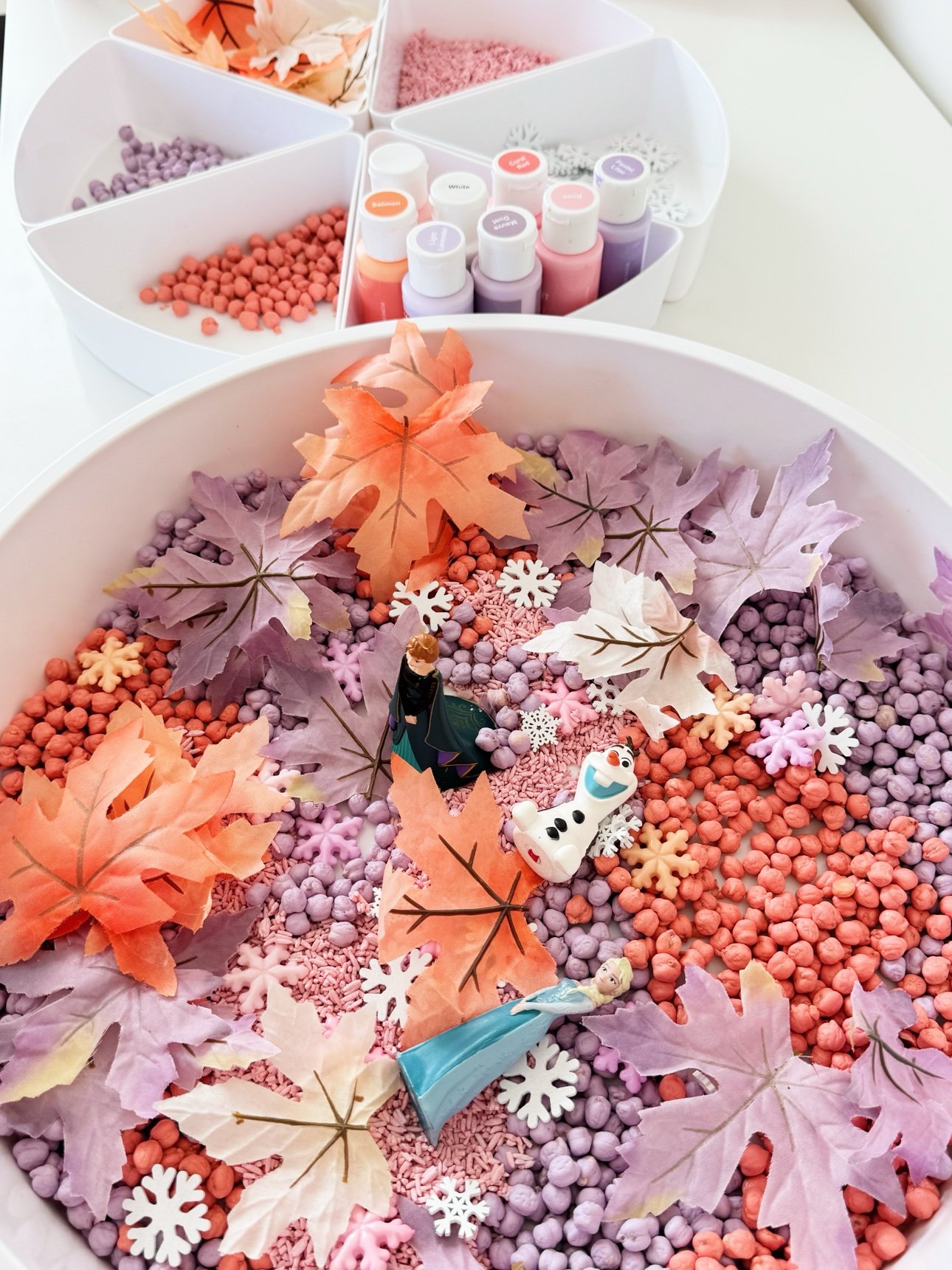
Our winter FLISAT guide has the cold-weather version, for the months when the play moves indoors.
Keep it playful — the rule that matters most
Here's the thing I learned the slow way: the moment a sensory bin stops feeling like play, a toddler stops playing in it. The counting, the sorting, the patterns — they all work because they're hidden inside a game a child chose. The day the game becomes a lesson, the bin gets dumped and abandoned, and the math goes with it.
So keep it light. Count out loud, but don't correct the count — just count again, together, touching each object. Ask "which bowl has more?" and accept the wrong guess with a smile, then count it out to check. Let the pattern be wrong sometimes — a red where a blue should be is a pattern, too, just a different one, and the child who made it is proud of it. The bin is a place to try things, not a place to be tested.
Start with one move this week — sorting, counting onto cards, or the shop — and let it run for a few days before you add the next one. When it gets boring, swap the objects and the game feels new. And when the bin gets dumped on the floor for the third time in a morning, remember: dumping is the play, too. Scoop it back in, and start again.
Early math sensory bins FAQ
What age can toddlers start learning math in a sensory bin?
From age 2, with sorting and scooping — two colors into two cups, counting scoops out loud. Number cards and one-to-one counting fit best around age 3, and the shop game and number hunt land around age 4.
Do I need special materials for math sensory bins?
No — a dry filler from the pantry (lentils, oats, pom-poms), a muffin tin or divided tray, and a set of number cards are enough for all eight moves. Tongs, measuring cups, and play coins add variety. The math is in the sorting, counting, and comparing.
How do I teach counting with a sensory bin?
Put a number card beside the bin and count that many objects onto it, touching each one as you say its number. Start with cards 1 to 3 and add higher cards when the small ones are solid. Our guide to teaching a toddler to count covers the whole sequence in more depth.
What if my toddler just dumps the bin instead of sorting?
Dumping is the play at first, not a problem with it — a two-year-old dumps because dumping is the most interesting thing a bin can do. Keep the filler shallow (two or three cups), give one tool at a time, and put the bin on a tray so the dumping stays contained. The sorting game arrives when the dumping gets boring.
How do I keep math play from feeling like a lesson?
Hide the math inside a game the child chose — a shop, a hunt, a bakery — and count out loud while you play beside them. Don't correct the count; count again together.
The bin was never just a bin — it was the farm, the bakery, the shop, and the counting game, all in one tray on the floor. Start with sorting this week: two colors, two cups, and felt balls in the lentils. That's how our sensory play worked when my daughter was little: one bin, eight ways to play in it, and the numbers hiding in every scoop. If you want the full library of bins to try these moves in, start with our ultimate guide to sensory filler materials, then pick a bin from our sensory bin ideas for 4-year-olds and add a counting game.